
In Shopping there are no keywords.
Your product data is the campaign.
You do not choose the words you show for. Google matches the shopper's query against your product data — the title, the attributes, the category, the image — and your bid only decides whether you compete at all. Which means the feed is the lever, and most agencies manage the campaign while leaving the feed to whatever the platform exported.
We work with pure-play ecommerce operators, manufacturers with parts catalogs, franchise systems selling product alongside service, medical and aesthetics practices with retail lines, and mid-market and private equity portfolio companies with a commerce arm — a hundred SKUs or a hundred thousand.
You are not bidding on words. You are being matched on data.
This is the single most consequential difference between ecommerce media and every other kind of paid search, and it is the reason feed work outperforms campaign work in almost every account we inherit. Nobody chooses the queries a product appears for. The product's own data decides.
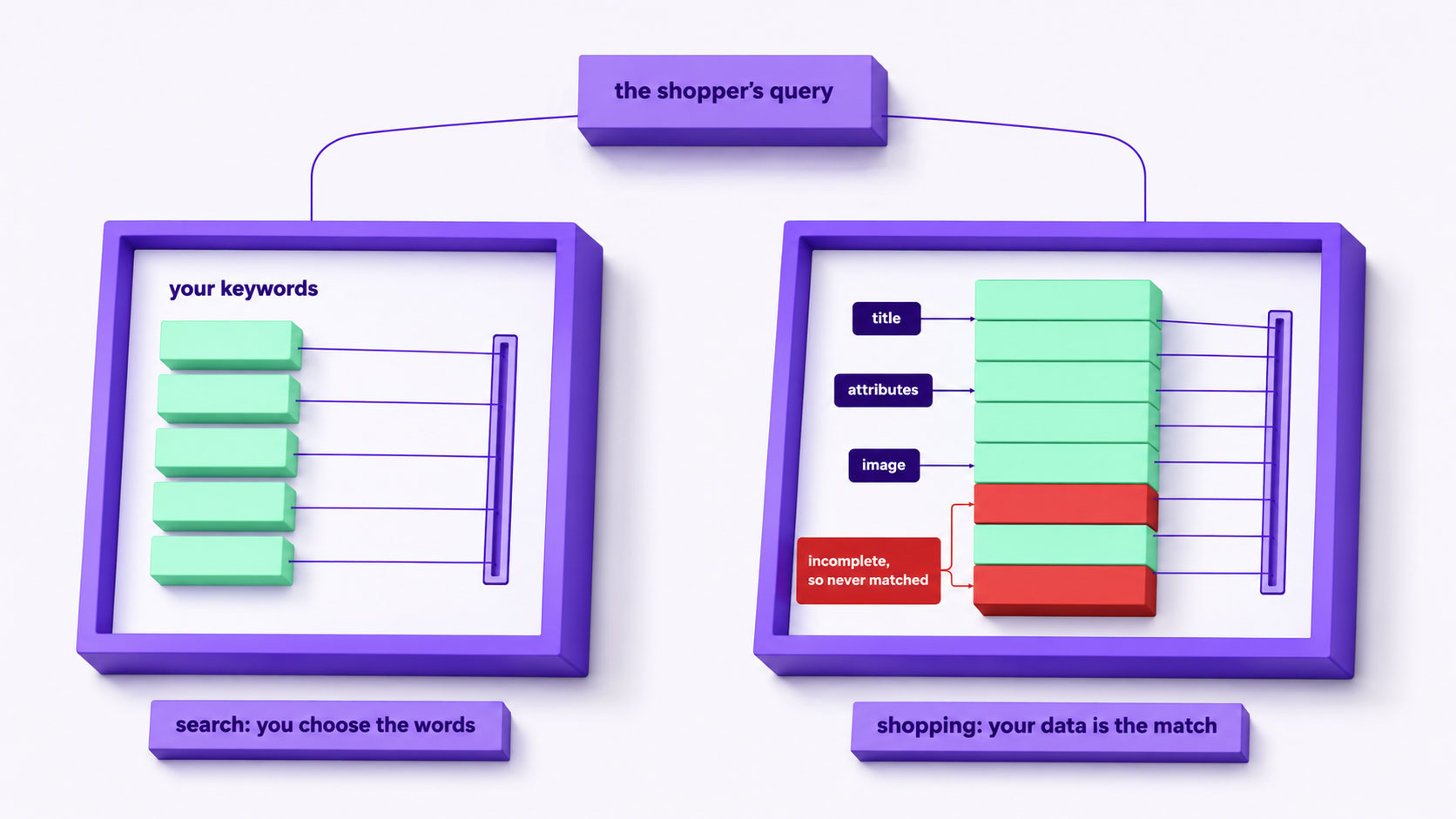
Start with what the platform publishes, because it settles the argument. The product data specification lists every attribute and its requirements, the shopping ads policies govern what may be advertised at all, and the auction determines position each time an item is eligible. Eligibility comes from the data. Position comes from the bid. Confusing the two is why so many accounts spend heavily and show for the wrong things.
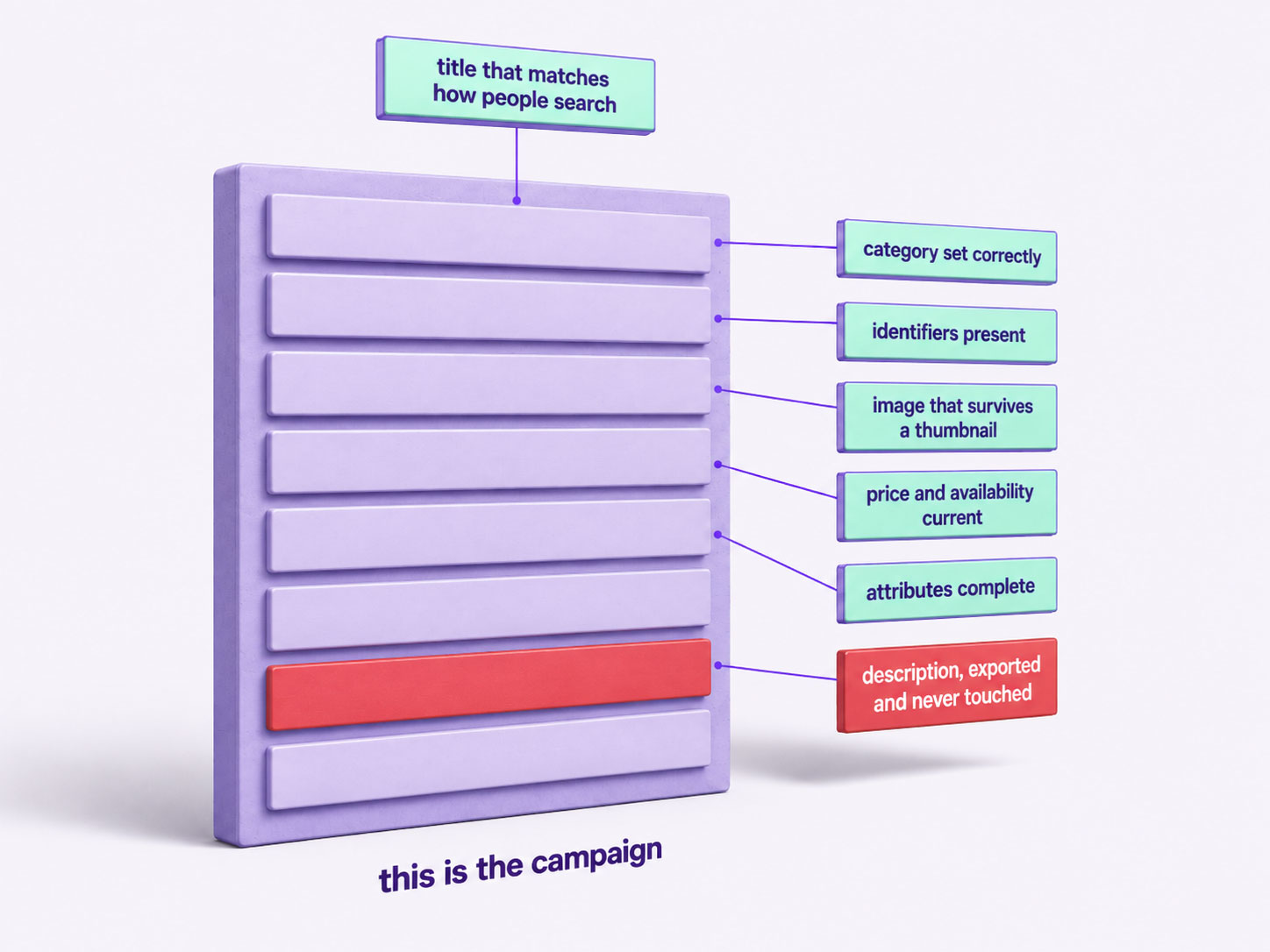
The practical consequence is that a product title is not a label, it is targeting. A title exported from a commerce platform typically reads as an internal SKU description — brand, model number, a code. A title written the way people actually search reads differently, and changing it changes which queries the product is eligible for. That is a copywriting task with the impact of a bidding strategy, and it sits in a file most agencies never open.
The same logic governs everything else in the record. Category assignment decides which comparisons you appear in. Identifiers decide whether the platform can confidently match your item to a known product. Images decide whether a shopper stops. Price and availability decide whether the click was worth buying. None of those are campaign settings and all of them determine campaign performance.
Which is why we do the feed before the media, every time. Spending against a poor feed does not fail quietly — it buys traffic for queries your products do not suit, at prices set by an auction that does not know any better. The fix is usually days of work and it changes the economics of everything spent afterwards. The catalog side of this sits on our ecommerce program page and the organic half on ecommerce SEO.
More revenue. Less money.
Return on ad spend treats every dollar of revenue as identical. Your accountant does not, and neither does your bank. A campaign can improve its ROAS every month while shifting your sales mix toward the products you earn least on, and the report will look excellent throughout.
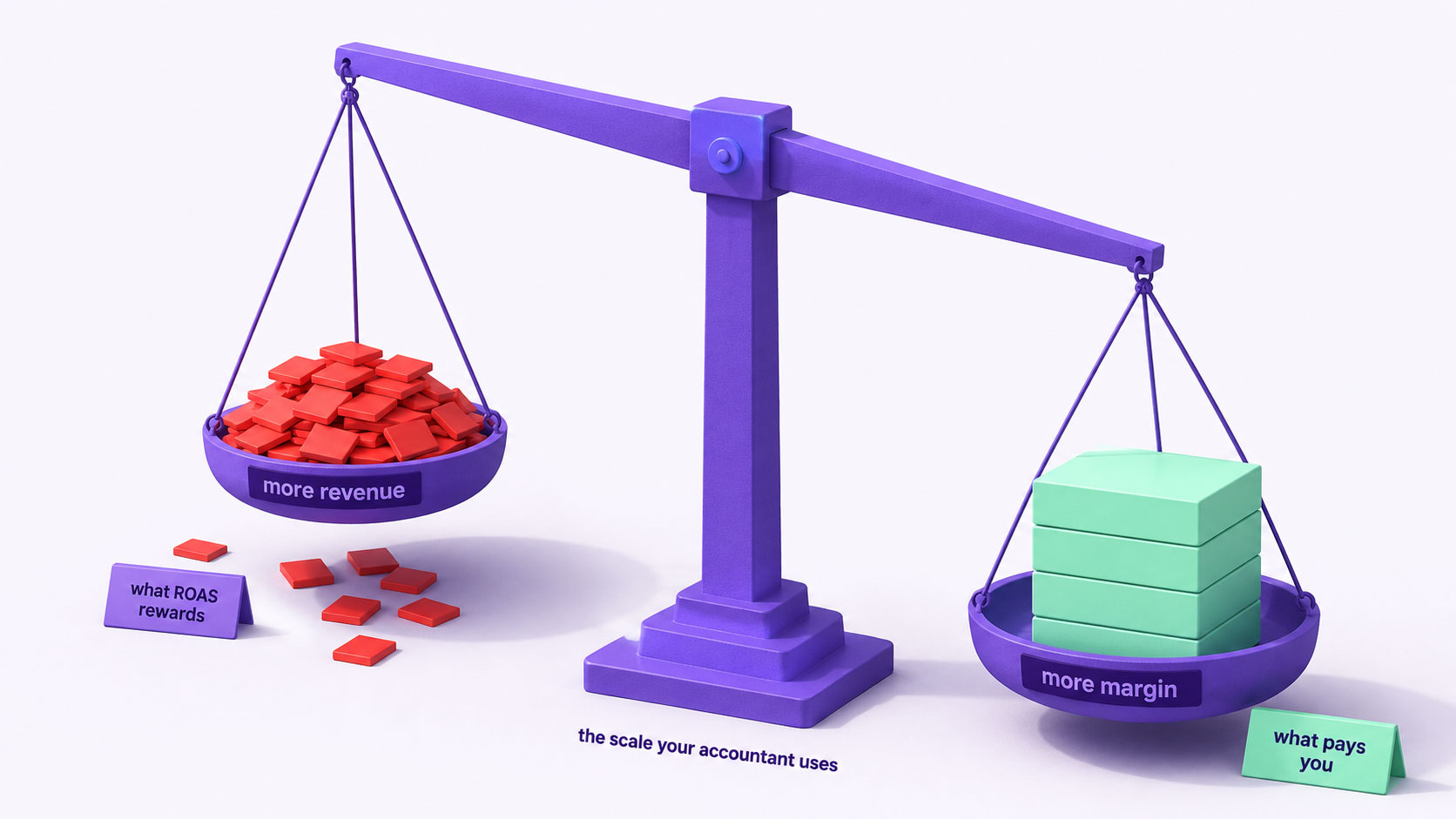
Growing whatever converts easiest
- Every revenue dollar weighted equally, regardless of what you keep from it.
- Budget flows to easy conversions, which are frequently your thinnest-margin lines.
- Returns invisible, so revenue that came back still counts as a win.
- High-margin products underfunded because they convert more slowly.
- The metric improves while contribution quietly falls.
Growing what you actually keep
- Products weighted by contribution, so bidding follows profit rather than turnover.
- Thin-margin lines capped deliberately rather than starved or over-funded by accident.
- Returns subtracted before anything is called a result.
- Slower, richer products funded properly because their value justifies the patience.
- The number that improves is the one your accountant already tracks.
Four things we do that most ecommerce PPC agencies will not.
Each of these delays the launch, reduces the spend, or invites scrutiny. That is why they are uncommon, and why we will put all four in writing.
Titles rewritten for how people search, categories set properly, identifiers completed, images checked at thumbnail size, availability and price verified against the live page. None of it is campaign work and all of it determines campaign performance.
It delays launch by a week or two, which is the whole reason it is skipped — and the reason accounts that skip it plateau at the level their data allows.
- Every item checked against the published specification, not a sample.
- Feed compared against the live page, since a valid feed can still contradict the store.
Bidding structured around what you keep rather than what you turn over. Where margin data exists we use it directly; where it does not, we build the best proxy available and say clearly that is what it is.
This occasionally means recommending you spend less on your best-selling product, which is a conversation most agencies have no incentive to start.
- Campaign structure and bid targets segmented by contribution rather than by category.
- Products that lose money at scale identified by name, even where they look successful.
Automated strategies optimize toward the conversions an account reports. Counting add-to-carts, duplicated events or orders that were later cancelled does not fail loudly — the system confidently learns to buy more of exactly that.
Being an AI-first agency has to mean this in a paid account: fixing the signal before handing the machine the wheel, rather than describing automation as a feature.
- Every counted conversion traced to an order in your own platform first.
- Conversion values corrected for margin where the data supports it.
Ad platforms report the conversions they believe they caused. Your commerce platform records orders that actually happened, and a portion of those come back. Reporting gross revenue against ad spend overstates performance in every category with meaningful returns.
The first reconciliation always produces a smaller number than the dashboard showed. Presenting it deliberately is far better than a partner finding it themselves.
- Platform-reported conversions matched against orders in your own systems.
- Return rates tracked per product group, because they vary enormously by category.
The machine is very good at buying whatever you told it to.
Modern campaign types hand bidding, placement and often creative assembly to automated systems. Those systems are genuinely capable, and they are entirely dependent on the conversion signal underneath them — which is the part nobody audits.
Why signal quality decides everything downstream
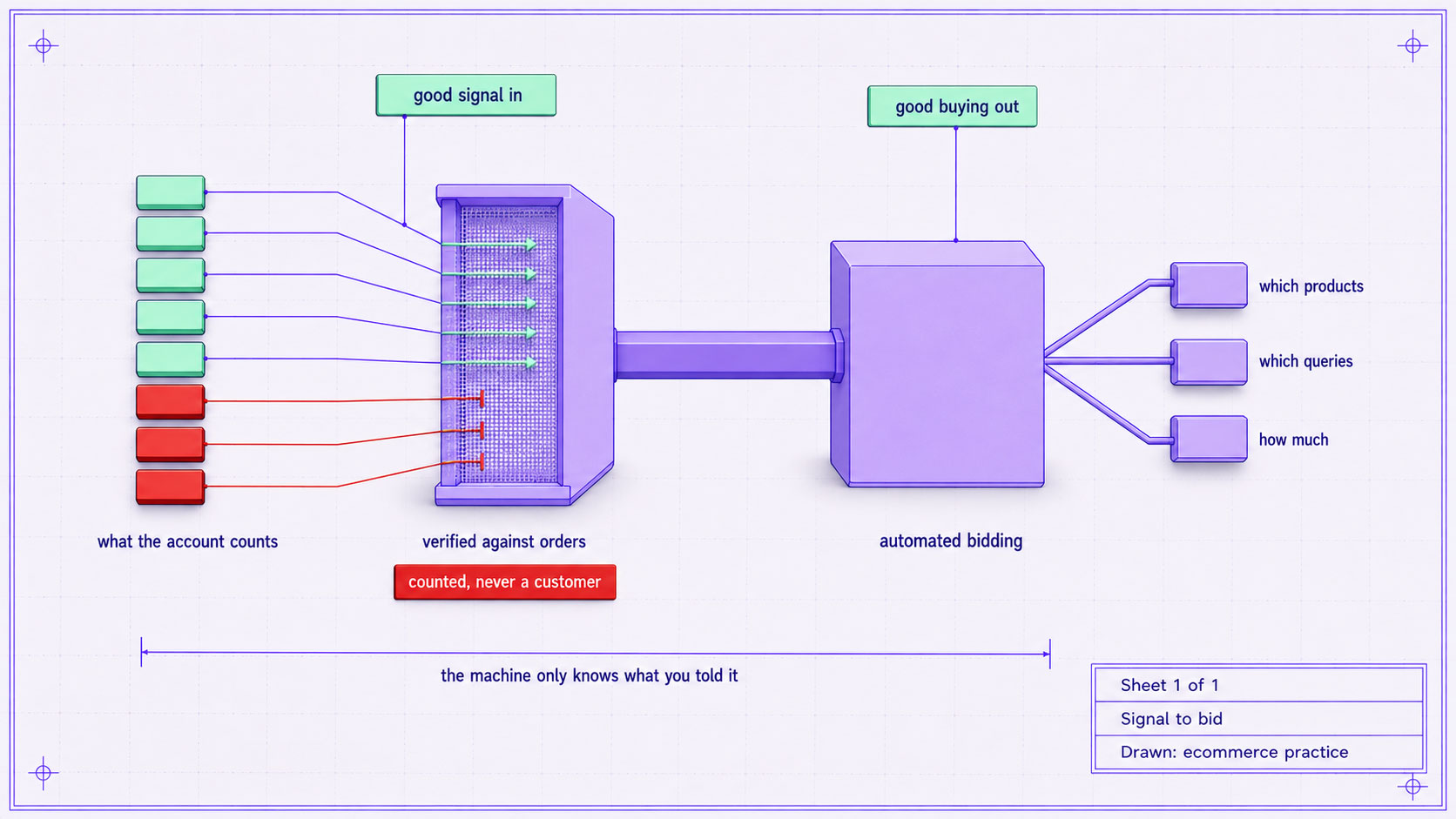
Google's documentation on Smart Bidding is explicit that these strategies optimize toward the conversions an account reports. That is the whole mechanism. Feed it verified orders and it becomes the most capable buyer you have ever had. Feed it add-to-carts, duplicated events, or orders that were cancelled a week later and it will pursue those with the same diligence.
The failure is silent, which is what makes it expensive. A misconfigured conversion does not throw an error. The account performs, the reported numbers rise, and the mix of what is actually being sold shifts underneath. By the time somebody compares platform figures against the commerce platform, months of learning have been built on the wrong foundation.
Conversion values matter as much as conversion counts, and are corrected far less often. If every order is passed at revenue rather than at contribution, the system optimizes for turnover. Where margin data exists, passing margin-adjusted values changes what the machine chases — and it is one of the highest-leverage changes available in an ecommerce account, precisely because so few accounts have done it.
None of this argues against automation, and we are not nostalgic about manual bidding. It argues for earning the right to use it. The sequence is: verify what is being counted, correct the values, then let the system work. Handing over control before that step is not adopting AI — it is scaling whatever was already wrong. The same reasoning runs through our paid search practice and our AI-first approach generally.
- What is counted — every conversion action, audited individually
- Duplicates — the same order recorded twice by two tags
- Micro-conversions — useful as diagnostics, ruinous as bidding targets
- Cancellations — counted at checkout, refunded later, never corrected
- Conversion values — revenue or contribution, and the difference matters
- Attribution window — decided deliberately rather than left at default
Data, then signal, then spend.
The order is the method. Media launched against a poor feed and an unverified conversion signal will spend efficiently on the wrong things, and every week of that becomes learning the system has to unwind later.
Feed and measurement
- Every item checked against the published product data specification
- Disapproved and quietly suppressed items identified with their causes
- Titles, categories and identifiers corrected for how people actually search
- Every conversion action audited and traced to real orders
Structure and priorities
- Products segmented by contribution rather than by catalog category
- Campaign structure built so budget follows margin
- Conversion values corrected where margin data supports it
- Destinations checked so paid traffic lands on pages that convert
Scale and reconcile
- Budget scaled where contribution justifies it, capped where it does not
- Platform-reported conversions reconciled against orders monthly
- Returns subtracted and tracked per product group
- Products losing money at scale named rather than averaged away
What an ecommerce PPC program covers
Feed underneath, channels on top, reconciliation at the end of every month. These are the pieces, and each is a practice you can read about and hold us to.
Feed optimization and management
Titles, categories, identifiers, images, price and availability corrected against the published specification and against the live page, then maintained rather than left to drift.
Runs with: Google Shopping
Shopping and automated campaigns
Campaign structure built so budget follows contribution, with automated bidding used deliberately once the signal underneath it has been verified.
Runs with: paid search
Paid social and demand creation
Reaching buyers before they search, with catalog-driven creative and frequency managed so a small audience is not simply shown the same product repeatedly.
Runs with: paid social and display
Remarketing across the catalog
Following up abandoned sessions and past buyers with the products that make sense rather than the last item viewed, which is rarely the right one.
Runs with: remarketing
Tracking and reconciliation
Conversion actions audited, values corrected for margin where possible, and platform figures reconciled monthly against orders in your own system net of returns.
Runs with: CRM and conversion work
Organic and AI visibility alongside
The same corrected product data earns organic visibility and lets assistants represent your products accurately — so feed work pays in channels you are not bidding in.
Runs with: ecommerce SEO and AI SEO
A hundred SKUs or a hundred thousand, the accounting is the same.
Catalog size changes the tooling, not the method. What changes more is how cleanly a business can tell us what it earns on each line.
We ask for your margins before we ask for your budget.
Most ecommerce PPC proposals open with a projected return on ad spend. We open by asking what you keep on each product line, because ROAS treats a dollar on your worst-margin item as identical to your best — and a campaign can improve that number every month while the business gets thinner. Where the margin data does not exist yet we say so plainly rather than optimizing a proxy and calling it a result.
The rest follows from the same principle. We fix the feed before spending, even though it delays launch. We verify every conversion signal before letting automated bidding learn from it, because a system fed bad data pursues the wrong thing with real skill. And we reconcile against your commerce platform monthly net of returns, including the months where the honest number is smaller than the dashboard. We built Allegiant as an AI-first agency rather than a traditional shop with AI added on, and in a paid account that means earning the right to automate rather than announcing it.
Ecommerce media runs alongside the wider ecommerce program, Shopping and the full digital plan. See the work in our case studies.
Six attributes that decide what you match. One nobody has touched.
Every row below is free to get right and expensive to leave wrong, because each one changes which queries a product is eligible for. This is the checklist we run every catalog against before a campaign is built.
| Attribute | How most feeds handle it | Allegiant How we handle it |
|---|---|---|
| Product title | Exported SKU description | Rewritten for how people search — this is targeting, not labeling |
| Category | Left at the platform default | Set deliberately, because it decides which comparisons you appear in |
| Identifiers | Partially populated | Completed, so the platform can match your item to a known product |
| Images | Whatever the store uses | Checked at thumbnail size, where the shopper actually sees them |
| Price and availability | Synced on a schedule | Verified against the live page, because a mismatch costs eligibility |
| Description | Exported once, never revisited | Written — the attribute most likely to be untouched since setup |
Take the first row to your own feed this afternoon. If your product titles read like internal SKU descriptions, you are competing for queries nobody types and missing the ones they do — and no bid adjustment fixes that.
Four ecommerce media line items you can stop paying for.
Each is common, each looks like performance, and three of them can improve while your business gets worse.
ROAS reported as the outcome. It weights every revenue dollar equally regardless of what you keep. A campaign can improve its return every month while shifting the sales mix toward your thinnest lines, and the report will look excellent throughout. It is the most widely quoted metric in the category and the least connected to whether you made money.
Gross revenue reported without returns. Revenue that came back is not revenue. Any ecommerce media report that never mentions return rates is describing orders placed rather than money kept, and in categories with meaningful returns the difference is not marginal.
Campaign management with the feed left untouched. In Shopping, the product data decides what you match. Managing bids and structure while leaving titles as exported is optimizing the smaller half of the account, and it is the most common shape of ecommerce PPC engagement we inherit.
Automated bidding switched on before the signal is verified. These systems are capable and they optimize toward whatever the account reports. Enabling them over unaudited conversions does not adopt AI — it scales an existing error efficiently and calls it modernization.
The pattern beneath all four: the easiest number to improve is rarely the one connected to what you banked.
- Google Merchant Center — Product data specification
- Google Merchant Center — Shopping ads policies
- Google Merchant Center — Product categories
- Google Merchant Center — Feed rules and requirements
- Google Ads — How the Google Ads auction works
- Google Ads — About Smart Bidding
- Google Ads — About conversion tracking
- Google Ads — Account structure and organization
- Google Search Central — Product structured data
- Google Search Central — Ecommerce documentation
- Google Merchant Center — Price benchmarks
- Google Ads — Conversion value rules
- FTC — Advertising and marketing business guidance
Ecommerce PPC, answered
Straight answers, including the ones that cost us work.
Why does the feed matter more than the campaign?
Because in Shopping you do not choose the queries you appear for. The platform matches the shopper's query against your product data, so titles, categories, identifiers and images decide what you are eligible for, and the bid only decides whether you compete once eligible. The product data specification sets out every requirement. This is why we fix the feed before spending, and why feed work usually outperforms campaign work in inherited accounts. The Shopping specifics are on our Shopping page.
What is actually wrong with optimizing on ROAS?
It treats every revenue dollar as identical when your margins are not. A campaign optimized on return on ad spend grows whichever products convert most readily, and in most catalogs those are the thinnest-margin lines — so the metric improves while contribution falls. We ask for margin by product line before structuring anything, and where it is not available we say plainly that we are optimizing a proxy until it is. The catalog-wide version of this argument is on our ecommerce program page, and the conversion-value mechanics that make it possible are documented by Google.
Should we use automated bidding?
Yes, once the signal underneath it is verified. Google's Smart Bidding documentation is explicit that these strategies optimize toward the conversions an account reports — so they are extremely effective at pursuing whatever you told them to value. Enabling them over unaudited conversions scales an existing error efficiently. Verify what is counted, correct the values, then automate. That sequencing is what our AI-first approach means in a paid account rather than a claim on a slide.
Our products keep getting disapproved. What causes that?
Usually a mismatch between feed and page, or a missing required attribute. The feed requirements and shopping policies set out both. What most teams miss is that items can be quietly suppressed rather than formally disapproved, producing no alert at all — which is why we compare the feed against the live page rather than only against validation. The catalog reconciliation runs through our ecommerce practice.
Why do our ad platform numbers not match our store?
Because they measure different things. Ad platforms report conversions they believe they caused using their own attribution windows; your commerce platform records orders that happened. Google's conversion tracking documentation explains what it records and what it does not. The gap is normal — what matters is that somebody reconciles monthly and reports the difference rather than quoting whichever number flatters the work. We also subtract returns, through your own order data.
How should product titles be written for Shopping?
The way customers describe the product, with the attributes they actually search on carried early. An exported title typically reads as an internal SKU string — brand, model code, a reference number — which competes for queries nobody types. Rewriting it changes which searches the product is eligible for, so it is a copywriting task with the impact of a bidding strategy. The category guidance matters alongside it, and the same language work improves organic performance through ecommerce SEO.
How should an ecommerce account be structured?
By contribution rather than by catalog category, which is the more common default. Grouping products by how much you keep on them lets budget follow profit and lets you cap thin-margin lines deliberately instead of starving them by accident. Google's account structure guidance covers the mechanics; the segmentation decision is a business one we work out with you first. The same principle applies wherever we manage media, including paid search.
Do returns really change the picture that much?
In some categories they change it entirely. Return rates vary enormously by product type, and a campaign that looks strong on gross revenue can be unprofitable once returns are subtracted — particularly in apparel and anything sized or fitted. Because returns arrive weeks after the order, they never appear in the ad platform's view at all. We track them per product group and net them out before calling anything a result, using the order data in your own systems and the same reconciliation standard as remarketing, against what conversion tracking can and cannot see.
How does AI change ecommerce advertising?
In two places. Inside the account, automated bidding and campaign types now make most of the buying decisions, which makes signal quality decisive rather than merely useful. Outside it, assistants increasingly summarize product options before a shopper reaches any store, assembling those summaries from the same structured product data that governs Shopping eligibility. So clean feed work pays in the auction and in channels you are not bidding in. Our position on what can and cannot be promised there is on the GEO page, and the underlying markup is documented by Google.
Should we advertise our whole catalog?
Almost never. Most catalogs contain products that cannot be advertised profitably at any bid — margin too thin, price uncompetitive against the price benchmarks Merchant Center reports, or a category where acquisition costs more than the item earns. Advertising them because they exist is how budgets get consumed by items that were never going to pay. We identify those lines by name and recommend excluding them, which reduces the media we manage. Google's ecommerce guidance covers the organic alternative for products worth having visible but not worth buying traffic for, which is exactly the work our ecommerce SEO practice handles.
What makes Allegiant different from the ecommerce agency we use now?
Three things you can verify. We fix the feed before spending, even though it delays launch. We ask for margin by product line before structuring anything and tell you plainly when we are using a proxy. And we reconcile against your commerce platform monthly net of returns, including when the honest number is smaller than the dashboard. We are also built as an AI-first agency rather than a traditional shop with AI added on. Start with the A.R.C. Report, or read the FTC's advertising guidance against whatever your current agency claims.
Find out what your feed is actually competing for.
The A.R.C. Report covers your whole marketing position. For an ecommerce media account we check your product data against the published specification, compare the feed to your live pages, audit every conversion action, and identify the products being advertised that cannot pay for themselves. Findings are yours whether or not we work together.
- Product data checked against the published specification, item by item
- Feed compared against live pages, including quietly suppressed items
- Product titles assessed against how people actually search
- Every conversion action audited and traced to real orders
- Platform-reported revenue reconciled against your store, net of returns
- A straight answer on which products should not be advertised at all
Explore the wider program: ecommerce digital marketing, ecommerce SEO, ecommerce web design, all services and the A.R.C. Report.
Tell us your platform and roughly how many products you advertise, and we will show you what the feed is buying.
No cost, no commitment. We will follow up by email or phone to walk you through the findings.

