
Search has fundamentally changed.
Your visibility strategy needs to change with it.
Most searches now end without a single click — the answer itself is the new front door. Allegiant's OMNIVIZ™ framework is built on 25+ years of search expertise and engineered to earn your business citations across ChatGPT, Gemini, Perplexity, Claude, and Microsoft Copilot — so when AI answers, your business is the answer.
The way people find businesses changed faster than most agencies adapted.
In less than 24 months, generative AI fundamentally restructured how search engines surface information, how users phrase queries, and where the path to a purchase actually begins. Understanding this shift isn't optional — it's the foundation of every visibility decision your business will make over the next five years.
For two decades, ranking on the first page of Google was the goal. The mechanics were predictable: optimize for a keyword, earn backlinks, build content depth, and the traffic followed. That model is now incomplete. Search has fragmented across platforms, intents, and surfaces — and the businesses winning today aren't the ones ranking #1 on Google. They're the ones being recommended by name when a real person asks a real question to ChatGPT, Gemini, Perplexity, Claude, or Microsoft Copilot.
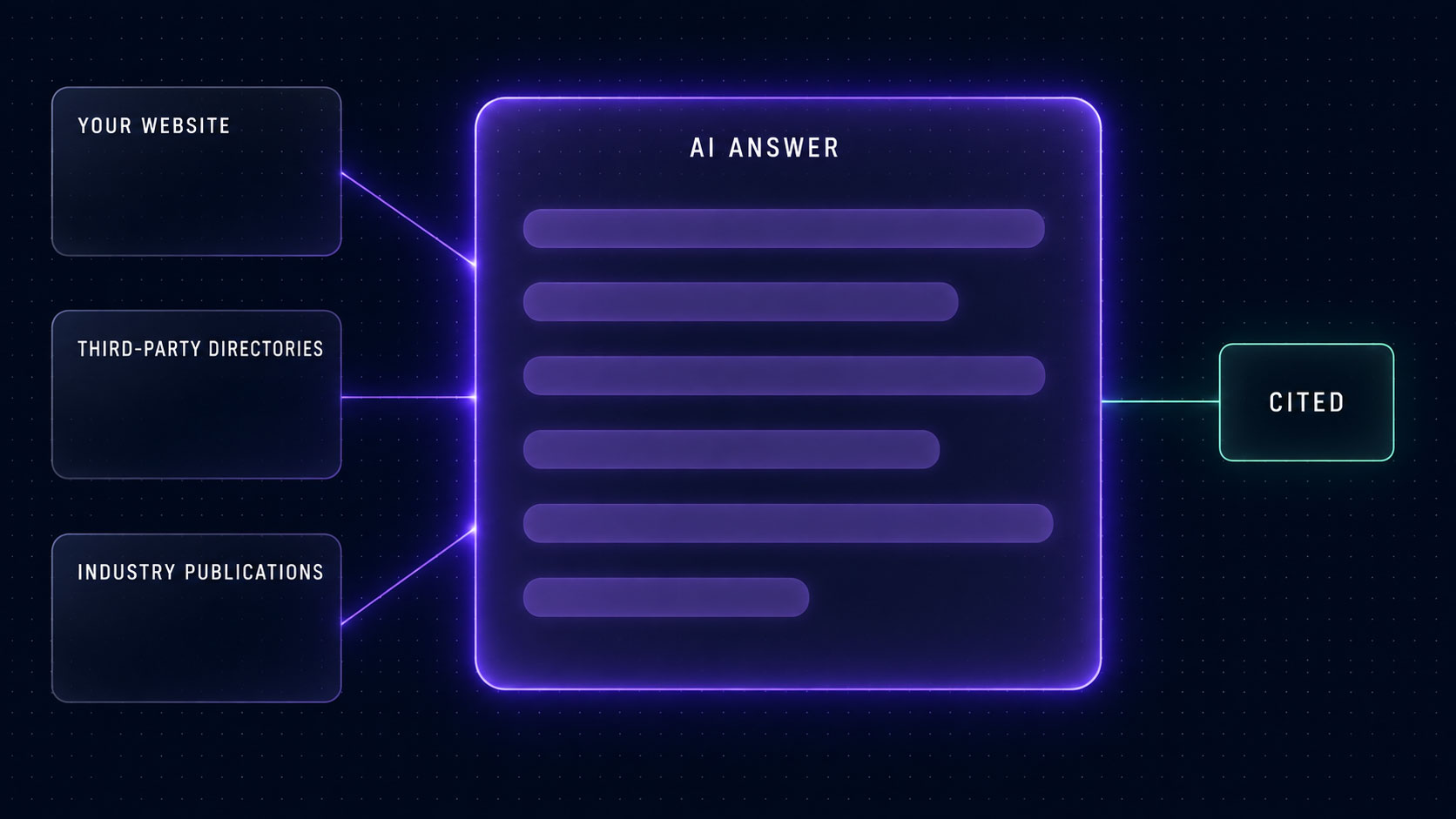
The shift is structural, not cosmetic. AI platforms don't surface ten blue links — they synthesize an answer and cite a small number of sources. If your business isn't one of those sources, you don't appear at all. The competitive landscape changes from "who ranks highest" to "who gets cited" — and citation logic operates on different signals than traditional ranking algorithms ever did.
The implication for any business that depends on being found is clear. The visibility playbook of 2020 produces diminishing results in 2026. A new framework is required — one that addresses both traditional search and AI-driven discovery as a single, integrated visibility strategy.
Traditional SEO still matters. It just isn't enough on its own anymore.
Classic SEO — keywords, backlinks, on-page optimization, technical hygiene — remains the foundation of organic visibility, and it works hand-in-hand with generative engine optimization, answer engine optimization, and LLM optimization. But the systems that decide whether AI cites your business operate on a different layer entirely. Understanding the difference is the first step toward closing the gap.
Built for ranking documents on a results page
- Keyword density and on-page signals were primary
- Backlinks functioned as the dominant trust signal
- SERP position was the success metric — page 1 or bust
- Content length and depth earned ranking authority
- Technical SEO focused on crawlability and indexation
- One platform — Google — drove the majority of organic traffic
Built for being cited by name in synthesized answers
- Entity recognition determines whether AI knows you exist
- Multi-source citation networks drive AI trust signals
- Citation share across platforms is the new success metric
- Answer-first content architecture earns AI placement
- Structured data becomes the language AI systems read
- Five platforms — each with distinct citation logic — drive discovery
Each AI platform plays by different rules. Each one matters.
Treating "AI search" as a single category is the most common mistake we see when businesses try to optimize for AI on their own. ChatGPT, Gemini, Perplexity, Claude, and Copilot each rank, retrieve, and cite information differently. A strategy built for one is incomplete for the others. Here's how each system actually works — and what it takes to earn placement on each.
ChatGPT Search uses a hybrid retrieval system that combines OpenAI's training data with live web results powered partly by Bing. It favors sources that have been cited or referenced across multiple authoritative third-party domains — particularly business directories, industry publications, and well-structured local listings. Recency matters: stale content is downranked aggressively in favor of pages updated within the last 90 days.
- Strong, consistent NAP signals across major business directories
- Recent, dated content covering specific service-and-location query patterns
- Structured data (Organization, LocalBusiness, Service schema) deployed correctly
- Multi-source mentions on industry-relevant authoritative domains
- Active reviews on platforms ChatGPT references (Google, BBB, industry-specific)
Gemini and Google's AI Overviews draw directly from Google's organic index, which means traditional SEO foundations carry forward — but with significantly more weight on E-E-A-T signals (Experience, Expertise, Authoritativeness, Trustworthiness) and structured data. Pages that rank in the top 3 organic results for a query are dramatically more likely to be cited in the AI Overview, but ranking alone isn't sufficient. The content also needs to be structurally answerable.
- Top organic ranking for the underlying query (still the strongest single signal)
- FAQPage and HowTo schema that mirror AI Overview question structure
- Author byline and credentialing on every piece of expert content
- Original first-party data, statistics, and proprietary research where possible
- Knowledge Graph entity recognition (Wikipedia, Wikidata, Google Business Profile)
Perplexity is built around explicit citations — every answer it generates surfaces 4 to 8 numbered source links. This makes it the most rewarding AI platform for businesses with strong content architecture, because citations are visible and clickable, and the user is explicitly invited to verify. Perplexity favors content with clearly delineated answers to specific questions, structured paragraphs, and content updated within the last 12 months.
- Direct, declarative answer to a specific question in the first 100 words
- Clean semantic HTML with proper heading hierarchy (H1 → H2 → H3)
- FAQPage schema with concise answers under 50 words each
- Statistics, data points, and specific facts stated unambiguously
- Domain authority on the topic — niche expertise is rewarded over generalist coverage
Claude has expanded into web search and is increasingly used by professionals for purchase research and recommendations. Its citation logic favors deep, substantive content from credible publishers and operators over thin SEO content. Claude appears to weight content nuance, accuracy, and the absence of marketing puffery — meaning generic "best [service] in [city]" content tends to underperform compared to genuinely informative resources.
- Long-form, technically accurate content that demonstrates real expertise
- Clear authorship, business identity, and verifiable credentials
- Content that addresses nuance and edge cases, not just basic answers
- Strong entity signals across the open web (consistent brand presence)
- Mentions on publications and forums where professionals reference businesses
Copilot is the most underestimated AI platform for B2B businesses. Built on Bing's index and integrated across the Microsoft 365 stack, Copilot shows up in workplace research, Outlook, Teams, and the Edge browser. Its citations skew heavily toward Bing-indexed pages, LinkedIn profiles and company pages, and content that performs well in Microsoft's organic ecosystem. For B2B and franchise systems, it's frequently the second-most-cited platform.
- Verified Bing Webmaster Tools setup and submitted sitemap
- Strong LinkedIn presence — company page completeness, employee profiles, regular activity
- Microsoft-specific structured data deployment (Bing supports schema variants)
- Content optimized for Bing's slightly different ranking weight on freshness and exact-match
- Mentions on B2B publications and authoritative business resources
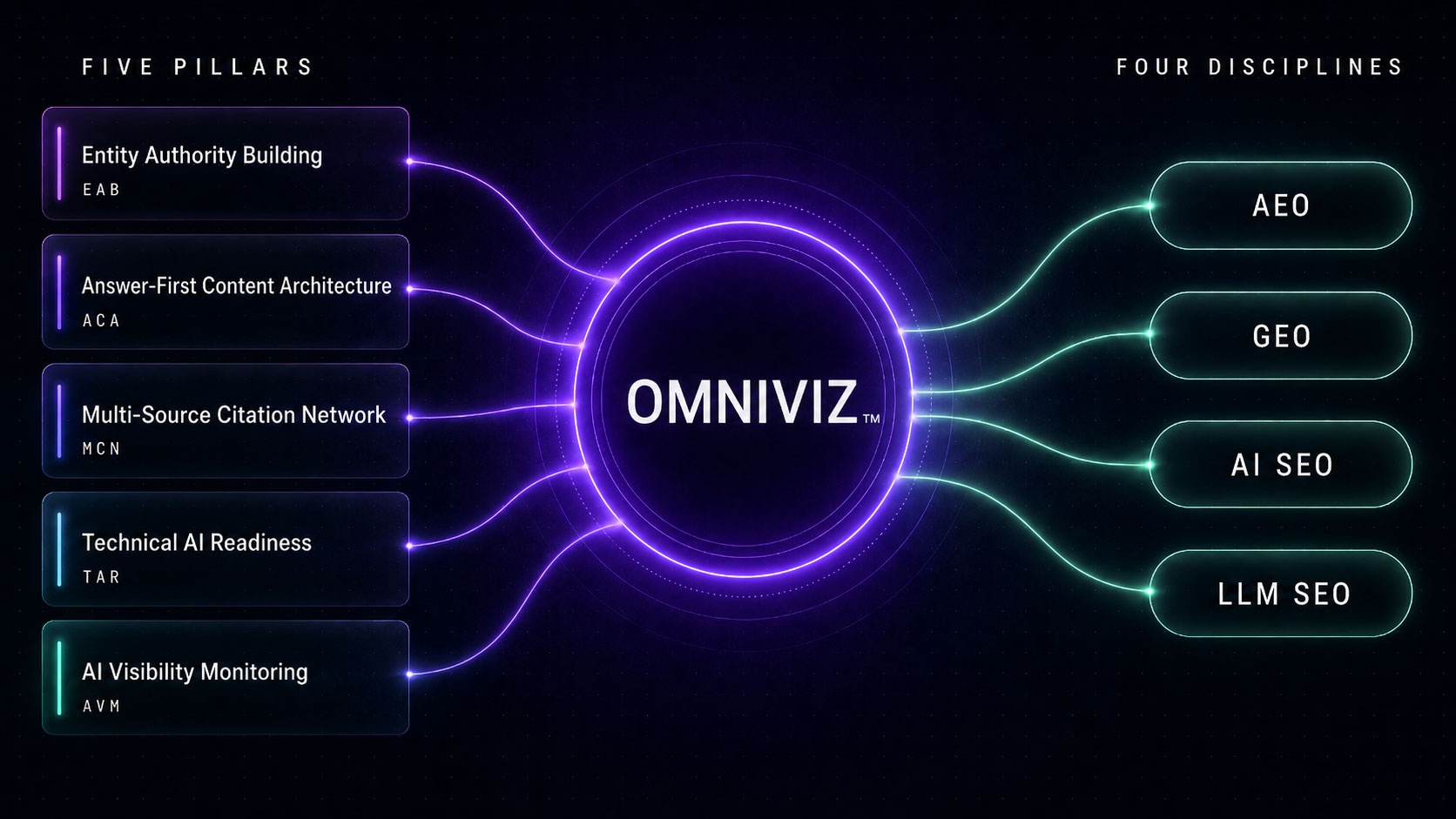
The OMNIVIZ™ Framework: five pillars that drive measurable AI visibility.
After analyzing thousands of AI search results across the five major platforms, we identified the underlying signals that separate businesses being cited from those being ignored. OMNIVIZ™ is the operational framework we apply to every partner engagement — built to address each signal layer with precision.
Before an AI platform can cite you, it has to know you exist as a distinct entity — not just a string of words on a website. Entity recognition is the foundation of every AI citation decision, and it's governed by a network of structured signals: your Knowledge Graph status on Google, your Wikidata presence, your schema markup, and the consistency of your business identity across the open web.
Most businesses fail at entity authority before they even start. Inconsistent NAP data across directories, missing or shallow schema markup, no Knowledge Graph entry, and a fragmented brand presence on third-party sites all signal to AI systems that the business is either small, unimportant, or untrustworthy. Allegiant's entity authority work begins with a comprehensive entity audit — mapping how AI systems currently perceive your business and identifying every structural gap.
From there, we deploy a deliberate sequence of corrections and enhancements: Organization and LocalBusiness schema with full property completion, Knowledge Graph submission and verification, Wikidata entry creation where appropriate, and a NAP consistency audit across the top 50 directories that AI platforms reference for business validation.
- Entity recognition audit (baseline)
- Schema deployment (Organization, LocalBusiness, Service)
- Knowledge Graph submission & verification
- Wikidata entry (where applicable)
- NAP consistency audit & correction
- Brand entity tracking across AI platforms
The mechanics of AI citation are deceptively simple: when a user asks a question, the AI platform searches for content that directly answers that question in a structurally extractable way. Content that buries the answer in storytelling, marketing language, or vague framing gets passed over. Content that delivers a declarative answer in the opening lines — supported by structured context — gets cited.
Most agency-produced SEO content is fundamentally incompatible with AI citation. It's optimized for keyword density and word count, not for answerability. Allegiant's Answer-First Content Architecture flips the structure: every piece of content begins with a direct, citable answer, followed by supporting evidence, contextual depth, and the broader narrative that makes the answer credible to a human reader.
This isn't a content style choice — it's a structural framework that governs how we approach every page on a partner's site. Service pages open with the specific answer to "what does this service involve and who provides it." Location pages lead with the service-and-area-served answer. Blog posts begin with a direct response to the underlying question, then expand into the depth that demonstrates expertise. The result is content that ranks well in traditional search and gets cited at significantly higher rates across AI platforms.
- Answer-first content audit of existing pages
- Page-level rewrites for AI extractability
- FAQPage schema deployment site-wide
- Question-pattern keyword research
- Monthly answer-first content production
- AI Overview reverse-engineering for top queries
AI systems don't trust a business based on what the business says about itself. They trust the business based on what credible third-party sources say about it. This is the same logic that has powered Google's link graph for two decades, but with one critical difference: AI platforms apply a much narrower set of trusted sources, and those sources vary by platform.
Perplexity favors industry publications and high-domain-authority sites. Claude weights mentions on professional forums, niche publications, and operator resources. Gemini reflects Google's broader trust signals. ChatGPT pulls from a Bing-influenced source set that includes business directories, review platforms, and authoritative content sites. A Multi-Source Citation Network is the deliberate, ongoing process of earning placement on the third-party sources that drive citation decisions across all five platforms.
Allegiant's MCN work is not link building rebranded. It's a category-specific outreach and placement program designed to put your business in front of the AI systems' trusted source pool. That includes industry publication features, structured guest contributions, citation in roundup and comparison content, placement in vertical-specific directories that AI platforms consult, and active management of the review platforms that influence each AI system's decision logic.
- AI-trusted source identification per platform
- Industry publication outreach & placement
- Vertical-specific directory submissions
- Review platform optimization
- Comparison & roundup content placement
- Quarterly citation network audit
Most websites — even ones with good traditional SEO — are technically illegible to AI systems in subtle but consequential ways. Crawlers can index the page, but the underlying content lacks the semantic structure, schema completeness, and clean HTML hierarchy that AI systems use to determine what's actually on the page and whether it's authoritative.
Technical AI Readiness is the audit and remediation layer that closes those gaps. It includes a complete schema audit (not just the presence of schema, but its correctness, completeness, and validity), semantic HTML structure review (proper heading hierarchy, list structure, table semantics), Core Web Vitals optimization (AI platforms downweight slow or unstable pages), robots.txt and AI crawler access configuration (a growing number of AI platforms require explicit crawler permission), and comprehensive sitemap submission across both Google and Bing properties.
This is the layer most agencies overlook entirely. They focus on content and links and ignore the technical substrate that determines whether AI platforms can actually understand the content in the first place. Allegiant's TAR audit is one of the first deliverables in any engagement — because fixing the foundation makes every other pillar work harder.
- Comprehensive schema audit & deployment
- Semantic HTML structure remediation
- Core Web Vitals optimization
- AI crawler access configuration
- Sitemap submission (Google + Bing)
- Quarterly technical re-audit
You cannot improve what you cannot measure. AI visibility is fundamentally different from traditional ranking tracking — it's not a single position on a results page, it's citation share across five distinct platforms, each with its own query patterns, citation logic, and competitive landscape. A business might rank #1 organically and still be invisible in three out of five AI platforms. A business with mid-tier organic rankings might be the most-cited source on Perplexity and ChatGPT for its category. Without ongoing visibility monitoring, you have no way of knowing.
Allegiant's AI Visibility Monitoring is built into the ASCENT™ partner dashboard. It tracks your citation status across all five major AI platforms for every query that matters to your business — service queries, location queries, comparison queries, and category queries — and surfaces the data in weekly and monthly reporting cadences. Every partner gets baseline OMNIVIZ™ Scorecard within 7 business days of engagement, with continuous monitoring after that. The reporting isn't decorative — it directly informs the next month's content, citation, and entity work.
- Baseline OMNIVIZ™ Scorecard (week 1)
- Weekly AI citation tracking, all 5 platforms
- Competitor visibility benchmarking
- Monthly performance review
- Query-level citation analytics
- ASCENT™ dashboard integration
Every engagement starts with the OMNIVIZ™ Scorecard.
Before we recommend a single tactic, we measure exactly where your business stands across all five AI platforms. The OMNIVIZ™ Scorecard is the diagnostic deliverable that begins every Allegiant engagement — and it's free as part of any audit request.
A baseline measurement of your AI visibility — across all five platforms, against your real competitors.
The OMNIVIZ™ Scorecard isn't a generic audit template. It's a custom diagnostic built around the specific service categories, locations, and competitors that define your business. Following your Free Standard Consultation, your scorecard is delivered — typically within 24 hours, with a 7-business-day maximum turnaround — answering four questions with precision.
- Where do you currently stand? Citation share across ChatGPT, Gemini, Perplexity, Claude, and Copilot for the queries that matter to your business.
- Who is winning the AI visibility race in your market? Competitor benchmarking against the businesses being cited most for your top 25 to 50 category queries.
- What's blocking your visibility right now? Specific technical, content, entity, and citation gaps identified across each of the five OMNIVIZ™ pillars.
- What's the path forward? A prioritized 30/60/90-day execution roadmap with specific milestones and outcomes attached to each phase.
Top quartile: 82
A 30/60/90-day plan engineered for visible progress.
AI SEO is a long game — but that doesn't mean you wait six months to see anything change. Allegiant's engagement structure delivers tangible deliverables and measurable improvements at 30, 60, and 90 days. Every milestone is mapped to your OMNIVIZ™ Scorecard so progress is observable from day one.
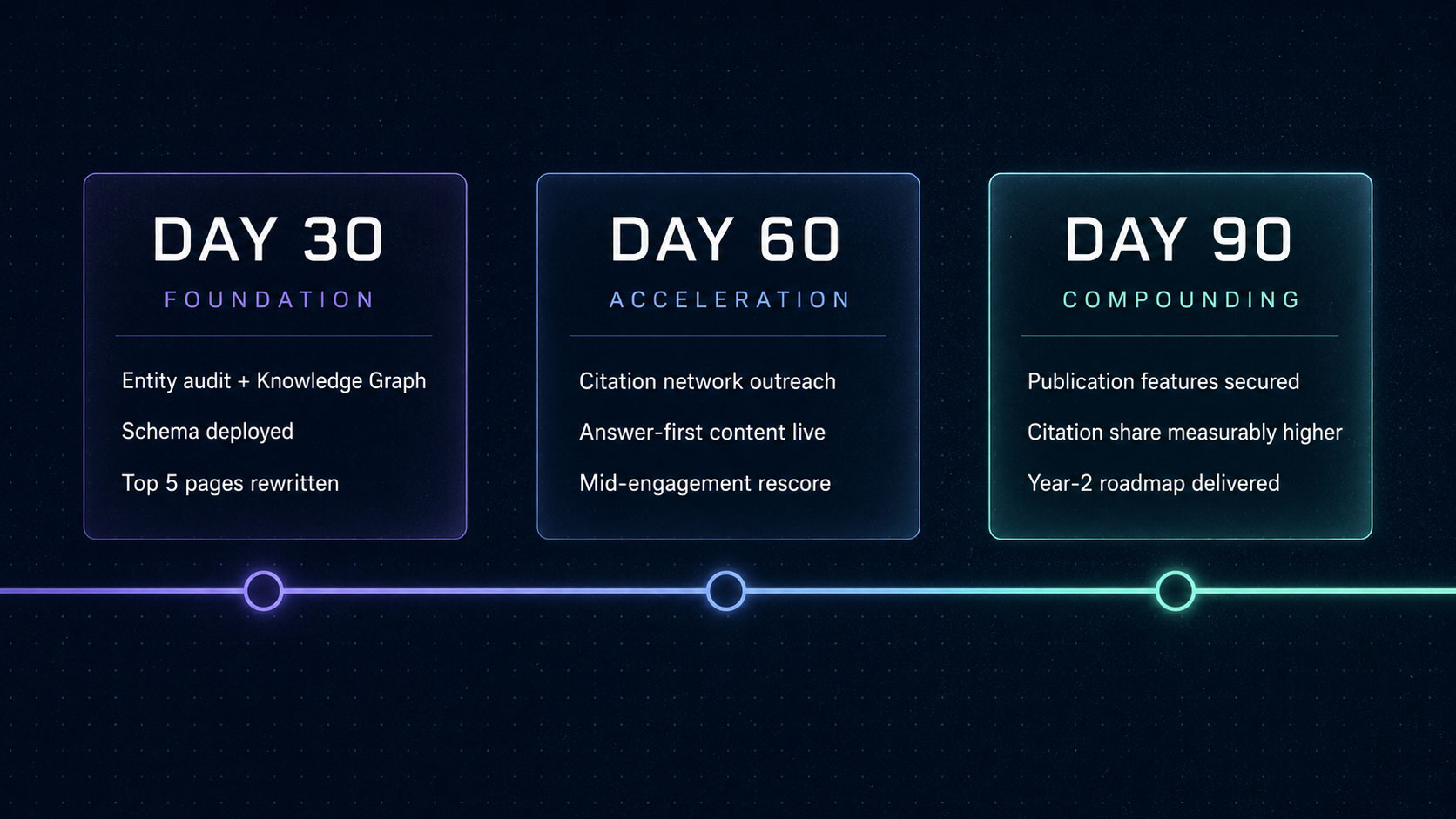
Foundation
- Complete OMNIVIZ™ Scorecard delivered (week 1)
- Entity audit complete; Knowledge Graph submission filed
- Schema markup deployed: Organization, LocalBusiness, Service, FAQPage
- NAP consistency corrected across top 50 directories
- Technical AI Readiness audit complete; critical issues fixed
- Top 5 service pages rewritten for Answer-First Architecture
- ASCENT™ dashboard live with weekly AI visibility tracking
Acceleration
- Multi-Source Citation Network outreach launched (industry pubs, directories)
- 4–8 new answer-first content pieces published targeting AI Overview queries
- Review platform optimization across Google, BBB, and vertical-specific platforms
- Bing Webmaster Tools verified; LinkedIn presence audited and elevated
- FAQPage schema expanded across all service and location pages
- Competitor citation analysis: identifying their wins and exploiting their gaps
- Mid-engagement OMNIVIZ™ rescore to measure progress
Compounding
- Industry publication features secured; vertical directories indexed
- 10+ pieces of original answer-first content live and getting indexed
- Entity authority signals visibly strengthened (KG, Wikidata, third-party mentions)
- AI Overview reverse-engineering applied to top 50 queries with iteration
- Cross-platform citation share measurably higher across all 5 platforms
- Quarterly strategic review delivered with year-2 roadmap
- Path to category dominance documented with specific 6-month milestones
The structural layer most agencies skip — and why it changes everything.
AI platforms read your website differently than humans do. They look for explicit semantic signals, structured data, and answerable, people-first content blocks. The technical foundation isn't optional — it's the layer that determines whether all your other optimization work is actually visible to the systems making citation decisions.
The foundation of entity recognition. Organization and LocalBusiness schema tell AI systems exactly what your business is, where it operates, what services it provides, and how to verify it. Most sites have incomplete schema. We deploy fully-populated markup across every relevant entity type.
FAQPage schema is the highest-leverage structured data deployment for AI Overview eligibility. Each Q&A block becomes a discrete, citable answer unit that AI systems can extract and cite directly. HowTo schema serves the same function for procedural content.
Allegiant deploys both across all relevant pages — service pages, location pages, blog content, and pillar resources — calibrated to the exact query patterns each page targets.
AI systems parse content by reading the document outline. Pages with broken heading hierarchy, missing semantic tags, or div-soup markup are dramatically less likely to be cited — even when the content itself is excellent.
Our technical audit reviews every page for: proper H1 → H2 → H3 nesting, semantic use of article, section and nav elements, list structure, table semantics, and accessibility-aligned ARIA where appropriate.
A growing number of AI platforms require explicit crawler access to include your content in their citation pool. Sites that block GPTBot, Google-Extended, ClaudeBot, or PerplexityBot in robots.txt are excluded entirely from those platforms' results.
We audit every partner's robots.txt configuration, X-Robots-Tag headers, and per-platform crawler permissions to ensure full inclusion across the AI ecosystem — while still respecting any deliberate content protection requirements.
Page performance is now an AI citation factor. Slow, unstable, or layout-shift-heavy pages are downweighted by Gemini and AI Overviews specifically — and Bing-powered Copilot appears to apply similar weighting. Speed is no longer just a UX consideration.
Allegiant's TAR audit includes complete Core Web Vitals measurement, identification of every blocking issue, and prioritized remediation through both the development team and partner-side technical implementation guidance.
Sitemap submission across both Google Search Console and Bing Webmaster Tools is non-negotiable for full AI platform coverage. Bing-only platforms (ChatGPT, Copilot) require Bing-side validation to surface your content efficiently.
We verify sitemap structure, ensure full URL coverage, monitor indexation status weekly, and address coverage issues before they affect citation eligibility.
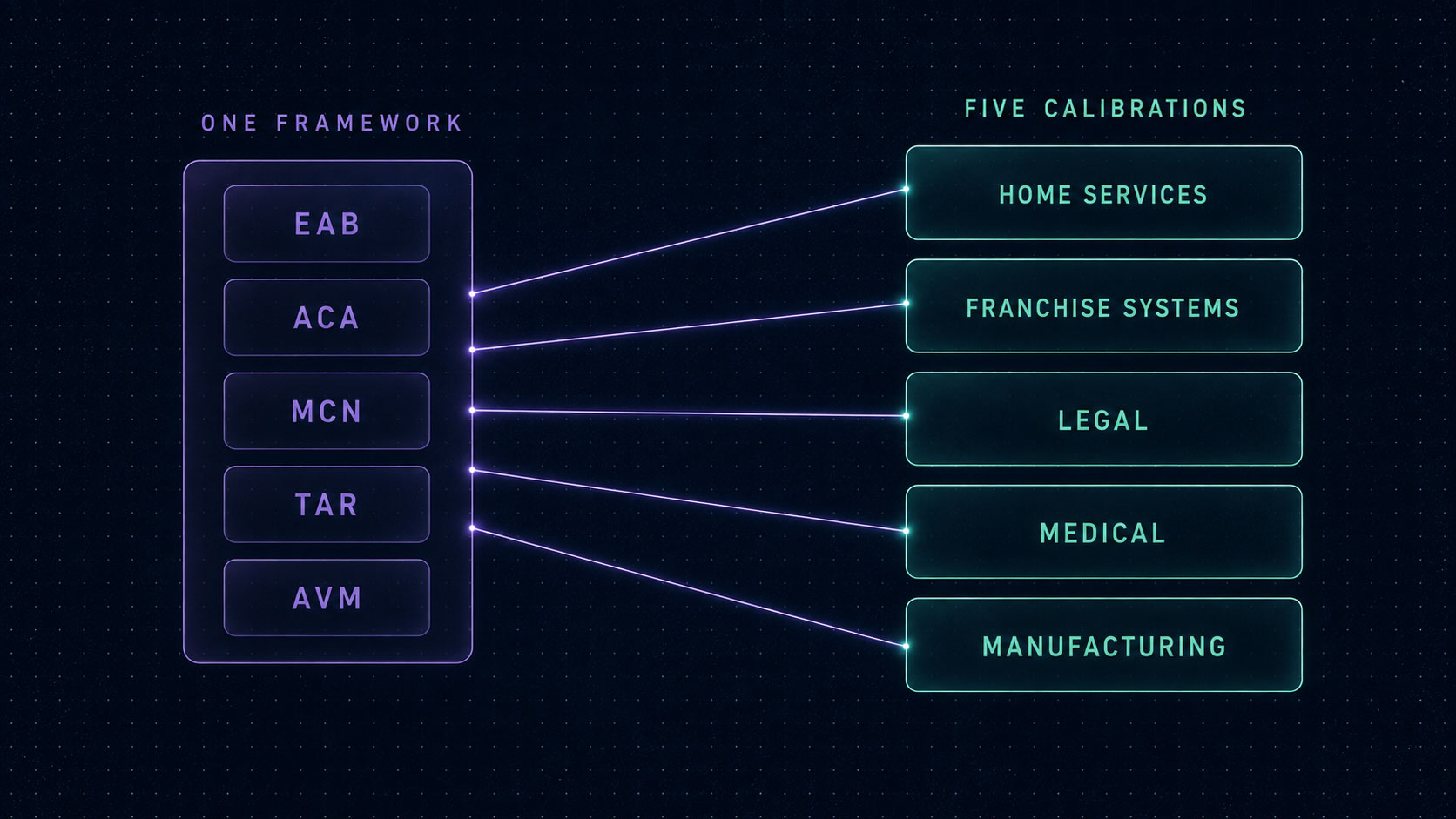
AI SEO doesn't work the same way across every industry.
The OMNIVIZ™ framework is consistent. The execution is calibrated. Each of Allegiant's primary partner verticals has distinct query patterns, citation sources, and competitive dynamics. Here's how the work shifts depending on what your business actually is.
25 years of search evolution. One mission that hasn't changed.
Allegiant was built by people who have been optimizing for search engines since before Google was the default. We've worked through every major algorithm shift — Florida, Panda, Penguin, Hummingbird, BERT, Helpful Content, AI Overviews — and watched the agencies that didn't adapt disappear with each transition. AI search is the latest shift, not the last one. And we've been preparing for it longer than most.
What separates us isn't a tool or a tactic. It's a 25-year operating philosophy: that visibility is earned through depth, that trust signals matter more than tricks, and that the businesses we work with deserve a partner who treats their growth as a long-term commitment rather than a contracted deliverable. We don't have clients. We have partners.
We named the agency Allegiant because of two German Shepherds — Lou and his son Akira — whose loyalty defined what we wanted this business to stand for. That story is at the foundation of everything we do, including the work we deliver under the OMNIVIZ™ framework. Partnership earned. Authority delivered.
OMNIVIZ™ vs. the alternatives.
Most AI SEO offerings fall into one of two camps: surface-level "we track ChatGPT" services tacked onto traditional SEO retainers, or DIY checklists that businesses attempt to execute internally without the methodology or measurement infrastructure to know what's working. Meet the team behind it → Here's how Allegiant's OMNIVIZ™ framework compares.
| Capability | AllegiantOMNIVIZ™ | Generic AI SEO Agency | DIY / In-House |
|---|---|---|---|
| All five major AI platforms tracked & optimized | ChatGPT, Gemini, Perplexity, Claude, Copilot | Usually 1–2 platforms | Rare |
| Named, documented methodology | OMNIVIZ™ 5-pillar framework | Generic tactics | Ad-hoc |
| Baseline visibility scorecard | OMNIVIZ™ Scorecard within 7 days | If requested | No measurement infrastructure |
| Entity authority & Knowledge Graph work | Foundational pillar (EAB) | Rarely included | Specialized expertise required |
| Answer-first content architecture | Site-wide structural rewrites | Surface-level FAQs | Requires copywriting depth |
| Multi-source citation network outreach | Active placement program (MCN) | Often confused with link building | Time and relationship intensive |
| Per-platform citation logic expertise | Calibrated tactics for each platform | Treats AI as one category | Limited platform knowledge |
| Weekly visibility tracking dashboard | ASCENT™ — included with engagement | Often a paid upsell | Requires multiple subscriptions |
| Integration with traditional SEO & PPC | Single integrated strategy | Often siloed teams | If team is multidisciplinary |
| Industry-specific calibration | HVAC, legal, franchise, PE, medical, B2B | Generalist approach | Limited cross-industry exposure |
| 25+ years of search expertise | Founding leadership, every algorithm | Variable | Rare |
Four engagement tiers. Custom-quoted to your business reality.
Every business is at a different stage of AI visibility maturity, has different competitive dynamics, and operates at a different scale. Allegiant's AI SEO engagements are structured into four tiers, each calibrated to a specific stage of need. Pricing is custom-quoted based on your zone, scale, and complexity.
+ Service-level
All page types
Multi-brand support
Multi-brand views
+ AI SEO strategist
Executive sponsor
The questions every business asks before starting AI SEO.
If your question isn't here, request your free OMNIVIZ™ Scorecard and we'll address it directly during your strategy review.
What's the difference between AI SEO, GEO, AEO, and LLM SEO?
These terms describe overlapping disciplines, all focused on visibility in AI-driven search. AI SEO is the umbrella term for optimizing for any AI-driven discovery surface. GEO (Generative Engine Optimization) specifically refers to earning placement in generative answer engines like ChatGPT and Perplexity. AEO (Answer Engine Optimization) is closely related and emphasizes structured-answer formats. LLM SEO focuses on how large language models reference and cite content. Allegiant's OMNIVIZ™ framework covers all four — they aren't competing strategies, they're different lenses on the same underlying problem: getting cited by AI systems.
How long does it take to see results from AI SEO?
Initial visibility improvements are typically observable within 30 days — particularly on ChatGPT and Gemini, which respond quickly to entity authority and schema improvements. Meaningful citation share gains across all five platforms generally take 60 to 90 days, with continued compounding through month six. The work isn't a one-time campaign — it's ongoing visibility maintenance, similar to traditional SEO. The OMNIVIZ™ Scorecard's weekly tracking shows exactly how progress is unfolding.
Will AI SEO replace traditional SEO?
No. Traditional SEO and AI SEO are complementary layers of a single visibility strategy. Many AI platforms — particularly Gemini and Google AI Overviews — draw heavily from organic search rankings as a primary citation signal. Strong traditional SEO is a prerequisite for strong AI visibility on Google's surfaces. ChatGPT and Perplexity also weight content that ranks well organically. The right framing isn't "AI SEO instead of SEO" — it's "modern visibility requires both, working together."
How is AI SEO measured? What does success look like?
AI SEO is measured by citation share across the five major AI platforms for the queries that matter to your business. Success looks like: increasing the percentage of your target queries that surface your business as a cited source, expanding citation share against named competitors, and earning citations on higher-value queries (commercial intent, location-specific, comparison). Allegiant's OMNIVIZ™ Scorecard tracks all of this weekly, with month-over-month progress reporting in your ASCENT™ dashboard.
Can I do AI SEO myself, or do I need an agency?
Pieces of AI SEO are doable in-house — basic schema deployment, NAP corrections, a few answer-first FAQ pages. The full OMNIVIZ™ framework requires specialized expertise across five distinct technical and content disciplines, ongoing tracking infrastructure across five platforms, and a citation outreach program that takes years of relationship building to execute. Most businesses we work with started with DIY AI SEO and brought us in once the complexity exceeded their internal team's bandwidth.
Does AI SEO work for local home services businesses?
Yes — and home services is one of Allegiant's core verticals. Local AI visibility is particularly impactful because users increasingly ask AI platforms for service recommendations the way they used to ask Google. "Who's the best HVAC company near me," "find an emergency plumber in Austin," "compare roofers in [zip code]" — these queries now produce AI answers, and the businesses being cited capture the lead. Our OMNIVIZ™ work for home services focuses heavily on entity authority tied to specific service areas and review platform depth.
What is the OMNIVIZ™ Scorecard, and is it really free?
Yes — the OMNIVIZ™ Scorecard is genuinely free. The only requirement is a Free Standard Consultation with our sales team — a 30 to 45-minute conversation where we learn about your business, your competitors, and what success looks like for you. After that consultation, your custom scorecard is delivered, typically within 24 hours, with a 7-business-day maximum turnaround. The scorecard measures your AI citation share across all five major platforms for your top 25 to 50 category queries, benchmarks you against competitors, and identifies the specific gaps blocking further visibility. The consultation requirement exists because we deliver real, custom analysis — not an automated PDF — and we want to make sure we understand your business before we put our findings in front of you.
How does Allegiant's approach compare to other AI SEO agencies?
Most AI SEO offerings either bolt a single-platform tracking tool onto a traditional SEO retainer, or provide checklist-style "AI optimization" without a real methodology. Allegiant's OMNIVIZ™ framework is a five-pillar operational system covering all five major platforms, with a documented diagnostic process (the OMNIVIZ™ Scorecard) and a 30/60/90-day execution sequence. The depth of platform-specific tactics, the integration with traditional SEO, and the ASCENT™ tracking infrastructure are the most consistent points of differentiation.
What is entity authority and why does it matter for AI SEO?
An entity is a distinct, recognizable thing in the way AI systems and modern search engines understand the world — a specific business, person, place, product, or concept. Entity authority is the degree to which AI platforms recognize your business as a credible, distinct entity. It's governed by structured signals: your Knowledge Graph status, schema markup, Wikidata presence, NAP consistency, and the consistency of your brand identity across the open web. Without entity recognition, AI platforms can't cite you — even if your content is excellent. That's why entity authority is the foundational pillar of OMNIVIZ™.
Will AI Overviews hurt my organic traffic?
It depends on your strategy. Businesses without an AI visibility plan are losing organic clicks because AI Overviews answer the user's question directly. Businesses with strong AI SEO are capturing the citation, which still drives high-intent users to their site and — equally important — establishes brand recognition with users who don't click immediately. The strategic shift is from "earn the click" to "earn the citation." OMNIVIZ™ is built around earning both.
Can AI SEO help my business if I'm in a competitive market?
Yes — and it may be the highest-leverage move you can make in a saturated market. AI search creates asymmetric opportunity: most competitors are still optimizing exclusively for traditional SEO, which means the AI citation slot for your category is often undefended. A business with 25th-position organic rankings can be the most-cited source in ChatGPT or Perplexity if they execute AI SEO correctly. Competitive markets often have the largest AI visibility gaps to exploit.
Do AI platforms cite small or local businesses, or only big brands?
AI platforms cite small and local businesses regularly — particularly for queries with location specificity or niche service categories. The citation logic is more about entity authority and answer quality than brand size. A well-optimized local HVAC company can outcompete a national franchise on "best HVAC repair in [city]" if the OMNIVIZ™ pillars are executed correctly. National brands often dominate generic queries; local entities dominate location-specific ones, which are where the actual leads come from.
How does AI SEO work for franchise systems and PE portfolios?
Multi-brand and multi-location AI SEO requires a coordinated dual-layer strategy. System-wide work establishes brand-level entity authority for the parent organization (franchisor or portfolio holding company). Location-level work drives citation share for individual franchisees or portfolio brands in their respective markets. Allegiant's Custom tier is specifically designed for these engagements, with portfolio rollup reporting in ASCENT™ and centralized OMNIVIZ™ measurement across the entire system.
Is AI SEO included in your traditional SEO packages, or separate?
AI SEO can be deployed as a standalone engagement or integrated with Allegiant's traditional SEO packages (Foundation, Accelerator, Dominator, Omni-Presence). For most businesses, the integrated approach delivers the strongest results because traditional SEO and AI SEO share underlying signals — entity authority, content depth, and technical foundations. The OMNIVIZ™ Scorecard is the right entry point either way; the strategic conversation about engagement structure happens after the diagnostic.
What happens after the OMNIVIZ™ Scorecard? What's the next step?
After your scorecard is delivered, your Allegiant partner success specialist walks you through the findings in a 60-minute strategy review. You'll see exactly where you stand, who's beating you, what's blocking your visibility, and what an OMNIVIZ™ engagement would look like. There's no obligation to engage — businesses regularly take their scorecard and use the findings to improve internally. For those who want help executing, we recommend the engagement tier that best matches your scale and goals, then custom-quote based on your specific market and complexity.
Book your free Standard Consultation.
A 30–45 minute conversation with our sales team about your business, your competitors, and what visibility means for your growth — followed by a custom OMNIVIZ™ Scorecard delivered within 24 hours (7 business days max).
- Citation share analysis across ChatGPT, Gemini, Perplexity, Claude & Copilot
- Competitor benchmarking on 25–50 category queries
- OMNIVIZ™ five-pillar gap analysis with prioritized findings
- 30/60/90-day execution roadmap calibrated to your business
- 60-minute strategy review with your partner success specialist
See where your business stands across ChatGPT, Gemini, Perplexity, Claude and Copilot — measured against the competitors being cited for your category queries.
No cost, no commitment. We will follow up by email or phone to walk you through the findings.


