
Win the ranking and the answer.
One program, one accountable team.
Rankings still matter. So do AI answers. Allegiant builds one search strategy that earns both — technical foundations, content that gets cited, and measurement you can hand to your CFO without a disclaimer. Not an AI add-on bolted onto a legacy retainer.
Search changed faster than most agencies did.
For two decades the playbook was stable: rank on page one, earn the click, convert the visit. That playbook still produces revenue — and it is no longer the whole board.
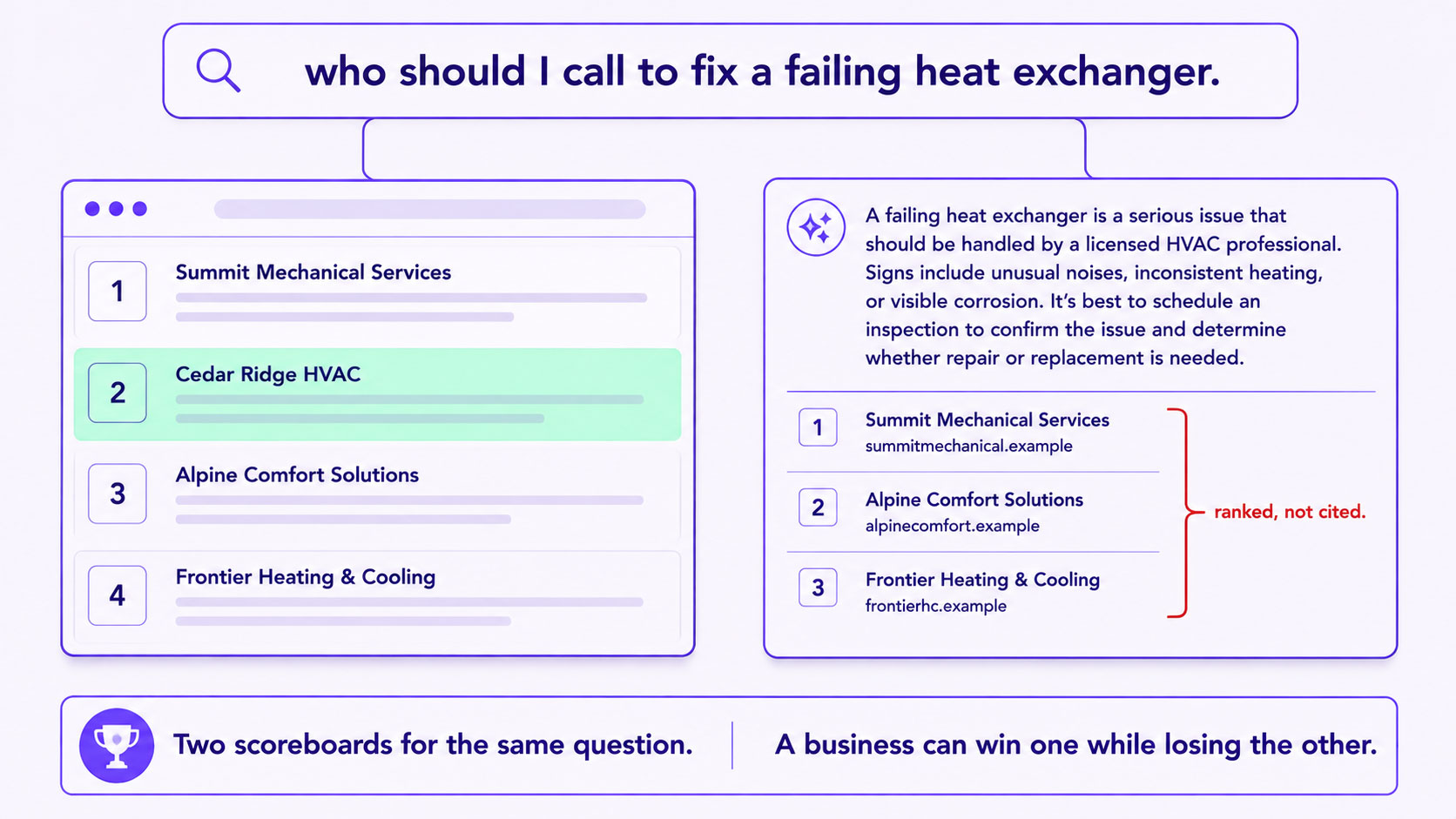
The operators winning right now are not choosing between traditional SEO and AI visibility. They are running both from a single strategy, because the same foundations — crawlable architecture, structured data, and answerable, people-first content — feed both systems.
What changes is the ceiling. Research from the Semrush AI Search Study indicates that most pages ChatGPT cites rank outside Google's top twenty for related queries. Citation logic is not simply ranking logic — which means a rankings-only program leaves AI visibility on the table, and an AI-only program abandons the channel that still produces most of the revenue.
That is the practical case for one team rather than two vendors. The site does not know which agency made which change, and neither does a search engine or an answer engine. When technical work, content and entity data are sequenced by one owner, they compound. When they are split across two retainers with separate queues, they collide.
Allegiant runs the whole board: the technical foundations, the content strategy, the citation network, and the AI visibility practice — as one program for Partners across the United States and Canada.
Traditional SEO and AI SEO are one strategy. We build it that way.
The split is not a philosophical preference. It is the difference between work that compounds and work that quietly undoes itself.
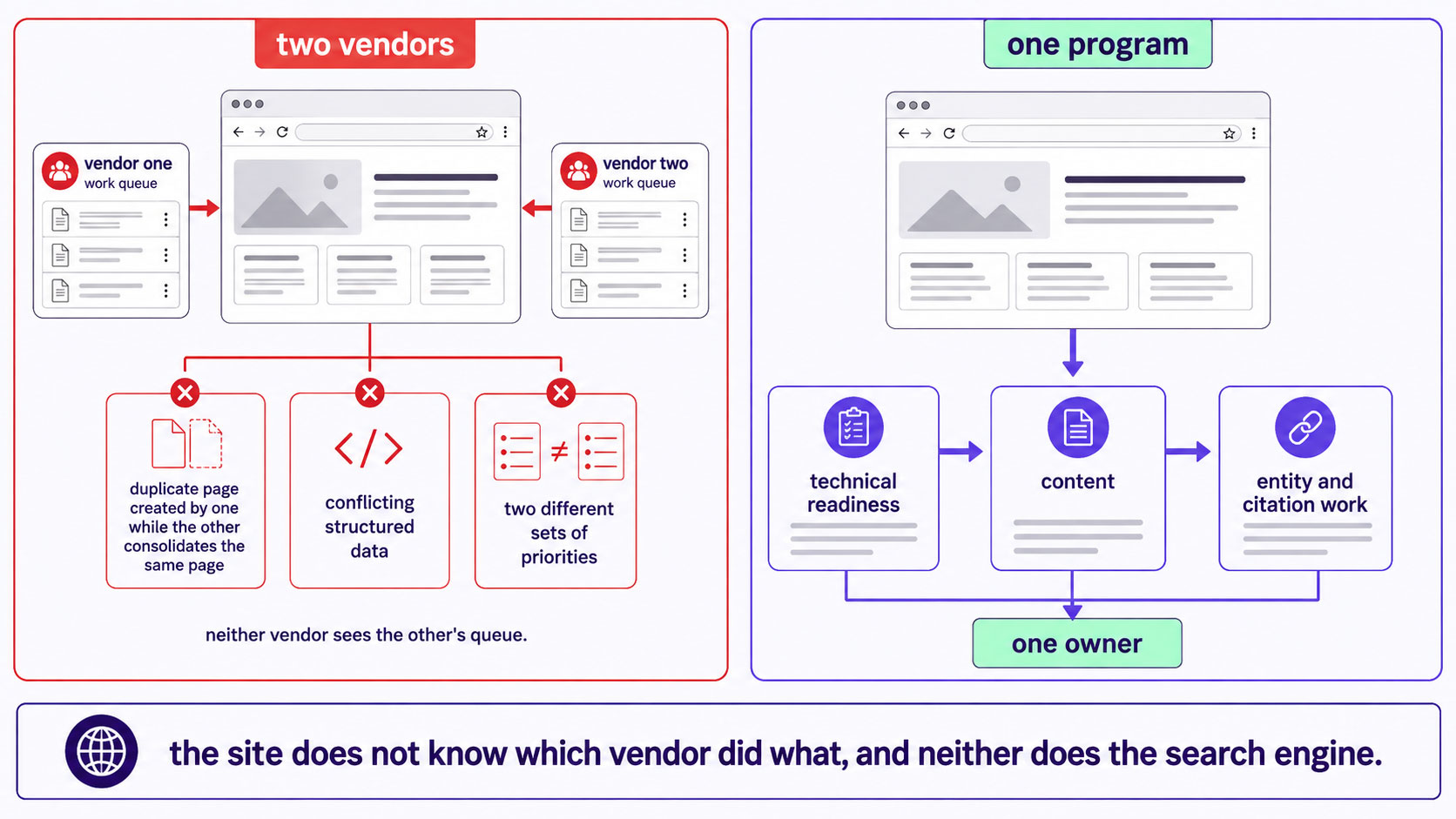
Work that collides
- Duplicate pages. One vendor creates a page for a query the other is consolidating, and the search engine picks a canonical neither of them chose.
- Conflicting structured data. Two teams describing the same business to machines, differently.
- Split priorities. Neither queue can see the other, so sequencing is accidental.
- Divided accountability. When results stall, each vendor's report shows their half succeeding.
- Paid twice. Two audits, two baselines, two sets of overhead, one website.
Work that compounds
- Sequenced. Technical readiness, then content, then entity and citation work — each stage feeding the next rather than racing it.
- One description of your business. Structured data, profile, listings and body copy agreeing everywhere machines read them.
- Shared assets. The content that earns rankings is the content that gets cited. Built once.
- One baseline. Measured against one documented starting point rather than two competing ones.
- Accountable. When something is not working, there is one place to ask and one plan to change.
Deep benches in the verticals where search decides the winner.
Search strategy is not vertical-agnostic. Buying cycles, review dynamics and query patterns differ — and the program should too.
HVAC, plumbing, roofing, electrical and the trades. Emergency intent behaves differently from planned replacement, the map pack decides a large share of it, and an untracked phone call is a conversion that never gets counted.
- Map pack and profile strength, per profile optimization
- Review velocity and response, per reputation management
- Service-area coverage without doorway duplication
- Call attribution so the channel is not understated
- Playbooks: HVAC SEO, plumber SEO and roofing SEO
- Vertical hub: home services
Brand and locations compete for the same queries, location pages get stamped out as thin duplicates, and nobody owns the outcome. That is a structural problem, not an execution one.
- Brand-level authority built once at the top
- Location-level visibility built on genuinely local signals underneath
- Governance so the two reinforce rather than cannibalise
- Thin duplication avoided — see local SEO
- Start with SEO for franchises and franchise digital marketing
- Vertical hub: franchisor systems, plus franchise SEO
Diligence-grade audits, standardised playbooks applied across portfolio companies, and reporting that rolls up to the fund rather than stopping at the operating company.
- One documented baseline method applied identically across holdings
- Findings that survive an outside reader — every claim sourced
- Comparable measurement, so portfolio companies can be ranked honestly
- Evidence standards per competitor analysis
- Vertical hub: private equity portfolios
- Proof of work: case studies
A 30/60/90 rhythm engineered for visible progress.
Every engagement opens with a full audit — traditional SEO, AI visibility, site performance and competitive position — so the plan is built on your data rather than on a template.
What happens, and in what order
Priority fixes ship immediately rather than waiting on a strategy deck. The sequence matters: content that cannot be crawled does not rank, and pages AI crawlers cannot read do not get cited.
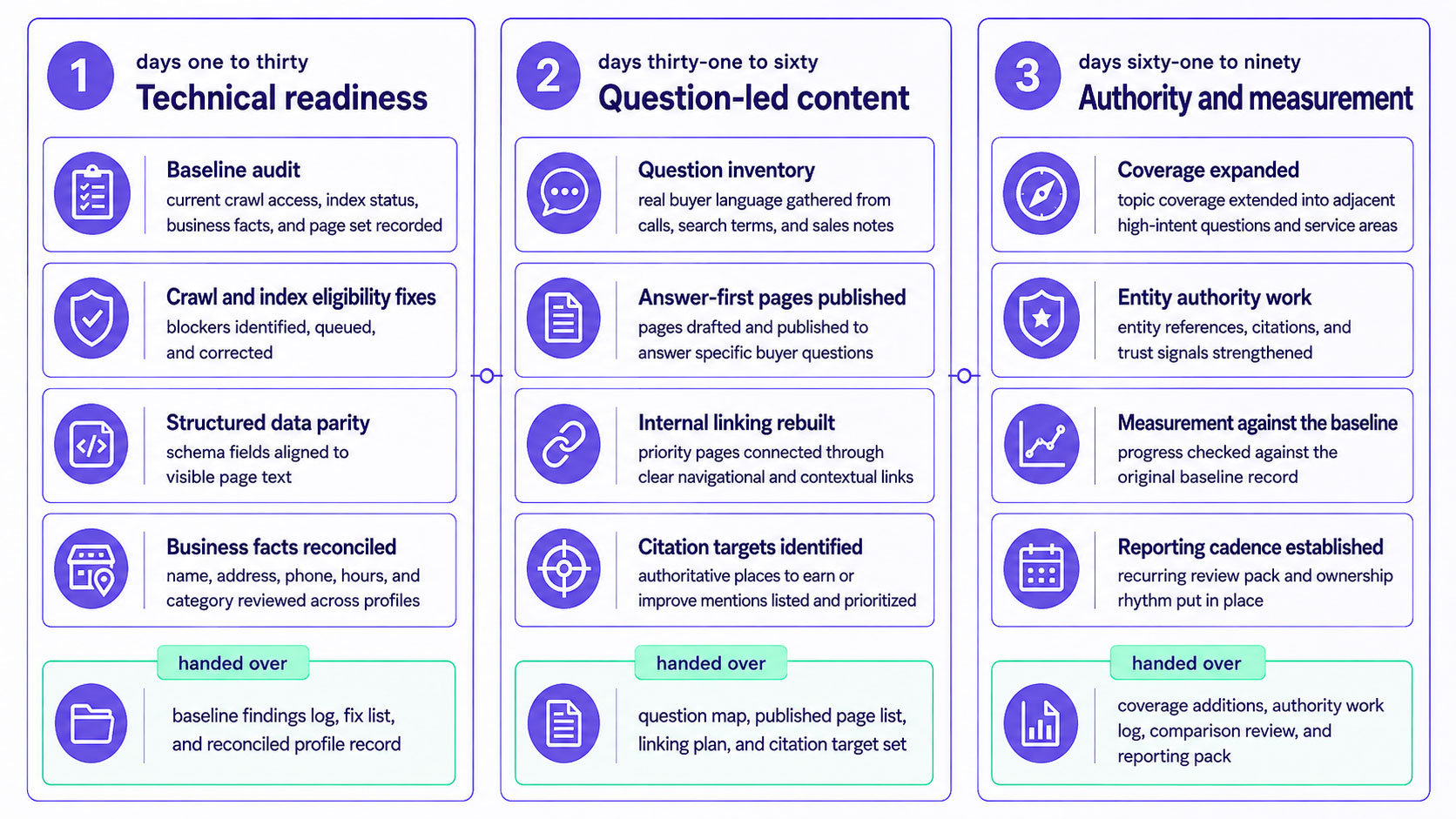
- Days 1–30 — audit, baseline, foundations. Full technical crawl, content inventory, and a visibility baseline across Google and the five AI platforms. Indexation and technical fixes ship in this window.
- Structured data brought into parity. Markup made to agree with what the page visibly says, per Google's structured data guidance — a contradiction here is worse than an absence.
- Business facts reconciled. Name, address, phone, hours and services made consistent everywhere machines read them, per directory optimization.
- Days 31–60 — build and publish. Content production against the audit's priority map, on-page optimization of the pages that carry your revenue, and citation-network work.
- Answer-first structure. Pages written so the answer is extractable — the format AI platforms quote and traditional search rewards, per Google's people-first standard.
- Days 61–90 — measure and compound. Rankings, citations, traffic and lead quality reviewed against the baseline. What worked gets scaled; what did not gets rebuilt.
- Reporting cadence established. Deliverables run through ASCENT™, Allegiant's Partner platform, so your team sees the same numbers ours does.
Every discipline a serious search program needs. Under one roof.
Allegiant is a full-service operation. You will not be handed a thin retainer and a monthly PDF — each engagement pulls from the complete bench, scoped to what your position actually requires.
Technical SEO
Crawlability, indexation, site speed, schema deployment and architecture — the layer that determines whether anything else you do is visible at all.
Why it leads: content that cannot be crawled does not rank, and pages AI crawlers cannot read do not get cited. See technical SEO.
Content strategy and production
Editorial strategy mapped to real buyer questions, then written to brief and reviewed for accuracy.
Two jobs, not one: content marketing decides what to publish and why; content writing decides how the sentence is built.
Local and profile visibility
Map pack, review signals and location relevance for businesses that win or lose in their service area — coordinated with the national strategy, never siloed from it.
Covered by: local SEO, Google Business Profile and reputation management.
Citation and entity network
Consistent business data and authoritative listings across the sources search engines and AI platforms use to verify who you are.
Why it matters twice: the same agreement that helps the map pack is what an answer engine checks before naming you. See directory optimization.
Conversion and landing experience
Traffic is a cost until it converts. Landing experience, message match and testing that turn visibility into booked revenue.
Split deliberately: CRO owns measurement and testing; landing pages owns construction. Stores that live on discoverability run ecommerce SEO, and paid demand runs through paid search.
Sites built for search from the wireframe
Structure, speed and conversion paths built in rather than retrofitted after launch, and kept working afterwards.
Two disciplines: website design builds it; website maintenance detects it when something silently breaks.
Operator-to-operator. Evidence over adjectives.
Three things we will defend in any room. First, one integrated strategy across traditional rankings and AI visibility, run by one accountable team — not an AI add-on bolted to a legacy retainer.
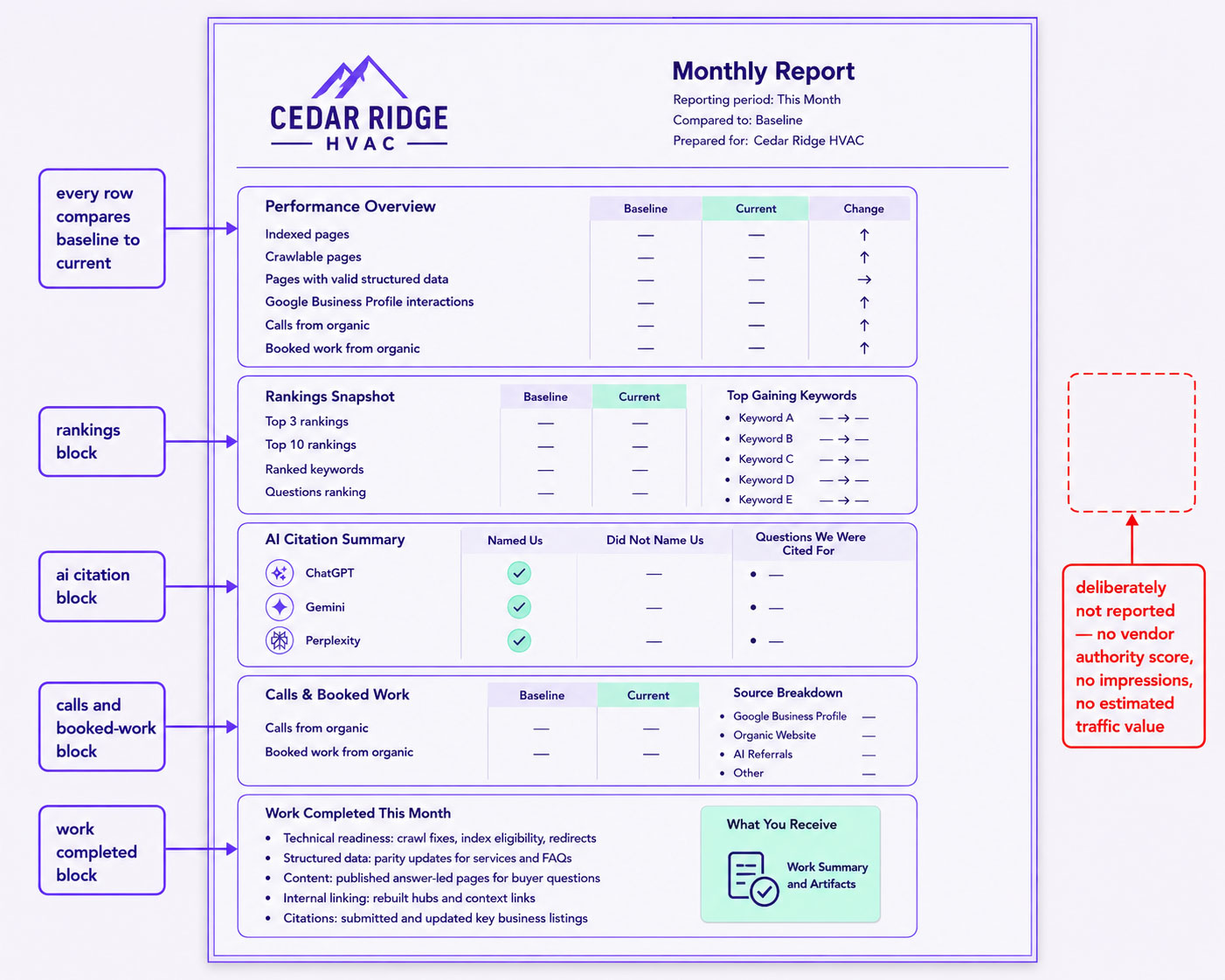
Second, verifiable reporting. Every number we show you traces to a source, projections are labeled as projections, and we would rather show you a smaller true number than a bigger soft one.
Third, the Partner model. We call the businesses we work with Partners because the engagement is built to survive a hard conversation — including the ones where we tell you a channel is wrong for you, or that the technical foundation is sound and the real constraint is somewhere we do not get paid to fix.
Every number against a baseline. Nothing you cannot audit.
Not a competitor teardown — a description of where the practices differ, so the choice can be made on substance.
| Practice | Standard SEO retainer | AllegiantOMNIVIZ™ |
|---|---|---|
| Scope | Rankings, with AI as an add-on | Both scoreboards, one strategy, one team |
| Starting point | A strategy deck | A documented baseline, with fixes shipping in month one |
| Reported figures | Vendor authority scores and impressions | Rankings, citations, calls and booked work, each against baseline |
| Estimates | Presented as measurements | Labeled as estimates every time they appear |
| AI visibility | Claimed, not measured | Tracked across five platforms on a fixed question set |
| Access to specialists | Through an account manager | Direct — no telephone game |
| When a channel is wrong for you | Sold anyway | We say so, in writing, before you commit |
Four SEO line items you can stop paying for.
Two are metrics nobody outside a tool vendor recognizes. One is a promise no agency can keep. The fourth is real work sold at a price that guarantees it will not be done.
Guaranteed rankings, or a guaranteed timeline. Nobody controls a search engine's ranking systems, and Google states plainly that meeting every technical requirement does not guarantee indexing or serving. What can be committed to is a documented baseline, a cadence, and honest reporting against it.
Vendor authority scores reported as search engine metrics. These are proprietary inventions, computed differently by each tool, and no search engine assigns them. Useful for watching your own direction of travel; meaningless as a target or as a competitive gap.
Volume content priced per word. A hundred thin pages built to a keyword list is the shape Google's guidance describes as scaled content, and it competes with your own pages. Fewer pages built on something only your operators know is the whole argument of content writing.
The cheapest retainer in the market. It is usually the most expensive line item you will ever carry, because it buys activity rather than outcomes and you pay for the year twice — once for the retainer and once for the rebuild. We do not compete on that price, and we will tell you when a smaller scope done properly is the better buy.
The pattern beneath all four: they optimize for what is easy to report rather than what is hard to earn.
- Semrush — AI Search SEO Traffic Study
- Semrush — AI Visibility Index
- Google Search Central — Introduction to structured data
- Google Search Central — Creating helpful, people-first content
- Google Search Central — Technical requirements
- Google Search Central — Spam policies for Google web search
- Google Search Central — Evaluating third-party SEO advice
- Google Search Central — AI features and your website
The questions operators ask before hiring an SEO agency.
Answered against primary sources where they exist, and answered honestly where they do not.
What does a full-service SEO agency actually do?
It owns every layer of your search visibility rather than one slice of it. At Allegiant that means technical SEO — crawlability, indexation, speed, structured data — plus content strategy and production, on-page optimization, authority building through citations, local and profile work where it applies, and conversion optimization so the traffic becomes revenue. The alternative is a specialist per layer, none of whom can see the others' queue. Background reading: how SEO works, how it works on Google, and how Google ranks a site. Google's technical requirements set the floor all of it stands on.
How long does SEO take to produce results?
It depends on your starting point, your market and how much authority you already carry — anyone quoting a universal timeline is selling rather than planning. What we can control is cadence. Engagements run on a 30/60/90 rhythm: the first thirty days ship foundation fixes that often move measurement quickly, days thirty-one to sixty put priority content into production, and by day ninety there is movement to review against the documented baseline. Google is explicit that meeting every requirement does not guarantee indexing or serving, which is why nobody should promise a date. See the audit.
What is the difference between traditional SEO and AI SEO?
Traditional SEO earns positions in ranked results; AI SEO earns mentions and citations inside AI-generated answers on ChatGPT, Gemini, Perplexity, Claude and Copilot. The disciplines overlap heavily — crawlable pages, structured data and genuinely useful content feed both — but AI platforms weigh entity recognition and extractable answers more aggressively, and they frequently cite pages that do not rank well for the same query. Go deeper at AI SEO.
Does AI search make traditional SEO obsolete?
No, and the evidence argues the opposite. Many AI experiences are built directly on top of search infrastructure — Google's own AI features documentation makes clear its AI surfaces draw on its Search index — and the same signals that earn rankings feed citation decisions. What changes is the ceiling: the Semrush AI Search Study indicates most pages ChatGPT cites rank outside Google's top twenty for related queries, so citation logic is not simply ranking logic and a rankings-only program leaves visibility unclaimed. See answer engine optimization.
How much does working with an SEO agency cost?
We do not publish one-size pricing, because honest scopes are built from your audit — market competitiveness, site condition, content debt and how fast you need to move all change the math. Engagements are custom-quoted and every quote itemizes the work, so you can see exactly what you are buying and what each piece is for. What we will say plainly: the cheapest retainer in the market is usually the most expensive line item you will carry, because it buys activity rather than outcomes. We wrote up the difference between affordable and cheap SEO. Start with the free audit and Google's guidance on evaluating third-party SEO offers.
How is SEO performance measured and reported?
Against a baseline, with numbers a CFO can audit. Every engagement opens by documenting where you stand: rankings for the queries that matter, organic traffic and its conversion behavior, technical health, and visibility across the five major AI platforms. Monthly reporting then shows movement against that baseline — rankings, qualified traffic, leads and calls, and citation presence — along with the reasoning behind each change. Vendor authority scores are not search engine metrics and we do not report them as such, per Google's own guidance. Related: CRM.
We already run paid ads. Do we still need SEO?
They are complements, not substitutes. Paid buys immediate, controllable demand; SEO builds an owned asset whose traffic you stop renting. Running both makes each smarter — paid search data reveals which queries actually convert, which sharpens the organic content plan, while strong organic coverage lets you stop paying for clicks you would have earned anyway and move budget to terms where you cannot rank. How the two work together is covered in this breakdown, and the destinations both channels send to are covered under landing pages, and Google's people-first standard governs the content either way.
What is technical SEO, and why does it come first?
It is the infrastructure layer: whether search systems can crawl your pages, whether the site renders and loads acceptably, whether structured data tells machines what each page is, and whether your architecture routes authority to the pages that earn revenue. It comes first because everything else depends on it — content that cannot be crawled does not rank, and pages AI crawlers cannot read do not get cited, particularly since many never execute JavaScript. Full detail at technical SEO, and on site speed specifically.
How does national SEO differ from local SEO?
National SEO competes on topical authority — winning the informational and commercial queries your buyers ask regardless of geography, which is content-and-authority work at scale. Local SEO competes on proximity and trust signals: profile strength, review velocity and rating, consistent citations, and location-relevant content that wins the map pack. Most real businesses need a deliberate blend, and the failure mode is running one while assuming it covers the other. Google's people-first guidance applies to both.
Can Allegiant handle SEO for franchises and multi-location businesses?
Yes — franchise systems are one of our core verticals. Multi-location search has a specific failure pattern: brand and locations compete for the same queries, location pages get stamped out as thin duplicates, and nobody owns the outcome. Our approach separates the jobs — brand-level authority built once at the top, location-level visibility built on genuinely local signals underneath — with governance so the two reinforce rather than cannibalise. Thin duplicated location pages also edge toward what Google's spam policies describe. See local SEO.
What makes Allegiant different from other SEO agencies?
Three things we will defend in any room. One integrated strategy across traditional rankings and AI visibility, run by one accountable team rather than an AI add-on bolted to a legacy retainer. Verifiable reporting: every number traces to a source, projections are labeled as projections, and we would rather show a smaller true number than a bigger soft one. And the Partner model — the engagement is built to survive a hard conversation, including the ones where we tell you a channel is wrong for you. The same standard we apply to competitors in competitor analysis, per Google's guidance on evaluating claims.
What is the OMNIVIZ™ framework, and how does it relate to SEO?
OMNIVIZ™ is Allegiant's framework for AI visibility — five pillars that extend a traditional SEO program into AI-generated answers: Entity Authority Building, Answer-First Content Architecture, Multi-Source Citation Network, Technical AI Readiness and AI Visibility Monitoring. The relationship to SEO is direct: it takes the assets your program already produces — content, structure, authority — and makes them legible to AI platforms. Nothing in it is separate work, which is why it is not billed as a separate retainer. Detail at AI SEO, and Google's AI features documentation is the reference point for the surfaces.
What happens in the first 90 days of an engagement?
Days one to thirty: a full audit and documented baseline — technical crawl, content inventory, competitive position, and visibility across Google and the five AI platforms — with priority fixes shipping immediately rather than waiting on a strategy deck. Days thirty-one to sixty: production against the audit's priority map, on-page optimization of revenue pages, and citation-network work. Days sixty-one to ninety: measurement against the baseline, with what worked scaled and what did not rebuilt. Structured data is brought into parity with visible text throughout, per Google's guidance. Start at the audit.
Can Allegiant work alongside our in-house marketing team?
Yes, and some of our strongest engagements run exactly this way. The division of labour gets written down early: typically your team keeps brand voice, approvals and channel ownership while Allegiant carries the technical program, search strategy, content production capacity and measurement infrastructure. Your people get direct access to our specialists rather than an account-manager telephone game, and everything we build ships with documentation so it does not become knowledge only we hold. Production standards are described under content writing, with a primer on optimizing content for search, measured per Google's people-first standard.
How do we get started with Allegiant?
Start with the free website audit. We baseline your current position — technical health, rankings, content coverage and AI visibility — and walk you through the findings in a straightforward working session: what is holding you back, what the opportunity looks like, and what we would do first. If the fit is right, you get a custom-scoped proposal with itemized work and honest expectations. If it is not, you still leave with the findings and they are yours to act on. Google's guidance on evaluating third-party SEO advice is a fair lens to point at our proposal.
Find out where you actually stand on both scoreboards.
The free audit baselines your technical health, your rankings, your content coverage and your visibility across the five AI platforms — then we walk you through what is holding you back and what we would do first. Findings are yours whether or not we work together.
- Technical crawl — indexation, rendering, speed, structured data parity
- Ranking position for the queries that actually carry revenue
- AI visibility across ChatGPT, Gemini, Perplexity, Claude and Copilot
- Content coverage against the questions your buyers ask
- Citation and listing agreement across the sources machines check
- A documented baseline every later number is measured against
Explore the wider program: all services, AI SEO, technical SEO, local SEO, content marketing and conversion rate optimization. More about us: the team, case studies, partner reviews, the blog and contact.
We will show you where you stand on rankings and on AI answers, and what it would take to close the gap.
No cost, no commitment. We will follow up by email or phone to walk you through the findings.

