
Booked jobs from the panel above the map,
and only for leads that were real.
Every other paid channel takes a credit card and starts spending. This one makes you pass a screening process first — the business, the owner, and everyone who goes into a customer's home. That gate is the hardest part of the channel and the best thing about it, because your competitors have to pass it too.
Local Services runs inside an AI-first program here. AI-assisted lead review reads every charged call rather than sampling, and the profile strength that wins the panel is the same entity work that decides whether AI platforms and search engines name you when a homeowner asks an assistant who to call.
AI is reshaping how homeowners choose a contractor, and Local Services sits directly in that path. The verified business data that clears Google's screening is the same entity information AI assistants draw on, so the work compounds across both surfaces rather than serving only one.
Every other platform takes your money first. This one checks you first.
You can launch a search campaign in an afternoon with a card and a credit limit. Local Services Ads will not let you spend anything until a screening process has run against your business, your ownership and the people you send into customers' homes — and that is the most valuable thing about the channel.

Google's own words set the bar. Its screening and verification documentation states that to participate in Local Services Ads, all businesses must pass Google's screening and verification process, that the process varies by business category and location, and that it may include background, business registration, insurance and license checks along with minimum review requirements.
The scope is wider than most operators expect. The same documentation describes background checks reaching the business, the business owner, and their field worker roster — employees, contractors including subcontractors, and others who provide services in customers' homes, workplaces or other properties. And it notes that from time to time you may be asked to repeat one or more checks in order to continue participating.
Read that last part again, because it changes how the channel should be managed. The verification is not a launch task that gets ticked off. It is a standing condition, and an operator whose insurance lapses or whose crew changes without the roster being updated can find the channel switched off without a campaign setting having changed at all.
Now the part that makes this worth the trouble. Every competitor in your category has to clear the same gate. A channel that requires licensing, insurance and criminal background screening is structurally hostile to the operator working out of a truck with no paperwork — which is exactly the competitor who is otherwise happy to undercut you on price. The friction you resent during onboarding is the moat afterwards.
That is why we treat screening as the engagement rather than as paperwork before the engagement. Getting through it cleanly, keeping it current, and knowing which checks apply to your category and location is most of the value an agency can add here — and it is unglamorous enough that plenty of agencies would rather sell you a management fee and let you fight the documents alone.
One got reviewed. The other just got paid for.
You are billed per lead rather than per click, which sounds like it removes the waste. It moves it. The waste is now in the leads that were never yours — wrong area, wrong service, wrong number — and the only thing standing between you and paying for them is whether somebody looks.
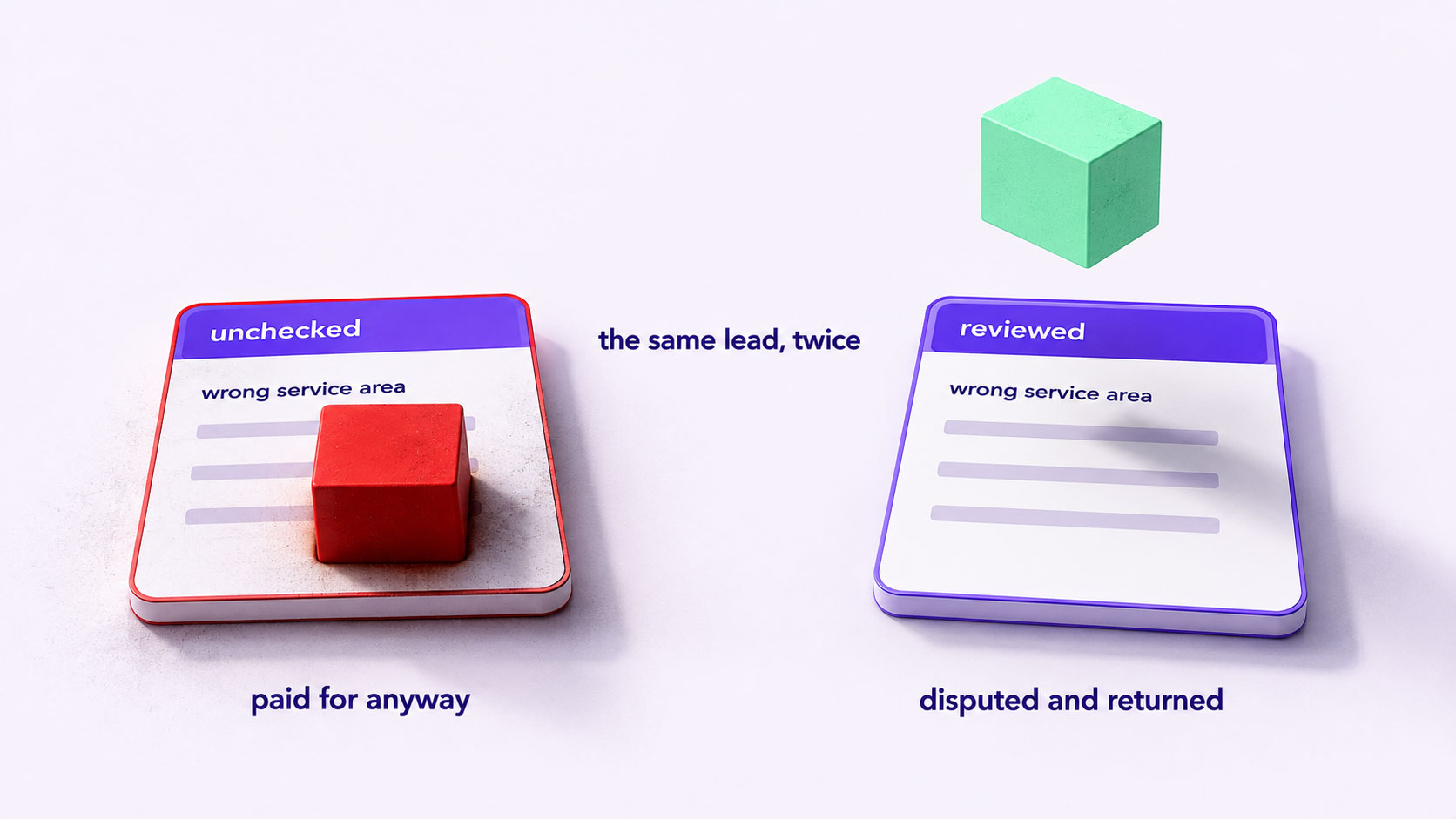
Every charge stands by default
- Nobody listens to the calls. The recording exists and no one has time, so the charge is simply accepted.
- Out-of-area leads paid for because the service area was set once and never checked against where you actually drive.
- Wrong-service leads paid for because the job types were left broad to increase volume.
- Missed calls charged anyway. A lead you never answered is still a lead you were billed for.
- No dispute history at all, which means the account has never once pushed back.
Every charge has been looked at
- Calls reviewed on a standing cycle, not when the invoice looks unusually high.
- Service area matched to the territory you dispatch to, and tightened where it is generating charges you cannot service.
- Job types set deliberately, accepting narrower volume in exchange for leads you can actually take.
- Missed calls treated as an operations finding and reported, because that is where the money really goes.
- Disputes submitted with the reason recorded, so the pattern is visible over time.
Two are gates. Two are dials. Most accounts get all four wrong.
The gates decide whether you can run at all. The dials decide what you pay for once you can. Both are documented, and neither is set correctly by default.
Google documents the screening and verification requirements and the process itself. What applies to you depends on your category and where you operate, so the first job is establishing which checks are yours rather than assuming a general answer.
The re-check clause is the one that surprises people. Checks can be requested again to continue participating, which makes this a standing obligation rather than a launch milestone.
- Establish the exact requirements for your category and location before promising a launch date.
- Track insurance and license expiry so a lapse never switches the channel off silently.
Google publishes guidance on uploading license or insurance documents. The requirements are specific, and a document that does not meet them is a rejection rather than a request for clarification.
This is where launches actually slip. Not strategy, not creative — a certificate naming the wrong entity, or an expiry date inside the review window, discovered after submission rather than before.
- Check documents against the published requirements before they are submitted, not after rejection.
- Confirm the legal entity on the paperwork matches the one on the account.
Google's ad rankings documentation states that provider listings are displayed and ranked by an auction taking into account bid and overall profile quality, and that your bid is the maximum you are willing to pay for a lead though you may pay less.
Profile quality is the half that money cannot fix quickly. It accrues from how you actually operate, which means the work sits in the business rather than in the account.
- Improve the inputs to profile quality rather than treating bid as the only lever.
- Use Google's own performance guidance as the checklist rather than folklore.
Service area and job types decide which enquiries reach you, and both are usually set broad at launch to get volume moving. Broad settings on a pay-per-lead channel are a decision to be billed for work you may not want.
Narrower is frequently cheaper per booked job, even though it produces fewer leads, and that trade is invisible if nobody reviews what the charges were actually for.
- Match the service area to where you genuinely dispatch, not to where you would like to.
- Turn off job types you take reluctantly, and measure booked work rather than lead count.
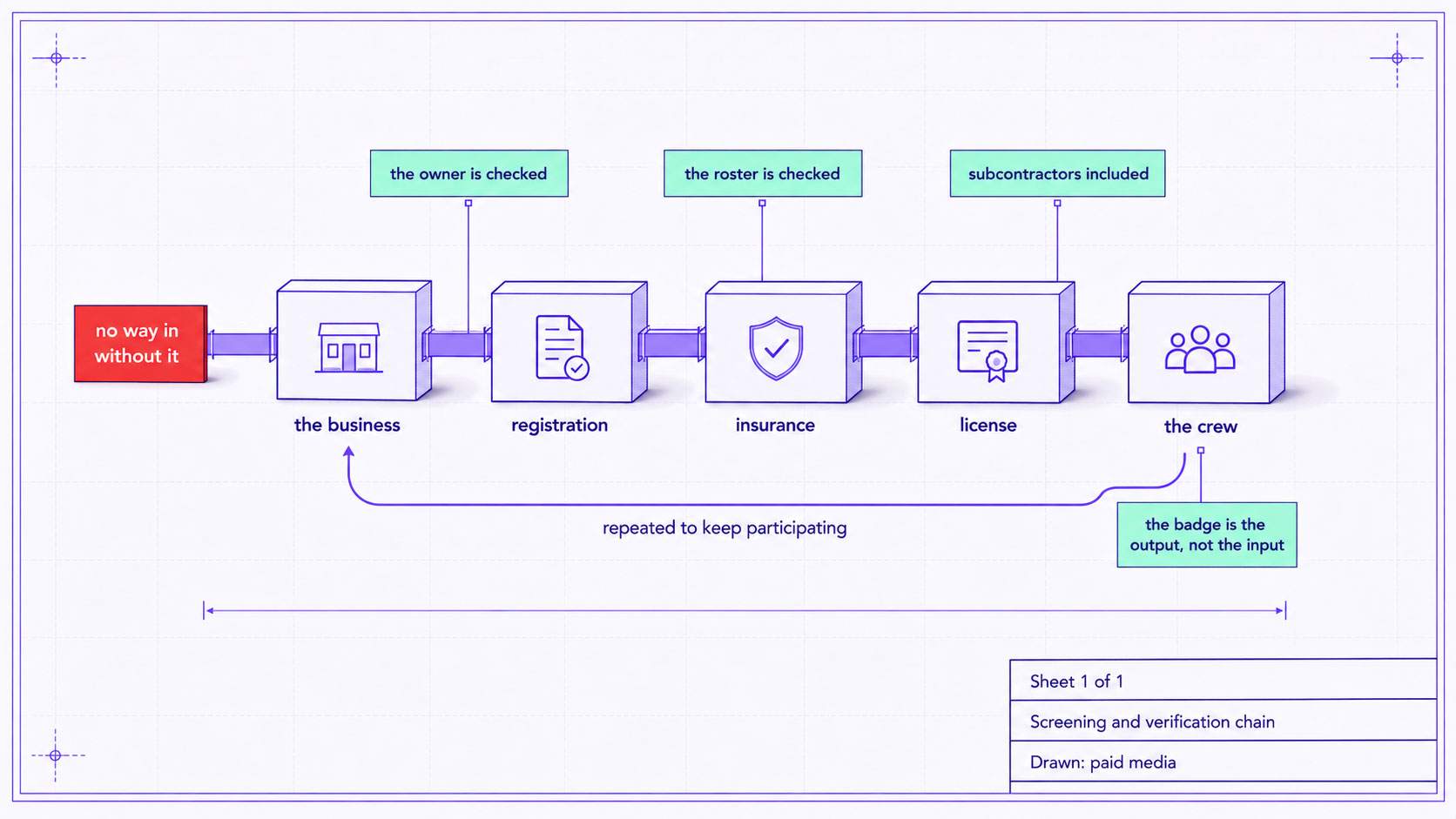
Not just the company. The owner, and everyone who knocks on the door.
Operators expect a business check. The scope described in Google's documentation goes considerably further, and understanding that in advance is the difference between a four-week onboarding and a four-month one.
The chain, and the loop at the end of it
Google's screening documentation describes a process that may include background checks, business registration checks, insurance checks and license checks, alongside minimum review requirements, with the specifics varying by category and location. It describes background checks in specific categories and locations covering the business, the business owner, and the field worker roster — employees, contractors including subcontractors, and others who provide services in customers' homes, workplaces or other properties.
The field worker roster is the part that trips operators up. A business that subcontracts overflow work in busy season has people entering customers' homes who are not on any payroll, and the roster is expected to reflect reality rather than the org chart. That is a conversation to have before submission rather than during a review.
And the process loops. The documentation notes you may be asked from time to time to repeat one or more of these checks in order to continue participating. So the correct mental model is a license to operate that must be maintained, not a hurdle cleared once.
None of this is a reason to avoid the channel. It is a reason to plan the onboarding properly, and it is the single strongest argument for why a lead from this panel is worth more than a lead from an ad anybody could have bought.
- The business — registration and identity of the company itself
- The owner — identity and criminal history checks where required
- The field worker roster — employees, contractors and subcontractors
- Insurance — current, correctly named, not expiring mid-review
- License — where your category and location require one
- Again, later — checks may be repeated to continue participating
Clear the gate, tighten the scope, then review every charge.
Most agencies treat this as a set-and-forget channel because the platform does the targeting. That is exactly why unreviewed accounts pay for leads nobody wanted for years at a time.
Before anything goes live
- Requirements established for your specific category and location
- Documents checked against the published requirements before submission
- Field worker roster discussed honestly, subcontractors included
- Expiry dates tracked so nothing lapses quietly later
Setting the scope
- Service area matched to where you actually dispatch trucks
- Job types set to work you want rather than work you tolerate
- Hours aligned to when somebody genuinely answers
- Bid approach chosen against capacity, not against ambition
Every month after
- Every charged lead examined against the four qualifying questions
- Anything failing one of them queried rather than absorbed
- Missed and unanswered calls reported as an operations finding
- Booked work reconciled against leads charged, not against lead count
Six things, and two of them are uncomfortable
Half of this list is administrative work most agencies would rather leave with you. The other half involves telling you things about your own operation that are easier not to mention.
Screening requirements established first
Which checks apply to your category and location, confirmed before a launch date is promised, because the answer varies and a general answer is not an answer.
Source: Local Services Help — screening and verification requirements
Documents pre-checked before submission
Entity names, coverage and expiry dates checked against the published requirements, because a rejected document costs weeks and nobody explains why in advance.
Source: Local Services Help — uploading license or insurance documents
Every charged lead reviewed
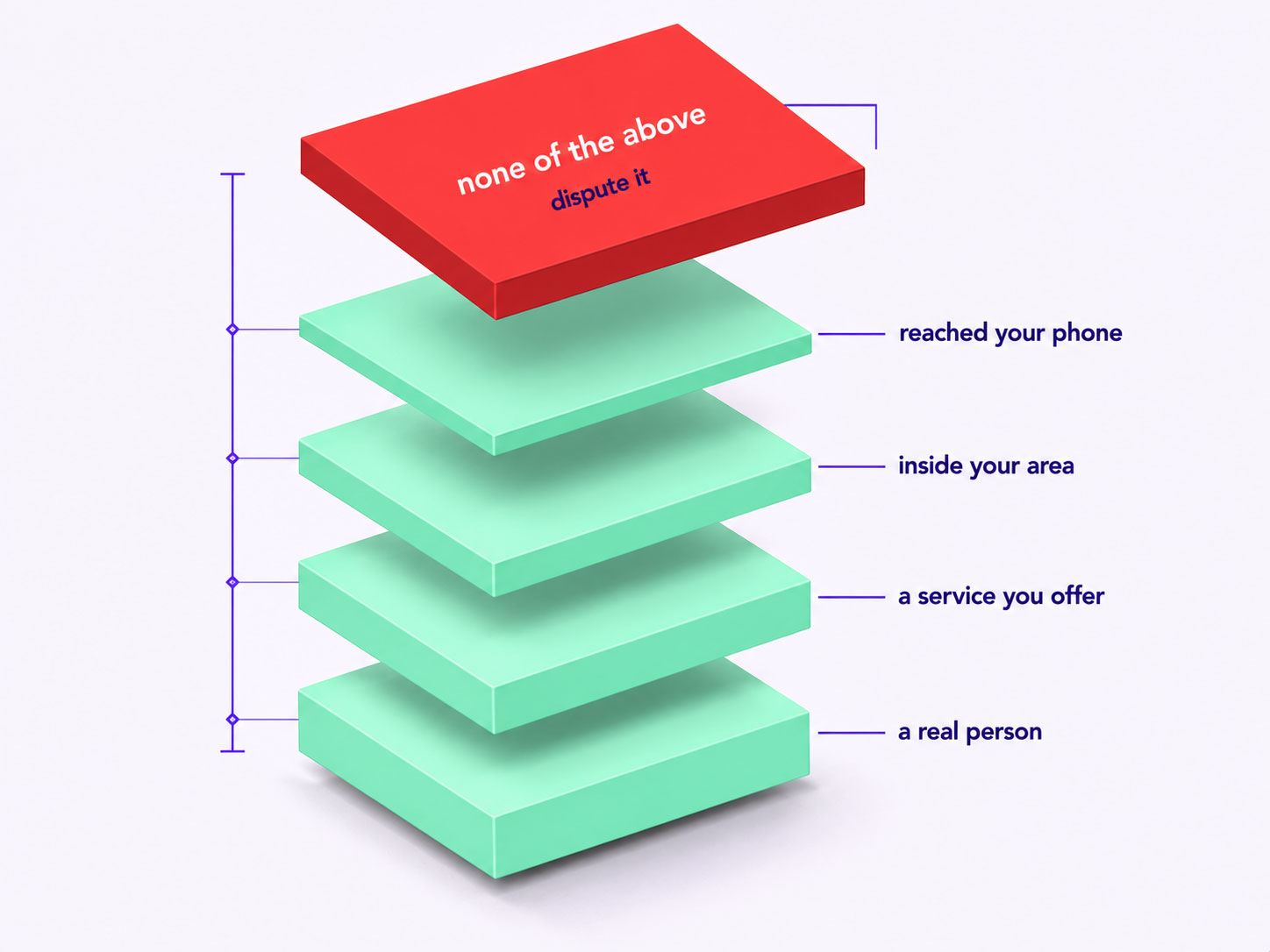
Examined against four questions — real person, service you offer, inside your area, reached your phone — with anything failing one of them queried rather than absorbed.
This is Allegiant operating practice, stated as such rather than quoted from a policy that changes.
Missed calls reported, not hidden
An unanswered lead is a lead you were billed for. We report the count even when the cause is inside your business, because it is usually the largest single loss on the account.
Related: what happens to the call afterwards is CRM work.
Profile quality worked on as operations
Ranking runs on bid and overall profile quality, and the quality half accrues from how you actually operate — responsiveness, reviews, completeness — rather than from account settings.
Held apart from the other local surfaces
This panel is not the map pack and not your profile listing. They appear near each other and are earned differently, so we report and manage them separately.
Related: local SEO and profile optimization.
We will tell you how many leads you never answered.
On a pay-per-lead channel the most expensive line is almost never the bid. It is the leads that rang and nobody picked up, which you paid for in full and never had a chance at. That number is uncomfortable, it belongs to your operation rather than to us, and we report it every month.
We will also tell you when this is the wrong channel. If your category does not qualify, or your paperwork cannot support the screening yet, the honest answer is to fix that first or spend elsewhere — and that answer costs us the retainer.
This sits alongside paid search, local visibility and the wider digital program, and it is usually the highest-intent traffic in the whole plan.
Four things make a lead yours. Miss one and it is a question.
Reviewing charges is not an argument with the platform. It is a routine check against four plain conditions, and the value is as much in seeing the pattern as in any single query.
| What you were billed for | How it is usually handled | Reviewed What we do with it |
|---|---|---|
| A real customer enquiry | Accepted, correctly | Accepted, and tracked through to whether it became a booked job |
| Outside your service area | Absorbed as a cost of doing business | Queried, and the service area tightened so it stops recurring |
| A service you do not offer | Absorbed, job types left broad | Queried, and the job type turned off if it keeps producing them |
| A wrong number or spam call | Never listened to | Identified in the call review and queried |
| A call nobody answered | Invisible, and paid for | Reported to you as an operations finding — this one is not the platform's fault |
The last row is the one that changes accounts. Every other line is a question for the platform. That one is a question for the business, and on most pay-per-lead accounts it is worth more than every dispute combined.
Four line items you can stop paying for.
One is a promise about a process nobody controls. One is a number reported without its cost. One is broad scope sold as growth. The fourth is a management fee with no review behind it.
Guaranteed approval or a guaranteed timeline through screening. The process runs on Google's side against checks that vary by category and location, and any agency promising an outcome or a date is promising something it does not control. What can be committed to is preparation — that the documents meet the published requirements before they are submitted.
Lead volume reported without lead quality. On a pay-per-lead channel, volume is the cost line rather than the result. A report showing more leads month over month, with no reference to how many became work and how many were queried, is describing an increase in spending.
Broad service areas and job types sold as reach. Widening scope reliably produces more leads and more charges, and it is the easiest way to make an account look busier. Narrower is frequently cheaper per booked job, which is the number that matters.
Management with no lead review in it. If nobody is listening to the calls and querying what does not qualify, the fee is buying account access rather than management. The review is the work on this channel; the settings barely move once they are right.
The pattern beneath all four: the channel bills by the lead, so anything that increases leads without qualifying them is selling you the cost side.
- Local Services Help — Understand the screening and verification process
- Local Services Help — Business screening and verification requirements
- Local Services Help — Uploading license or insurance documents
- Local Services Help — About ad rankings
- Local Services Help — Improve your Local Services Ads performance
- Local Services Help — Getting started with Local Services Ads
- Local Services Help — About direct business search
- Google — Local Services Ads
- Google Ads Help — Google Ads policies
- Google Ads Help — Different ways to track conversions
- Google Ads Help — Google Ads best practices
- FTC — Advertising and marketing business guidance
- FTC — Advertising FAQs: A Guide for Small Business
Local Services Ads, answered against the documentation
Every answer below links to Google's own published documentation, so you can check it without taking our word for it.
What does Google actually check before we can run?
More than most operators expect. Google's screening documentation states that all businesses must pass its screening and verification process, that the process varies by category and location, and that it may include background, business registration, insurance and license checks along with minimum review requirements. In specified categories and locations, background checks reach the business, the business owner and the field worker roster, including subcontractors who enter customers' properties. Establish which apply to you before promising anyone a launch date. Territory-level readiness is covered in the A.R.C. Report.
Why is our approval taking so long?
Usually a document rather than a decision. Google publishes requirements for uploading license or insurance documents, and a certificate naming a different legal entity, or one expiring inside the review window, is a rejection rather than a request for clarification. Check the paperwork against the published requirements before submitting rather than after. The other common cause is a field worker roster that does not match who actually attends jobs. Getting the operational answer right first is the same principle we apply on lead handling.
Is this the same as the map pack or our Business Profile?
No, and conflating them is common because they appear near each other. Local Services is a paid panel with its own screening, its own auction and its own billing — Google's getting started documentation covers it separately. The map results and your profile listing are earned rather than bought and behave differently, which is why we report and manage them apart. Those surfaces are covered on our local SEO and profile optimization pages.
How does Google decide who shows first?
By auction, and bid is only part of it. Google's ad rankings documentation states that provider listings are displayed and ranked based on an auction taking into account bid and overall profile quality, and that your bid is the maximum you are willing to pay for a lead though you may end up paying less. The profile quality half accrues from how you actually operate rather than from a setting, which is why bidding harder has limits here. Google's own performance guidance is a better checklist than folklore. Related: review program.
We keep getting leads outside our service area. What do we do?
Two things, in order. Query the charges, and tighten the setting so it stops recurring — a service area set at launch to match ambition rather than dispatch reality will keep producing them indefinitely. We review every charged lead against four questions: was it a real person, was it a service you offer, was it inside your area, and did it reach your phone. That review is our operating practice rather than a platform policy we are quoting. Google's performance documentation covers the settings side. Matching territory to capacity is a demand question too.
Can we get charged for a call we did not answer?
Yes, and on most accounts we review this is the largest single loss — larger than every questionable lead combined. A missed call is a lead you paid for in full and never had a chance at, and it is not the platform's fault. We report the count every month even though it is a finding about your operation rather than about the advertising, because nothing else on the account moves the number as much. Google's performance guidance treats responsiveness as material. What happens to the call afterwards is CRM work.
Do we have to keep passing checks after we are approved?
Potentially, yes. Google's screening documentation notes that from time to time you may be asked to repeat one or more checks in order to continue participating. So treat it as a standing condition rather than a launch milestone: track insurance and license expiry dates, and update the field worker roster when the crew changes. An operator whose coverage lapses can find the channel switched off without any campaign setting having changed. The same detection-over-time thinking is on website maintenance.
Should we run this alongside regular search ads?
Usually yes, because they answer different moments and sit differently on the page. Local Services bills per lead and appears above the map results; search text ads bill per click and compete in a separate auction — Google covers the paid search side in its best practices documentation. Running both means measuring them separately rather than letting one absorb credit for the other, and reconciling both against booked work. That accounting discipline is set out on our paid search page.
What should a monthly report on this channel contain?
Leads charged, leads queried and why, calls unanswered, and booked work reconciled against the charges. Lead volume alone is the cost line rather than the result, so a report showing volume rising without quality beside it is describing an increase in spending. Reconciling reported activity against work that reached the business follows the same discipline as paid search, and Google's conversion tracking documentation covers what the platform is and is not counting on the paid side.
Is this worth it for a local service business?
Where your category qualifies, it is usually the highest-intent traffic in the whole plan — someone in the panel is looking to book, not to browse. It is the wrong channel where your category is not eligible in your location, where the paperwork cannot yet support screening, or where the phone is not reliably answered, because a pay-per-lead channel punishes an unanswered phone harder than any other. Eligibility varies, so check Google's own overview for your category. An honest read of where your demand sits is what the A.R.C. Report is for.
Find out what your leads are actually costing you.
The A.R.C. Report covers your whole marketing position, and where Local Services is in the plan we look at what you have been charged for, how much of it qualified, and how many leads rang without being answered. Findings are yours whether or not we work together.
- Screening status and which requirements apply to your category and location
- License and insurance documents checked against the published requirements
- Service area compared against where you genuinely dispatch
- Job types compared against work you actually want
- Charged leads reviewed against the four qualifying questions
- Unanswered calls counted and reported, whatever the cause
Explore the wider program: all services, paid search, local SEO, profile optimization and the A.R.C. Report.
Tell us your trade and the area you serve, and we will tell you whether this channel is open to you and what it should cost.
No cost, no commitment. We will follow up by email or phone to walk you through the findings.

