
Clicks that become customers,
on spend you can account for.
You choose keywords. The auction chooses the queries you actually pay for, and on most accounts nobody has ever compared the two. Search engine marketing is an accounting discipline before it is a creative one. We account for every charged query, and we build for the surfaces answering searches now — not only the results page they were designed for.
Built for home services contractors, franchise systems, private equity portfolios and mid-market operators — one location or two hundred, from a single-truck shop to a Fortune 500 buying committee. Run by an AI-first agency: AI-assisted bid and query analysis, and the same entity work that decides whether AI platforms and search engines recommend you when a homeowner asks an assistant instead of typing a search.
You bought keywords. You paid for queries.
Those are two different lists, and the second one is the one your money went to. Google publishes it inside the account, for free, updated continuously. On a large share of the accounts we inherit, nobody has opened it — not once, across months of spend.
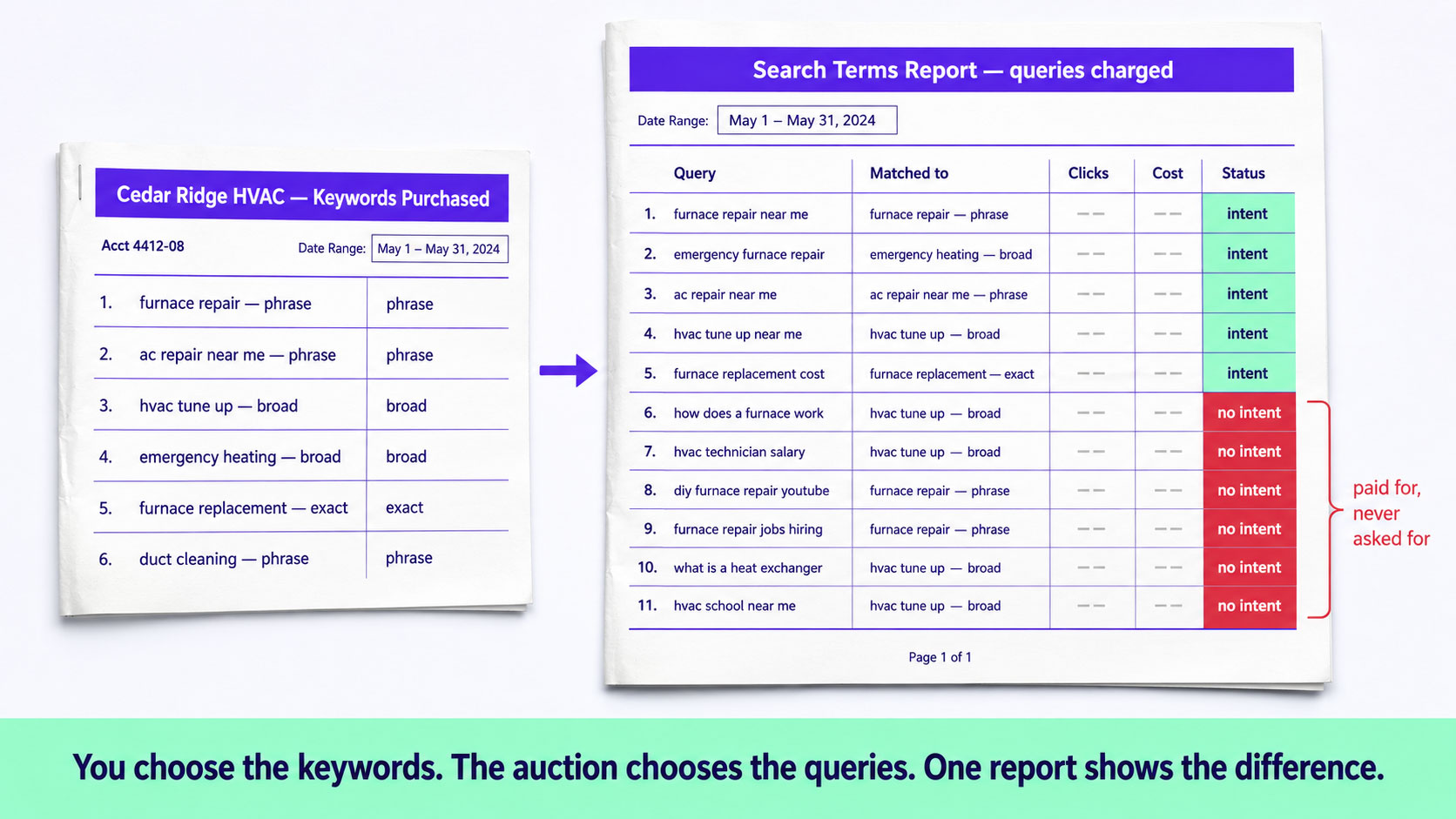
Here is the mechanic, in the platform's own words. A keyword is not a purchase order for that phrase. It is an instruction about which searches you are willing to enter an auction for, and the breadth of that instruction is set by how the keyword is matched. The search terms report is where Google shows you the actual searches that triggered your ads and produced your clicks.
The distance between those two lists is the entire argument of this page. A home services account bidding on furnace repair will, without intervention, pay for people researching how a furnace works, students looking for trade schools, technicians looking for jobs, and homeowners looking for instructions to fix it themselves. Every one of those is a real person with a real intent. None of them is going to book a call.
Nobody is being deceived here. Google documents all of it — the report exists precisely so advertisers can see and act on it. The failure is that reading it is unglamorous work that produces no screenshot for a monthly report, and so it quietly does not get done. The account keeps spending, the dashboard keeps showing clicks, and the clicks keep being real clicks by real people who were never going to buy.
What makes this expensive rather than merely wasteful is compounding. Automated bidding learns from the conversions it observes. Feed it a month of clicks from people with no purchase intent and it does not simply waste that month — it draws conclusions and bids accordingly next month. The cost of not reading the report is not the clicks it would have caught. It is the direction it would have corrected.
There is a second cost that is easier to miss. Broad, unfiltered query data does not only waste the budget it touches — it distorts the picture of the market that everyone downstream is working from. A business looking at a report full of clicks and few bookings concludes that paid search does not work for them, or that their prices are wrong, or that the phones are the problem. Sometimes those are true. Often the account was simply buying the wrong queries and nobody checked, and a correct conclusion was drawn from a corrupted input, which is why we start at the demand picture.
What a first clean pass typically surfaces is not exotic. It is job seekers, students, people looking for instructions, people in a city you do not serve, and searches for a service you stopped offering two years ago, which is the kind of thing a standing review surfaces. None of it is anybody's fault. It is the predictable output of a system doing exactly what it was told, instructed by somebody who has since moved on, and never reviewed since. The work is unglamorous and the return on it is immediate, which is a rare combination in this discipline.
So the first thing we do on any account, before touching a bid or writing an ad, is pull every charged query for the available history and classify it. Not sample it. All of it. That single pass usually explains more about an account's performance than every other diagnostic combined, and it is free.
One account is managed. The other is merely running.
Identical keywords, identical budget, identical ads. The difference is whether anyone opens the report that shows where the money actually went — and that difference compounds every month it goes unopened.
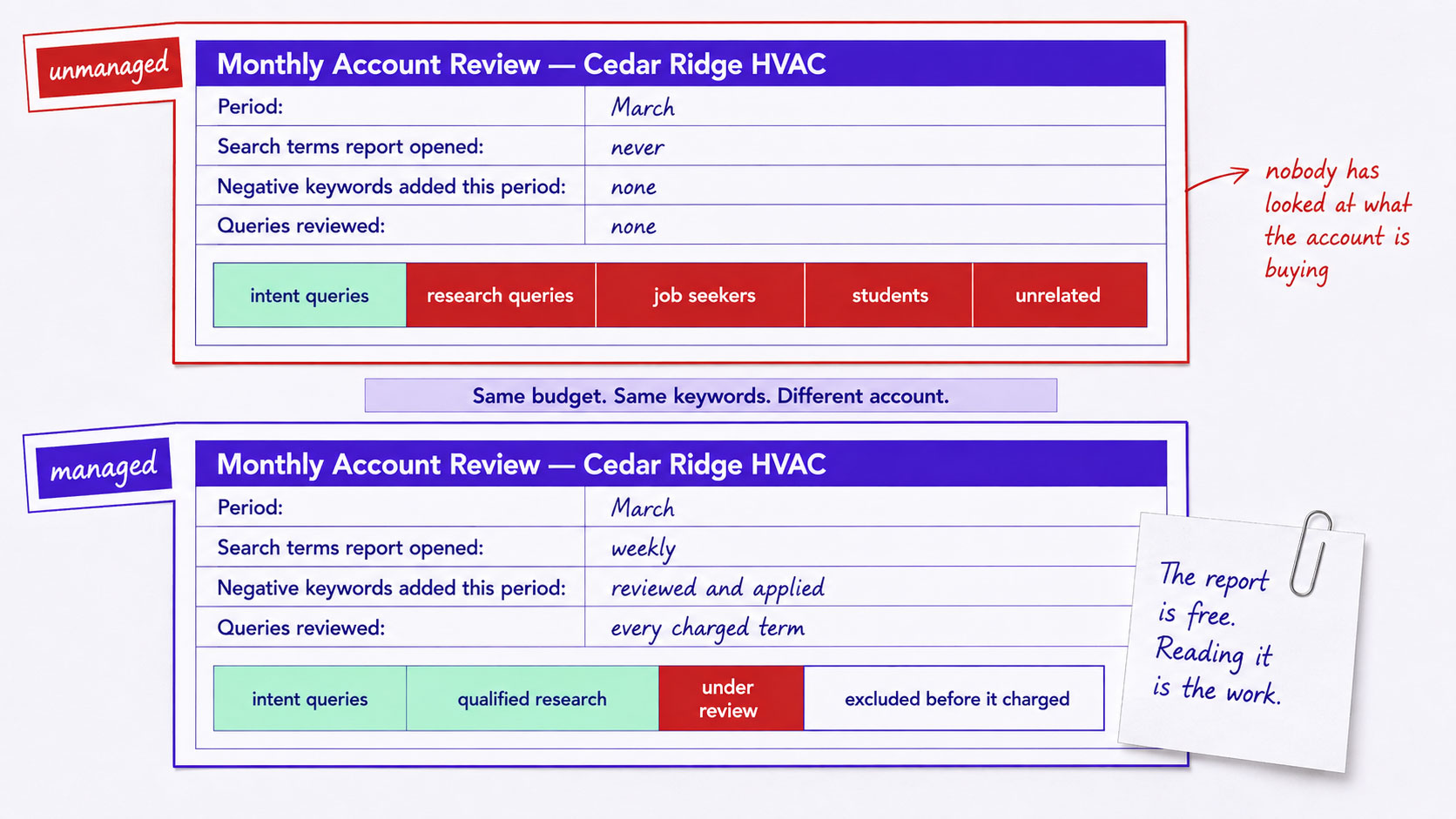
Nobody has looked at what it buys
- The search terms report has never been opened. It exists, it is free, and it has not been read.
- No negative keyword history. Nothing has ever been excluded, so nothing ever stops being bought.
- Conversions counted but not reconciled. The platform's number is reported as fact without checking it against work that arrived.
- Automation left to learn from unfiltered data. The system optimizes confidently toward the wrong audience.
- Reporting is a screenshot of the dashboard. Which reports what the platform chose to show, not what happened.
Every charged query is accounted for
- Every term reviewed and classified — intent, adjacent, or excluded — with the exclusions applied.
- A negative list that grows deliberately, built from what the account actually bought rather than from a template.
- Conversions reconciled against the business, so a reported lead corresponds to something that reached a person.
- Automation fed clean signal, so what it learns is worth learning and it improves rather than drifts.
- Reporting that accounts for spend, including the lines that are still unresolved.
The gap widens rather than holds. An unmanaged account is not static — it drifts, because the auction keeps finding new queries your keywords are eligible for, and every month without a review adds another layer of spend nobody has classified. A managed account moves the other way for the same reason: each cycle removes something and teaches the automated systems something truer, so the compounding runs in your favor instead of against you, in the same way it does with published content.
Each one is documented by the platform, and each is routinely left on its default.
These are not secrets or edge cases. They are the load-bearing controls in a paid search account, all publicly documented, and the difference between an account that works and one that merely spends usually comes down to whether somebody has deliberately set them.
A keyword tells Google which searches you are willing to compete for, and matching determines how far from your exact phrase that willingness extends. Google's guidance on building a keyword list is the starting point, and the search terms report is where you find out what the instruction actually bought.
The practical failure is inheritance. Campaigns are built once, matching is set once, and nobody revisits it — so a decision made for a launch three years ago is still governing what the account buys today.
- Set matching deliberately per keyword rather than accepting whatever the campaign was built with.
- Let breadth earn its place — a broad instruction is fine where the negative list is doing its job.
Negatives are the only control that removes spend rather than redirecting it. A useful negative list is not downloaded from anywhere — it is assembled from the queries your own account was charged for, which is why it cannot exist before somebody reads the report.
Negatives are also the control most likely to be undone by accident. A later manager sees an exclusion, does not know why it exists, and removes it — which is why we keep the reason attached to the exclusion rather than only the term.
- Add exclusions from observed spend, at the level they belong — account, campaign or ad group.
- Keep the reasoning, so a later manager does not undo an exclusion that was deliberate.
Google documents several ways to track conversions, and the choice matters because the automated systems optimize toward whatever is counted. A tracking setup that counts the wrong thing does not fail loudly. It simply teaches the account to buy more of it.
This is the highest-consequence setting in the account and the least examined. Every automated decision downstream inherits whatever this counts, so an error here is not one bad number in a report — it is the instruction the whole account optimizes toward.
- Verify that a counted conversion corresponds to something that reached the business.
- Check the tracking is live at deploy time — a paused tag reports zero and looks like a bad month.
Google describes Quality Score as a diagnostic estimated from historic performance rather than a score to be gamed, and Performance Max as a campaign type that places across surfaces on the platform's judgment.
Automation is not the problem and it is not the solution either. It is a multiplier applied to whatever you hand it, which makes the quality of the hand-off the only variable an agency actually controls.
- Treat automation as an amplifier of signal quality, so we fix the signal before increasing the delegation.
- Ask what a campaign type can and cannot report before recommending it, not after the first month.
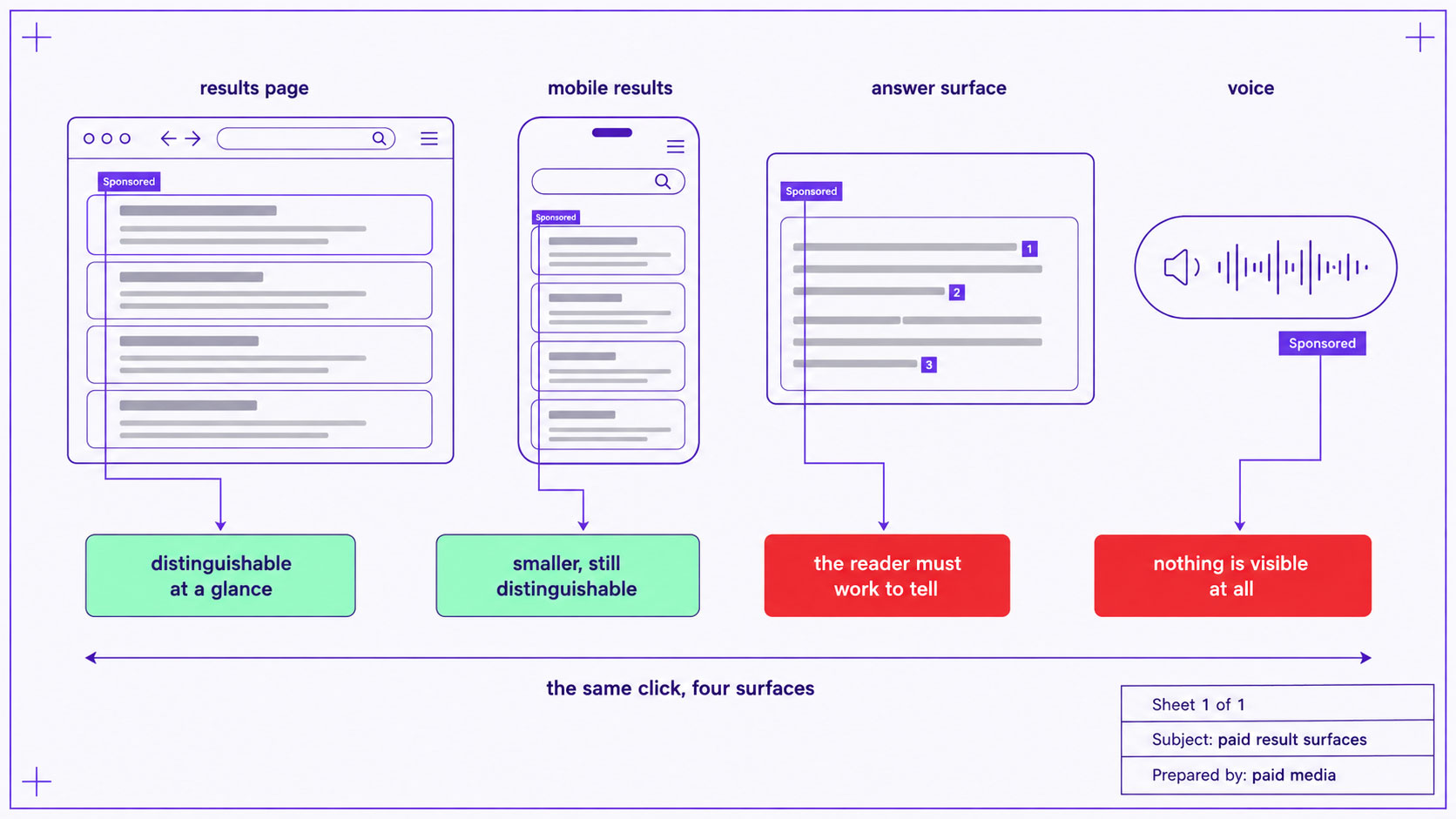
The same click now arrives from four different surfaces.
Paid search was designed for a page of ten blue links with ads above them. That page is now one surface among several, and the further you move from it, the harder it becomes for a person to tell what is paid. This is the part of search engine marketing that changed, and it is not a prediction — the concern is on the record and it is thirteen years old.
What the FTC said, and when
In June 2013 the Federal Trade Commission's consumer protection staff sent letters to search engine companies updating guidance first published in 2002. The letters noted that paid search results had become less distinguishable as advertising, and stated that failing to clearly and prominently distinguish advertising from natural search results could be a deceptive practice. They emphasized the need for visual cues and labels that are noticeable and understandable to consumers.
The part that matters for today is what the letters listed as the surfaces raising this concern: social media, mobile applications, voice assistants on mobile devices, and specialized search results integrated into general search results. That is a description of an answer surface, written in 2013. The principles of the original guidance, the staff noted, still apply even as search continues to evolve.
We are not claiming the FTC anticipated generative answers. We are pointing out that the underlying question — can an ordinary person tell what is paid — was identified as the durable one long before the current surfaces existed, and it travels with every new one. That is a more useful frame than treating each surface as a novelty, and it is checkable, which most claims about the future of search are not.
Practically, three things change for an advertiser as the surfaces multiply. Attribution gets harder, because a person may encounter you on a surface that reports nothing back and arrive later by another route entirely — which makes reconciliation against the business more important, not less. The destination carries more weight, because on a compressed surface there is less room to explain yourself before the click and more to prove after it on the page itself. And the query mix shifts, because people ask a synthesised answer different questions than they type into a results page.
None of that argues for abandoning what works. It argues for being able to say which surface your money reached, and for treating any agency that cannot answer that question with the same skepticism you would apply to one that cannot show you a search terms report. The surfaces are new. The obligation to account for the spend is not.
- Results page — the surface every convention was designed for
- Mobile results — same conventions, far less room to express them
- Answer surfaces — the response is synthesised and the labeling has less to attach to
- Voice — nothing visual survives at all
- Partner and automated inventory — placement decided by the platform rather than by you
- Your own destination — the one surface in this list you fully control
Account for it, correct it, then let automation compound it.
The order is the method, and it is the opposite of how most accounts are managed. Delegation to automated systems comes last, because delegating a bad signal produces a confidently wrong account faster than a human ever could.
Most accounts are managed in the reverse order — automation switched on early because it is the modern option, bids adjusted weekly because that feels like management, and the search terms report opened only when results disappoint. That sequence produces confident motion and very little correction, because the account is being tuned against data nobody has established is trustworthy — the same trap described on measurement.
Account for the spend first
- Every charged query pulled for the available history and classified
- Conversion tracking verified as live and counting something real
- Destination checked for message match against the queries actually arriving
- Findings reported including the lines that cannot yet be explained
Correct what the report shows
- Negative lists built from observed spend, applied at the right level
- Matching set deliberately per keyword rather than inherited
- Structure rebuilt where the account cannot report on itself clearly
- Ads and destinations aligned to the queries that survive
Then delegate, and keep checking
- Automated bidding introduced once the conversion signal is trustworthy
- Broader campaign types considered against what they can report
- Search terms reviewed on a standing cycle, not when something looks wrong
- Every reported result reconciled against work that reached the business
Six things that happen every month, whether or not anything looks wrong
Creative and bidding get the attention. This list is what actually separates an account that improves from one that plateaus, and none of it produces an impressive slide.
Each of these produces a finding rather than a deliverable, which is why they are the first things dropped when an account is priced on activity. They are also the reason an account that has been managed for two years should be materially cheaper to run than one that has been running for two years, and if it is not, something on this list has not been happening, which is what an A.R.C. Report is for.
Every charged query read and classified
Not sampled, not filtered to the top spenders. Every term the account was charged for, classified as intent, adjacent or excluded, with the exclusions applied and the reasoning recorded.
Conversion counting reconciled
A conversion in the platform is compared against something that reached the business — a call answered, a form that arrived, a job booked. Where the two disagree we report the gap rather than the larger number.
Related: what happens after the lead arrives.
Tracking verified as live
Tags are checked at deploy time and on a standing cycle, because a paused tag reports zero and reads exactly like a bad month. This is the highest-cost, lowest-effort failure in the discipline.
Related: detection over time.
Destination checked against the query
A click bought on a specific intent that lands on a general page is a click paid for twice — once to the platform and again in the visitor who leaves. Message match is a paid search cost, not a web design preference.
Related: landing page construction.
Policy exposure checked before launch
Restricted categories, claim substantiation and destination requirements are read against the campaign before it runs, because a disapproval discovered on launch day costs a week of the flight.
Source: Google Ads policies
Automation reviewed as a decision, not a setting
Each delegation to an automated system is recorded with what it was given to learn from and what it can report back, so a change in performance can be traced to a decision rather than attributed to the algorithm.
Source: Google Ads best practices
Geography checked against what you serve
Location settings decide which searches you compete for as surely as keywords do, and the defaults are broader than most operators expect. We check the geographic report against the territory you actually dispatch to, and we treat spend outside it as waste to be named rather than reach to be counted.
Related: the same service-area discipline runs through local visibility.
Structure built so the account can explain itself
An account grouped so that no report can separate one service from another cannot tell you which service is profitable. We build campaign and group structure around the questions you will need answered, not around what was quickest to launch, and we rebuild it where the inherited structure makes reporting impossible.
Paid search is one channel. These are the others, and each has its own page.
Search captures demand that already exists. The channels below create it, follow it, or reach it where search cannot. We run them under the same accounting discipline, and each has a page that goes into it properly rather than a paragraph here.
Every one of these pages was written the same way this one was: against the platform's own documentation or a published rule, with the failure nobody mentions named plainly, and with the parts we decline to sell stated rather than left out. If a channel below does not have a page yet, it is because we have not finished doing that work for it — the finished ones are listed under all services, not because it is unimportant.
We do not run these because a package includes them. Each is added when the demand picture says it should be, and each stays only while it can account for its own spend. A partner running paid search well and nothing else is in a better position than one running six channels nobody is reading the reports on — see how we assess the field.
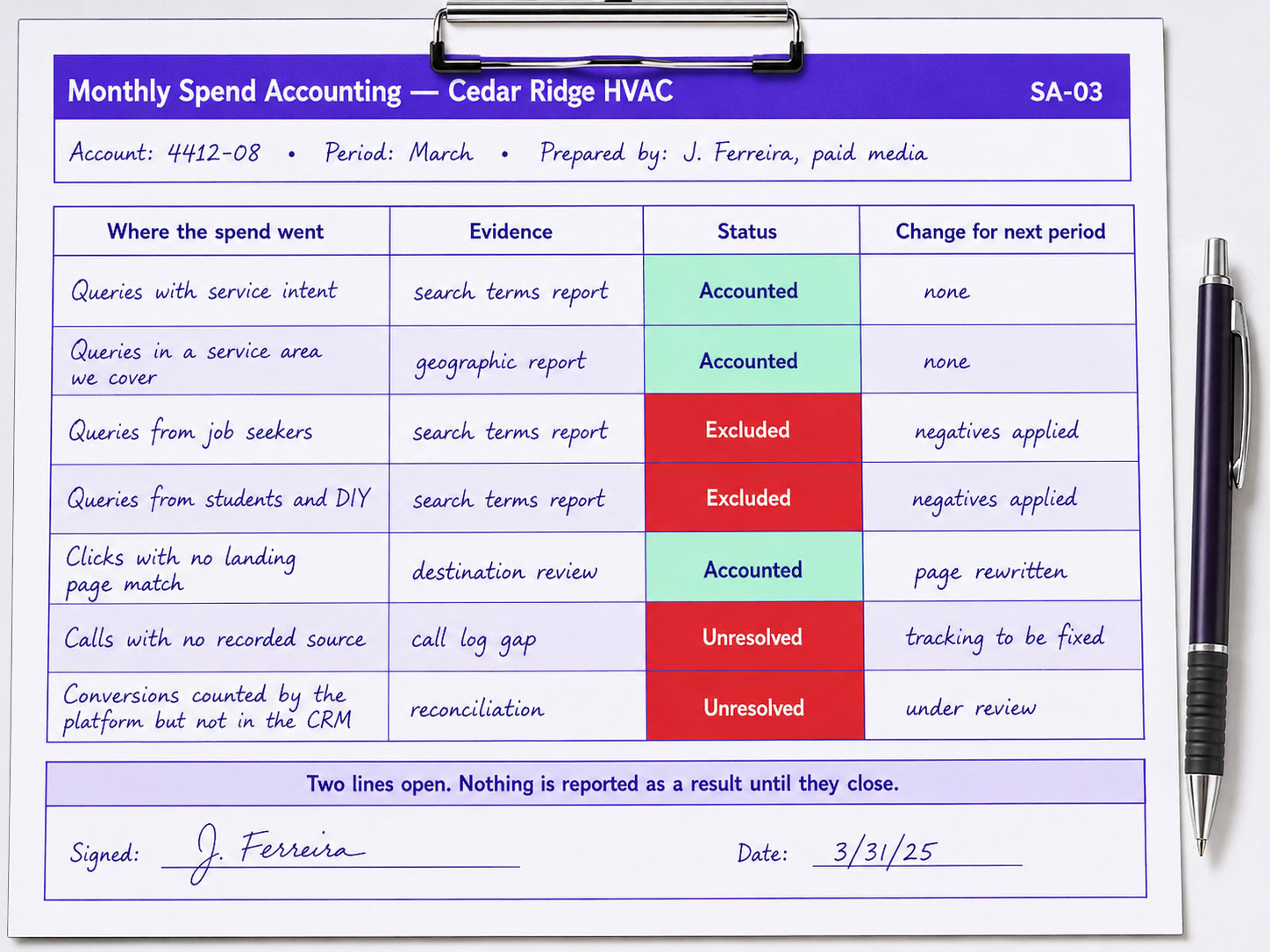
We report the spend we cannot yet explain.
Most paid search reporting is a selection of the platform's more flattering numbers. Ours includes the lines that are still open — the calls with no recorded source, the conversions the platform counted that nobody can find in the business. Those lines are the useful part of the report, because they are the only part that tells you what to fix.
We will also tell you when paid search is the wrong spend right now. If nobody answers the phone reliably, or the destination cannot convert the traffic it already gets, more clicks make the problem more expensive rather than less. That finding costs us the management fee and we report it anyway.
Paid search sits alongside organic search and the rest of the digital program, and the accounting discipline is the same across all of it.
The practical form this takes is unremarkable and it is the whole difference: we start every engagement by pulling what the previous arrangement actually bought, we tell you what we find including the parts that reflect badly on the effort so far, and we keep publishing the open lines until they close. Partners tend to describe that as transparency. We would call it the minimum standard for spending someone else's money on an auction they cannot see, and it is the same standard we hold on offline buys.
Not what performed well. Where the money went.
A report that only contains good news is not a report, it is a renewal document. The version below accounts for the whole budget, including the parts nobody has explained yet — and the open lines are the ones that make next month better.
| What gets reported | The usual monthly report | Accounted for What we send instead |
|---|---|---|
| Where the spend went | Total spend and clicks | Spend grouped by query category, with the excluded categories named |
| Conversions | The platform's count, reported as fact | The platform's count and what reached the business, with the difference stated |
| Calls | A total from the call tracking tool | Calls with a recorded source, and separately the ones without |
| Changes made | A summary of optimizations | Each change, what prompted it, and what it was expected to affect |
| Geography | Not reported separately | Spend inside and outside your service area, separated and named |
| Automation | Attributed to the algorithm | Each delegation recorded with what it learned from and what it can report |
| What is unresolved | Not reported | Listed by name, with an owner and a date, until it closes |
Two of those rows are the ones agencies resist. Separating geographic spend means showing money that went outside the service area, and recording each delegation to an automated system means the algorithm can no longer absorb the credit or the blame. Both are uncomfortable exactly once.
The last row is the one that changes a relationship. Any agency can produce the first four. Publishing what you cannot yet explain is uncomfortable for exactly one month, and after that it is the reason the account keeps improving instead of settling. There is a version of this that goes further and we run it where a partner wants it: every open line carries an owner and a date, and it stays on the report until it closes rather than quietly disappearing between months. It makes the report longer and it makes the relationship considerably shorter on argument, because there is nothing left to interpret, which is also how we run maintenance reporting.
Four paid search line items you can stop paying for.
One is a fee structure that rewards the wrong outcome. One is a number nobody can substantiate. One is work that produces a slide rather than a result. The fourth is a promise the auction cannot support.
Management priced purely as a percentage of ad spend. It is the industry norm and it aligns the agency's income with your budget rather than with your result. The agency that recommends spending less earns less for saying the true thing. We are not claiming everyone charging this way is acting badly — many do excellent work — but you should know which way the incentive points before you sign.
Industry benchmark figures. Cost per click, cost per lead and conversion rate benchmarks for your industry come from aggregated vendor panels of self-selected advertisers. They describe someone else's accounts, markets and offers. We publish none on this page, and a proposal that prices your campaign against one is pricing it against a stranger.
Optimization reported by volume. A monthly report listing dozens of changes is measuring activity. The number of changes made is not a result, and on a healthy account the right number in a given month is sometimes very small.
Guaranteed positions or guaranteed cost per lead. The auction runs per query, against competitors whose budgets and bids move independently of yours. Nobody controls the inputs required to guarantee an outcome in it. An agency offering a guarantee is either misunderstanding the mechanism or counting on you not to check it.
Accounts built in the agency's own structure. An account that lives inside a vendor's umbrella can leave when the relationship does, taking the conversion history and query data with it — and that history is what every automated system in the account learned from. Rebuilding it costs months of performance you already paid for. Ask where your account sits before you need the answer, and treat the reply as a straightforward operational question rather than a sensitive one, exactly as you would for the CRM.
The pattern beneath all five: the buyer is sold activity and volume when the thing worth buying is accounting.
- FTC — Staff updates guidance to the search engine industry on distinguishing advertisements from search results (June 2013)
- FTC — Advertising FAQs: A Guide for Small Business
- FTC — Advertising and marketing business guidance
- Google Ads Help — About the search terms report
- Google Ads Help — Basic tips for building a keyword list
- Google Ads Help — About Quality Score for Search campaigns
- Google Ads Help — Different ways to track conversions
- Google Ads Help — About Performance Max campaigns
- Google Ads Help — Google Ads policies
- Google Ads Help — Google Ads best practices
- Google Ads Help — About Google Ads
- Google Ads Help — Where your ads can appear
- Google Search Central — Keep a simple URL structure
- Google Search Central — Creating helpful, reliable, people-first content
Paid search and SEM, answered against the documentation
Every answer below links to the platform documentation or the regulatory source it rests on, so you can check it without taking our word for it.
What is the difference between PPC and SEM?
Search engine marketing is the broader discipline of earning visibility on search surfaces you pay for, and pay-per-click is the pricing model most of it runs on. In practice the terms are used interchangeably, and the more useful distinction is between paid and organic. Google's own overview describes the paid side; the unpaid side is covered on our SEO page. They answer the same query for the same person, which is why buying one badly makes the other work harder than it should.
Why am I paying for searches that have nothing to do with my business?
Because a keyword is an instruction about which auctions to enter, not a purchase order for one phrase, and how broadly that instruction is interpreted depends on how the keyword is matched. The search terms report shows the actual searches that triggered your ads. Pull it, read every line, and exclude what does not belong. The report is free and continuously updated — the only cost is somebody's attention, which is exactly why it goes unread. We apply the same "check the record" standard on directory listings.
Our agency says our Quality Score is good. Does that mean it is working?
Not on its own. Google describes Quality Score as a diagnostic estimated from historic performance rather than a score to optimize toward directly, and it says nothing about whether the queries you are winning are worth winning. An account can hold a healthy diagnostic while buying traffic that will never convert. Ask instead what share of last month's spend went to queries with purchase intent, and whether anyone can show you the list. That is a harder question and a more useful one, in the same way the questions on measurement are.
Should we let Google's automation run the account?
Eventually, and not first. Automated bidding and broader campaign types such as Performance Max optimize toward the conversions they observe, which makes signal quality the whole game. Delegate before the conversion tracking is trustworthy and the system will confidently pursue the wrong outcome, faster than a person would. Get the counting right, clean the query mix, then hand over — and keep checking what the automation can actually report back. The same "fix the input first" order applies to lead handling.
Can you guarantee a cost per lead or a top position?
No, and neither can anyone else. The auction runs per query against competitors whose bids and budgets change independently of yours, so the inputs required to guarantee an outcome are not held by any agency. Google documents where ads can appear and under what conditions, and none of it is a position you own. What can be committed to is method: every charged query accounted for, every reported conversion reconciled, and the open items published. We take the same line on guarantees in reputation work.
What is AI SEM, and is it different from what we are doing now?
It is the same discipline applied to more surfaces. A paid result now reaches people through a results page, a phone, an answer panel and a voice reply, and the conventions that make an ad recognizable were designed for the first of those. The Federal Trade Commission's staff raised exactly this in 2013, naming voice assistants and specialized results integrated into general results. What changes practically is that attribution gets harder and the destination matters more, because fewer surfaces let you explain yourself. That is why we start at the destination.
Our conversions look great but the phone is not busier. What is happening?
Usually the platform is counting something other than a customer. Google supports several conversion tracking methods, and it is easy to end up counting page views, partial form starts or duplicated events. The test is simple and rarely run: take last month's reported conversions and try to find them in the business — calls answered, forms received, jobs booked. Where the two numbers disagree, the smaller one is the real one. That reconciliation belongs with the system holding your leads.
How much should we be spending?
Less than you think until the account is accounted for, then as much as it can absorb profitably. Starting from a benchmark means starting from someone else's market and offer, which is why we publish none. Start instead from your capacity — the jobs you can actually service this month — and work backwards through what a booked job is worth to you. Google's best practices documentation covers the mechanics; the capacity question is a business one, and it is where our demand research starts.
Our ads keep getting disapproved. Why?
Almost always a policy the campaign was built without reading. Google Ads policies cover restricted categories, claim requirements and conditions on the destination page as well as the ad itself — so a disapproval is often about where the click lands rather than what the ad says. Read the relevant policy before launch rather than after, because a disapproval discovered on launch day costs a week of the flight. It is the same "constraints before creative" order we use on broadcast.
Is paid search worth it for a local service business?
Usually yes, and we will tell you when it is not. Paid search captures demand that already exists, which suits a business people go looking for when something breaks. It works badly when the phone is not answered reliably, when the destination cannot convert the traffic it already receives, or when capacity is the real constraint — in all three cases more clicks make the problem more expensive. Google's guidance on people-first content applies to the page the click lands on too. Start with an honest read of where your demand sits, which is what the A.R.C. Report is for.
How quickly should we expect paid search to work?
Traffic arrives the day it launches, which is the channel's genuine advantage and also what makes it easy to misread. The first two or three weeks are not performance, they are the account collecting the query data you will later act on, and the automated systems collecting the conversion data they will later optimize against. Judging an account before that data exists produces decisions made on noise. What should happen quickly is diagnosis: within days you should know which queries are being charged for and whether the conversion counting is real. What takes longer is the compounding, because every excluded query and every corrected signal improves the next month rather than this one. Google's best practices documentation covers the mechanics of the ramp. The slower, compounding side of the same demand is on our SEO page, and the two are usually worth running together rather than sequentially.
Should we bid on our own business name?
Usually yes, and the reason is not the one most agencies give. The common argument is that you would have got the click free from the organic listing, so the spend is wasted. That holds only if nobody else is bidding on your name and the surface still shows your organic listing prominently — two conditions that are less reliable than they were. Where a competitor is bidding on your brand, declining to appear hands them the moment of highest intent you will ever get. Where an answer surface compresses the page, your organic listing may not be where the reader is looking. Test it honestly: pause brand terms for a defined period and compare total booked work rather than paid conversions alone, because the number that matters is the one that reaches the business. That reconciliation habit is described on our CRM page, and Google documents where ads can appear across those surfaces.
A competitor is bidding on our business name. Can we stop them?
Partly, and the distinction matters. Google's trademark policy treats the use of a trademark in ad text differently from its use as a keyword, and it sets out a complaint process for trademark owners. So the realistic outcome is usually about what a competitor may write, not about whether they may compete for the query. Practically, the stronger response is defensive rather than procedural: hold your own brand terms, make sure the destination for them is your best page rather than your homepage by default, and check what a person actually sees on the query — which is often different from what an agency assumes. If you hold a registered mark, the complaint route is worth using; if you do not, the auction is the only lever. Watching what competitors claim is covered on our competitor analysis page.
Who owns the Google Ads account, us or the agency?
You should, and it is worth checking before you need the answer. An account built inside an agency's own structure can leave with the agency, taking the conversion history and the query data with it — and that history is the asset, because it is what every automated system in the account learned from. Rebuilding it costs months of performance you already paid for. The test is simple: ask whether the account exists under your own billing and administrative access, with the agency granted access rather than owning it. Do the same for the conversion tracking and call tracking configuration. Google's policies documentation covers the account requirements themselves. We build in the partner's account as a matter of course, which is the same position we take on data in the CRM — if it describes your business, it should be yours to keep.
How should we handle a seasonal business in paid search?
By deciding in advance what happens in the trough, and by protecting the learning through it. Turning an account off entirely between seasons saves the budget and costs the signal — automated bidding loses the recency of what it was learning from, and the restart is slower than the shutdown was cheap. Running it flat through a season with no demand spends money on queries nobody is making. The middle position is a reduced always-on presence on the terms that still convert out of season, with the seasonal terms scheduled against actual demand rather than the calendar. What makes that possible is knowing which queries carry intent in which month, which comes back to the search terms report read across a full year rather than a month. Where the demand actually sits, and when, is a research question before it is a bidding one.
Find out what your account is actually buying.
The A.R.C. Report covers your whole marketing position, and where paid search is in the plan we pull every charged query for the available history, check whether the conversion counting corresponds to anything that reached the business, and tell you what share of the spend went somewhere a customer would never have searched from. Findings are yours whether or not we work together.
- Every charged query pulled and classified, not sampled
- Conversion tracking verified as live and counting something real
- Reported conversions reconciled against work that reached the business
- Destination checked for message match against the queries arriving
- Automation reviewed against the signal it was given to learn from
- A straight answer if the spend should be somewhere else right now
Explore the wider program: all services, SEO, display, local services ads and the A.R.C. Report.
Tell us the account and the markets you compete in, and we will tell you what the spend is buying before you change anything.
No cost, no commitment. We will follow up by email or phone to walk you through the findings.


