
You bought a schedule.
Can you prove it ran?
Broadcast spots move dayparts, get preempted, and occasionally never air at all. The station knows exactly what happened and will tell you in writing if you ask. Most advertisers never ask, so the flight ends with an invoice, a verbal assurance, and no record of what was actually delivered.
Built for home services contractors, franchise systems and private equity portfolios buying broadcast, print, out-of-home and streaming in the markets they actually serve.
Traditional media runs inside an AI-first program here. Every flight is judged on measurable lift — branded search, direct calls, form volume against flight windows, and whether AI assistants begin naming you locally — rather than on delivered impressions.
Traditional media works for contractors, and it works for a reason worth stating. In a defined service area, repeated presence across radio, print, out-of-home and streaming makes you the company a homeowner already recognizes at the moment of a large, infrequent decision. We buy for single-location contractors, franchise systems and private equity portfolios — and unlike a traditional buying shop we tie every flight to measurable lift and report the markets that are not carrying their spend.
The Gap Nobody MeasuresWhat you bought and what ran are two different documents.
Every broadcast schedule drifts. Spots move to a different daypart, get preempted by breaking coverage, or fail to air. None of that is misconduct — it is how the medium works. The failure is having no record of it.
Traditional media still works for contractors, and it works for a reason worth stating plainly. In a defined service area, repeated presence across radio, print, out-of-home and streaming makes you the company a homeowner already recognizes when the system fails — which is worth more than a click at the moment of a large, infrequent decision. Where we differ from a traditional buying shop is that we tie every flight to measurable lift, and the regulatory detail below matters only because it decides whether a buy is honored as sold.
And traditional media is measurable now, which is what makes it worth buying again. As an AI-first agency we watch what a flight actually moves — branded search in the market, direct calls, form volume against flight windows, and whether AI assistants and search engines begin naming you locally. A flight that produces no lift in any of those did not build awareness; it bought impressions nobody can trace.
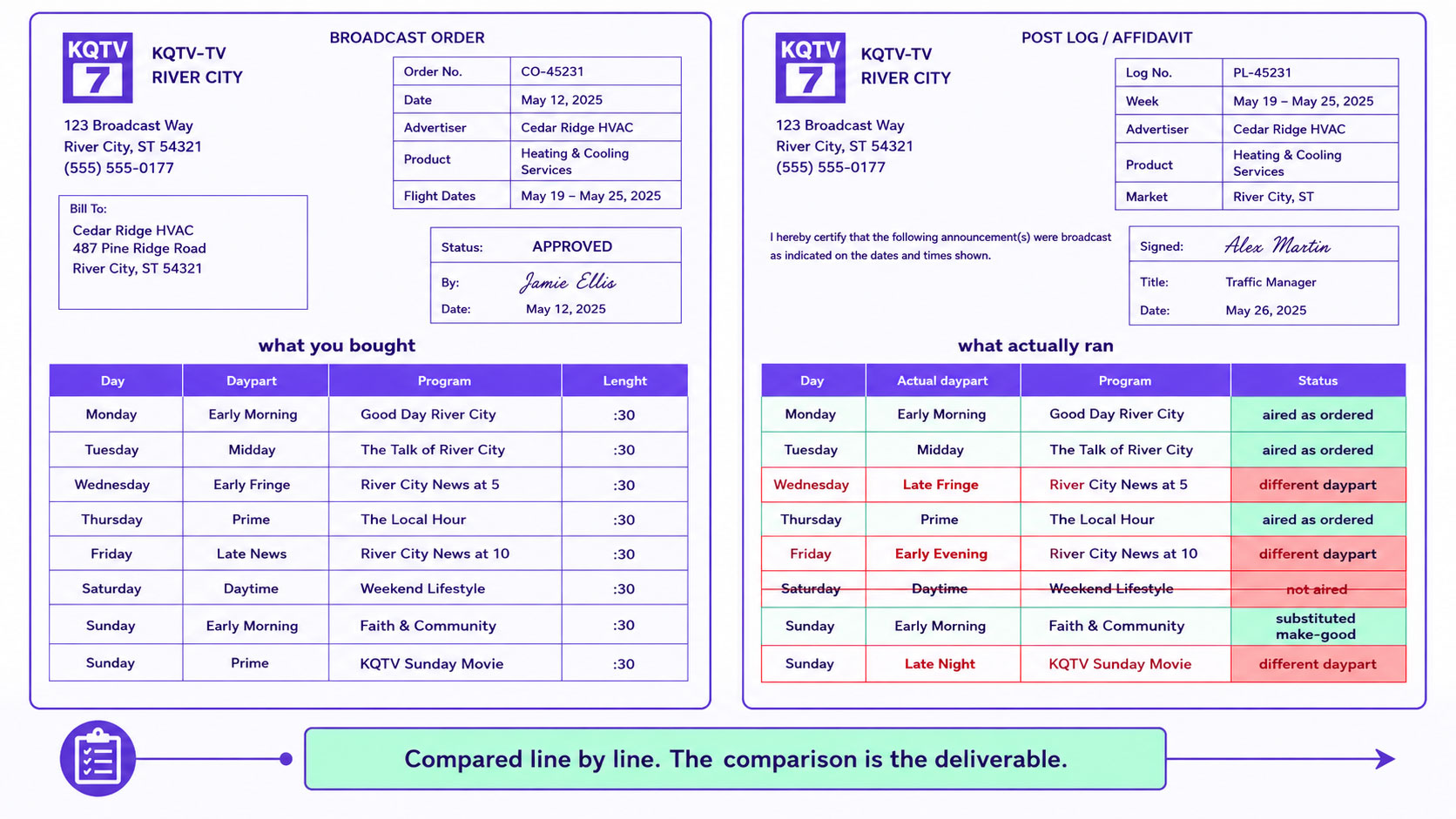
An approved order says eight spots across a week, with daypart, program and length on every line. The station's post-log says what actually happened to each of them. Comparing the two line by line is the entire discipline, and it is the step that separates a media buy from a media purchase.
Drift is normal and mostly benign. A spot bumped from an evening daypart into overnight is not fraud; it is inventory management. But you paid for the evening daypart, and whether you receive a credit, a make-good in comparable time, or nothing at all depends on a document nobody requested.
The station has this information. It has to. Broadcast licensees are required to maintain an online public inspection file under 47 C.F.R. 73.3526, and the records themselves sit at publicfiles.fcc.gov. Record-keeping is not something a station does as a courtesy to advertisers.
So the question on any broadcast buy is not whether the record exists. It is whether anyone on your side asked for it, and whether anyone compared it to the order — the same detection discipline we apply in website maintenance, where the expensive failures are the ones that produce no alert.
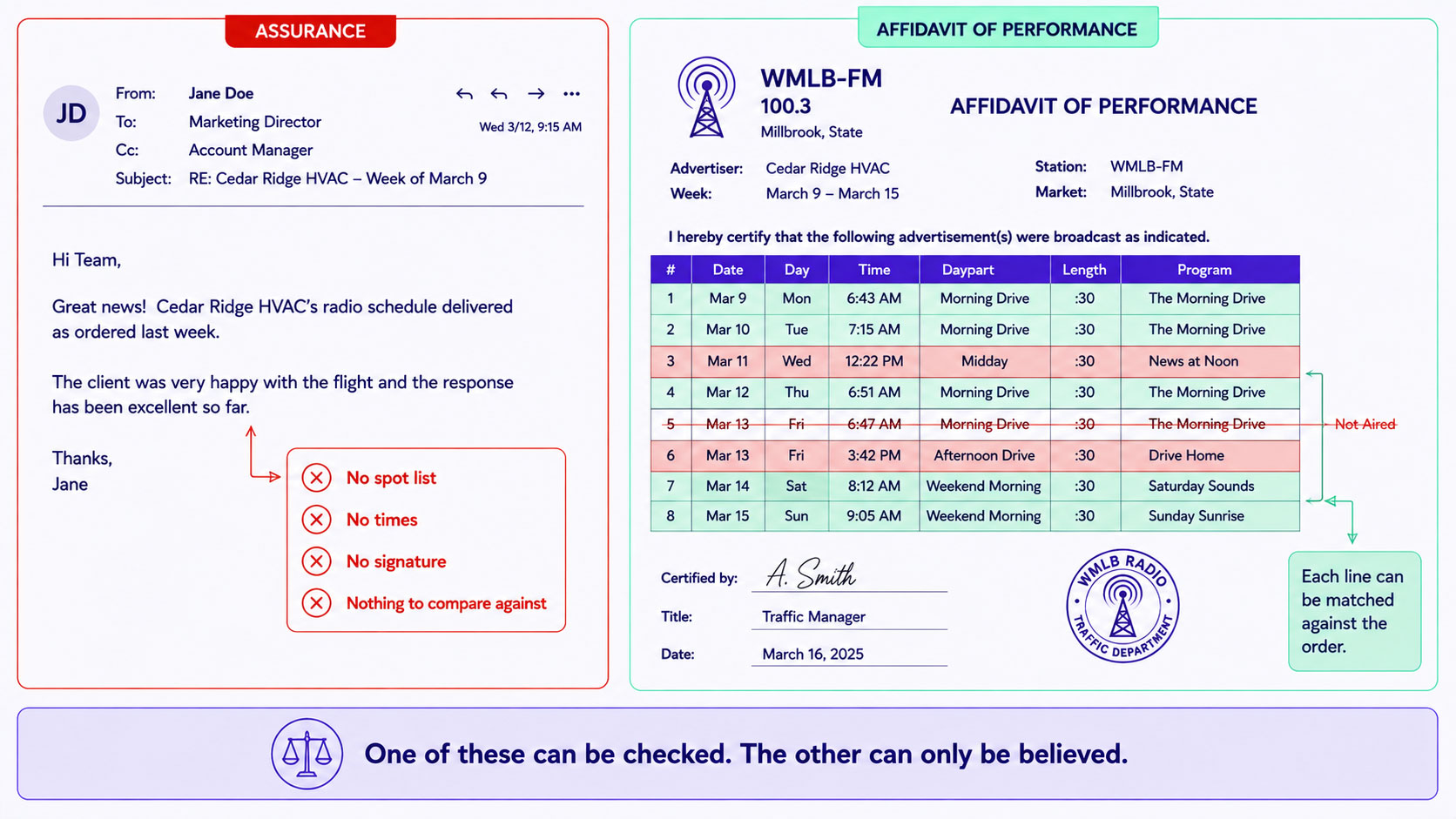
One of these can be checked. The other can only be believed.
Both arrive at the end of a flight, both sound like confirmation, and only one of them lets you do anything.
"The schedule delivered as ordered"
- What it contains. A sentence, usually in an email, usually from the person who sold you the buy.
- No spot list. Nothing to match against the order line by line.
- No times. A daypart claim with no timestamps behind it cannot be tested.
- No preemption record. A spot that never aired and a spot that aired late look identical from here.
- What it lets you do. Nothing. There is no basis for a credit request and no basis for pricing the next buy.
A signed record, spot by spot
- What it contains. Each spot with its date, time, length and program, on station letterhead with a signature.
- Matchable. Every line can be set against the corresponding line on your order.
- Preemptions visible. Missing spots show as missing rather than disappearing into a total.
- Make-goods traceable. A substituted spot appears as a substitution, so you can judge whether the replacement was comparable.
- What it lets you do. Request a credit with evidence, and price the next flight on what was delivered rather than on what was ordered.
Three of these you can ask for. One you can read without asking anybody.
A broadcast buy generates a paper trail whether or not anyone collects it. These are the four documents that decide whether the money can be judged.
Daypart, program, spot length and rate per line — specific enough that a post-log can be compared against it. An order stating a weekly total with no line detail cannot be reconciled against anything.
- Affidavit of performance required at flight end
- Preemption handling stated — credit or make-good, and in what class of time
- Make-good comparability defined rather than left to the station
Written into the order it is routine. Requested after a weak month it reads as a dispute, and the conversation changes. The document is the same either way; the ease of getting it is not.
- Match every line against the order — not the totals
- Flag daypart substitutions, not just missing spots
- Keep it with the invoice; the two answer different questions
A post-log filed without being compared to the order is filing, not reconciliation. The value is entirely in the diff — which lines moved, which vanished, and what was substituted for them.
- A credit request supported by evidence rather than by tone
- A real delivered cost per daypart for the next negotiation
- A record of which stations drift and which do not
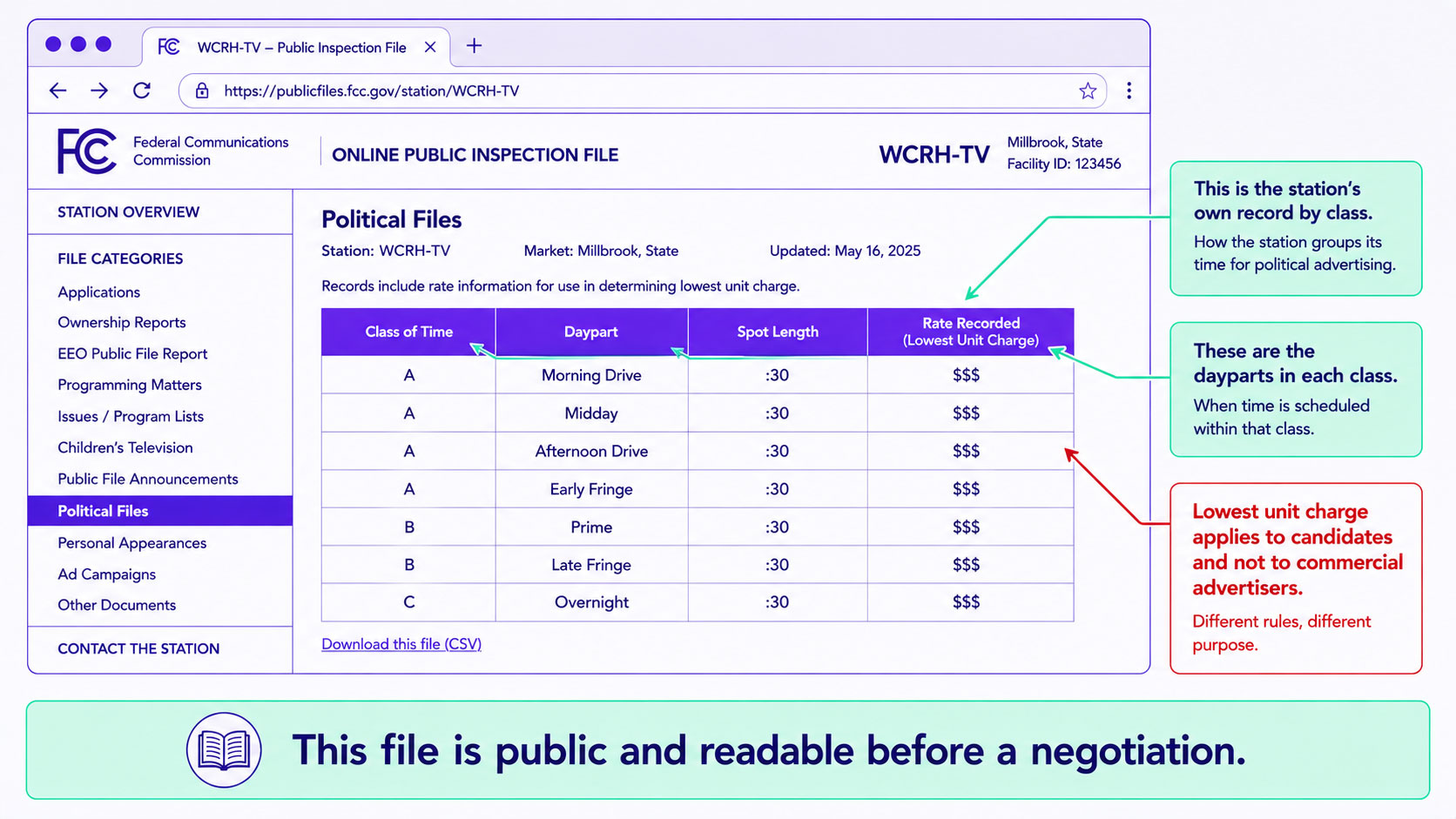
Broadcast licensees maintain an online public inspection file under 47 C.F.R. 73.3526, including the political records required by 73.1943. It is at publicfiles.fcc.gov.
- It documents rates charged by class of time
- Lowest unit charge protects candidates, not commercial buyers
- You are reading context for a negotiation, not claiming an entitlement
A station's own rate records are open before you negotiate.
This is the most useful document in broadcast buying and the least used. It is free, it requires no relationship, and no agency media-buying page mentions it.
What it is, and exactly what it is not
Broadcast licensees are required to maintain an online public inspection file. Inside it, the political file records the rates charged for political advertising by class of time. That is a record of what the station itself charged, published by requirement rather than by choice.
- Where it lives. The FCC hosts it at publicfiles.fcc.gov, searchable by station. No account, no request, no relationship required.
- What obliges it. 47 C.F.R. 73.3526 requires the file; 73.1943 requires the political records inside it.
- What it shows. Rates by class of time and daypart — the station's own floor for that inventory, in its own records.
- The limit, stated plainly. 47 U.S.C. 315(b) gives candidates the lowest unit charge for the same class and amount of time in defined pre-election windows. That entitlement is not available to a commercial advertiser, and any agency implying otherwise is misreading the statute.
- Why it still matters to you. Knowing what a station has charged for a daypart changes what you can reasonably ask for. It is context, not leverage by right.
- Cable and satellite too. 47 C.F.R. 76.1701 imposes political file requirements on cable systems.
Six rules every flight runs to — and why each one exists.
Four are documentary and two are measurement. None of them is a negotiation tactic; all six are things that either happen before the money moves or do not happen at all.
Affidavit written into the order
The requirement goes in the order document, not into an email at flight end.
Why: requested up front it is routine paperwork. Requested afterwards it reads as a dispute, and that is exactly when it becomes hard to obtain.
Reconciled line by line
Every spot on the affidavit matched against its line on the order — dayparts included, not just counts.
Why: totals hide substitutions. A week that delivered the right number of spots in the wrong dayparts reconciles perfectly at the total level.
Public file read before negotiating
The station's public inspection file checked for rate context by class of time, before a rate is discussed.
Why: it costs nothing and it is the only independent record of that station's own pricing. Read as context, never claimed as entitlement.
Preemption terms agreed in writing
What happens when a spot is preempted — credit, or make-good in a comparable class — stated before the flight.
Why: preemption is normal. Without a written rule, the remedy is whatever the station offers after the fact.
Measurement designed before launch
Matched markets or a holdout, unique numbers and URLs per station or daypart, and an agreed pre and post window.
Why: attribution assembled after a flight is a story fitted to a result. Design sits under traditional marketing.
Delivered cost, not ordered cost
The next buy is priced on what was actually delivered, per daypart, from the reconciliation.
Why: buying against the ordered schedule repeats last flight's drift at last flight's price. Conversions defined per Google's documentation so the response side agrees.
We reconcile the flight even when it went well.
We buy for single-location contractors and for national franchise systems and private equity portfolios. One market or fifty, the reconciliation discipline is identical — and at portfolio scale it is the only way to know which markets are actually carrying the spend.
Reconciliation gets treated as a dispute process — something you do when a campaign underperformed and somebody wants an explanation. That is backwards. A flight that delivered exactly as ordered is the one worth documenting, because it establishes what that station's inventory actually does.
The comparison is the deliverable, not the invoice. Line by line, dayparts included, with substitutions flagged as substitutions. It takes an afternoon and it is the only way the next buy gets priced on delivered cost rather than ordered cost.
The other half is uncomfortable to say to a prospect: the previous version of this page carried no citations at all, and its meta description began with the words "Coming soon!" in production. We are rebuilding it on the FCC's own record-keeping rules because that is what a page about media buying should have been built on to begin with.
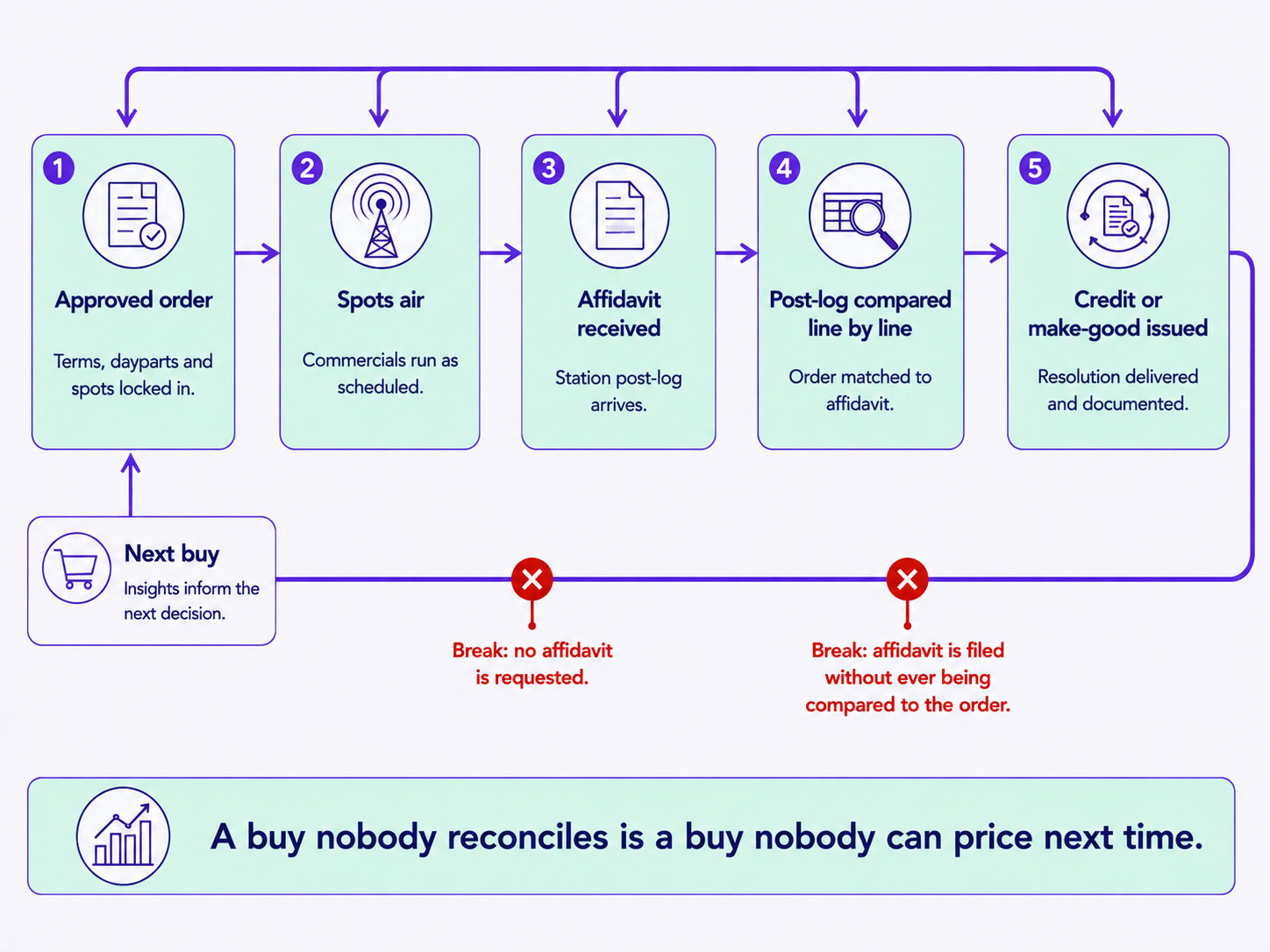
Two points where a buy quietly stops being verifiable.
Not a competitor teardown — a description of where the practices differ, so the choice can be made on substance.
| Practice | Standard media buying retainer | AllegiantOMNIVIZ™ |
|---|---|---|
| Affidavit of performance | Requested if something looks wrong | Written into the order before the flight |
| Post-log | Filed, not compared | Compared line by line, dayparts included |
| Preemptions | Handled by whatever is offered | Credit or comparable make-good, agreed in writing first |
| Rate context | The rep's rate card | The station's own public file records, read first |
| Lowest unit charge | Implied to apply to you | Stated plainly: it protects candidates, not commercial buyers |
| Next buy priced on | The ordered schedule | The delivered schedule, per daypart |
| A flight that went well | Not reconciled | Reconciled anyway — that is where the baseline comes from |
Four media buying line items you can stop paying for.
Two are numbers nobody can substantiate. One is a legal claim that is simply wrong. The fourth is real work with the verification step removed.
A buy with no affidavit requirement. The station keeps the record either way. Not asking for it is the whole failure — you end the flight with an invoice and a feeling, and the next negotiation starts from the ordered schedule rather than the delivered one.
"We'll get you the lowest unit rate." This is not a negotiating claim, it is a misstatement of law. 47 U.S.C. 315(b) gives the lowest unit charge to candidates, for the same class and amount of time, in defined windows before an election. A commercial advertiser has no such entitlement, and an agency promising one either has not read the statute or is counting on you not having read it.
Ratings estimates carried into results as delivery. Audience figures are modeled from panels and surveys. They are a legitimate planning input and they are not a count of who saw your spot. A planning estimate reproduced in a post-campaign report as delivered audience is an estimate wearing a measurement's clothes.
Broadcast sold on awareness with no measurement design. Awareness is a real objective and it is not a substitute for a design. Without matched markets, a holdout, or unique response paths agreed before launch, there is nothing to read afterwards — and the flight gets judged on a number reconstructed to fit whatever happened.
The pattern beneath all four: the buyer ends up with no independent record of what was delivered.
- 47 U.S.C. 315 — Candidates for public office (Legal Information Institute)
- 47 C.F.R. 73.3526 — Online public inspection file (eCFR)
- 47 C.F.R. 73.1943 — Political file (eCFR)
- 47 C.F.R. 73.1940 — Legally qualified candidates for public office (eCFR)
- 47 C.F.R. 76.1701 — Political file, cable systems (eCFR)
- FCC — Online Public Inspection Files
- 47 C.F.R. Part 73 — Radio Broadcast Services (eCFR)
- Google Analytics Help — About conversions
- Google Search Central — Evaluating third-party SEO advice
Media buying, answered against the source.
Answered against primary sources where they exist, and answered honestly where they do not.
How do we know our spots actually ran?
Ask for an affidavit of performance, and put the requirement in the order rather than requesting it at flight end. It lists each spot with date, time, length and program on station letterhead, which means every line can be matched against the corresponding line on your order. The comparison is the point — a post-log filed without being compared is filing, not reconciliation. Stations keep this information because record-keeping is a license obligation under 47 C.F.R. 73.3526, not a courtesy. Related: traditional marketing.
Can we see what a station charges other advertisers?
Partly, and it is public. Broadcast licensees maintain an online public inspection file under 47 C.F.R. 73.3526, and the political file required by 73.1943 records rates charged by class of time. It is searchable by station at publicfiles.fcc.gov with no account and no relationship needed. It shows political rates rather than every commercial rate, so read it as context for a negotiation rather than as a price list. See competitor analysis on verifying at the source.
Can we get the lowest unit rate?
No, and an agency promising it has misread the statute. 47 U.S.C. 315(b) entitles legally qualified candidates to the lowest unit charge for the same class and amount of time, within defined windows before a primary or general election. Commercial advertisers have no such entitlement. What the provision does give you is visibility: the resulting records document what that station charged by class of time, which is useful context you would not otherwise have. Candidate qualification itself is defined at 47 C.F.R. 73.1940. This is general information, not legal advice. Related: billboards.
What happens when a spot gets preempted?
Whatever your order says happens — which is why the term belongs in the order. Preemption is normal in broadcast: breaking coverage, a schedule change, a higher-paying buyer taking the inventory. The question is whether you receive a credit or a make-good, and if a make-good, in what class of time. Without a written rule the remedy is whatever the station offers afterwards, and a make-good in a materially weaker daypart is not equivalent value. The affidavit is what lets you see it happened at all, and the station's own logs sit behind the file required by 47 C.F.R. 73.3526. Related: CRM for keeping the record attached to the account.
What ratings or audience numbers should we expect?
We do not quote them, and there are none anywhere on this page. Broadcast audience figures are modeled from panels and surveys rather than counted, and no issuing authority publishes benchmarks for the medium. A modeled figure is a reasonable planning input; carried into a post-campaign report as delivered audience it becomes a claim you cannot support. Google's guidance on evaluating third-party claims makes the same point in a different market. The measurable half is response, not reach — see conversion rate optimization.
Does any of this apply to cable and streaming?
Partly. Cable systems carry their own political file obligation under 47 C.F.R. 76.1701, so the same public-record logic applies there. Streaming and connected TV sit outside the broadcast licensing framework entirely, which means there is no equivalent public file and no equivalent affidavit convention — verification has to be built into the contract rather than assumed from a regulatory obligation. That is a real difference in buyer protection between two things often sold as one line item. Related: traditional marketing.
How should broadcast performance be measured?
By designing it before the flight rather than reconstructing it afterwards. Matched markets or a holdout geography, unique phone numbers and web addresses per station or daypart, and an agreed window before and after. Conversions should be defined per Google's conversion documentation so the offline and online halves agree on what counts. The reconciliation feeds this directly: without knowing which spots actually ran in which dayparts, you are correlating response against a schedule that did not happen. See landing pages for the tracked-number mechanics.
Should we reconcile a flight that performed well?
Especially then. Reconciliation is treated as a dispute process, which is backwards — a flight that delivered as ordered is the one that establishes what that station's inventory actually does, and gives you a real delivered cost per daypart for the next negotiation. Skipping it because nothing went wrong means the next buy is priced on the ordered schedule again. It is the same principle as running standing checks on a site that appears healthy, which is covered under website maintenance, and it rests on records stations keep under 47 C.F.R. Part 73.
Is media buying worth it for a local service business?
Sometimes, and we will tell you when it is not. Broadcast reaches a whole market, so a business that can only service part of that market pays for coverage it cannot use and fields calls it has to turn down. It is also close to unmeasurable at low budget without a designed holdout. Where it earns its place is a business whose service area roughly matches a station's footprint, running long enough for frequency to matter, with the response side properly instrumented. Coverage questions belong with market research, which sources area data from the American Community Survey.
What should be in the order document itself?
Enough line detail that a post-log can be compared against it — daypart, program, spot length and rate per line, not a weekly total. Then three clauses most orders lack: an affidavit of performance required at flight end, preemption handling stated as credit or make-good with the class of time specified, and make-good comparability defined rather than left to the station's discretion. An order stating only a total and a flight window cannot be reconciled against anything, which is usually why it was written that way. The verification records themselves live in the station's public inspection file. Related: competitor analysis on findings you can re-check.
Find out whether your last flight can still be verified.
The A.R.C. Report covers your whole marketing position, and where broadcast is in the plan we check the documentary side — whether affidavits were obtained, whether anyone compared them to the order, and whether the measurement design can support the claim you will want to make afterwards. Findings are yours whether or not we work together.
- Whether affidavits of performance were requested and received
- Order line detail — is the buy reconcilable at all
- Post-log compared to order, dayparts included
- Preemption and make-good terms as written
- Public file rate context for the stations in the plan
- Measurement design — holdout, tracked numbers, agreed windows
Explore the wider program: all services, traditional marketing, billboards, local SEO, conversion rate optimization and the A.R.C. Report.
Tell us which markets and stations are in the plan and we will show you what the documentary side of the buy looks like.
No cost, no commitment. We will follow up by email or phone to walk you through the findings.

