
Almost everything in a competitor report
was estimated, not measured.
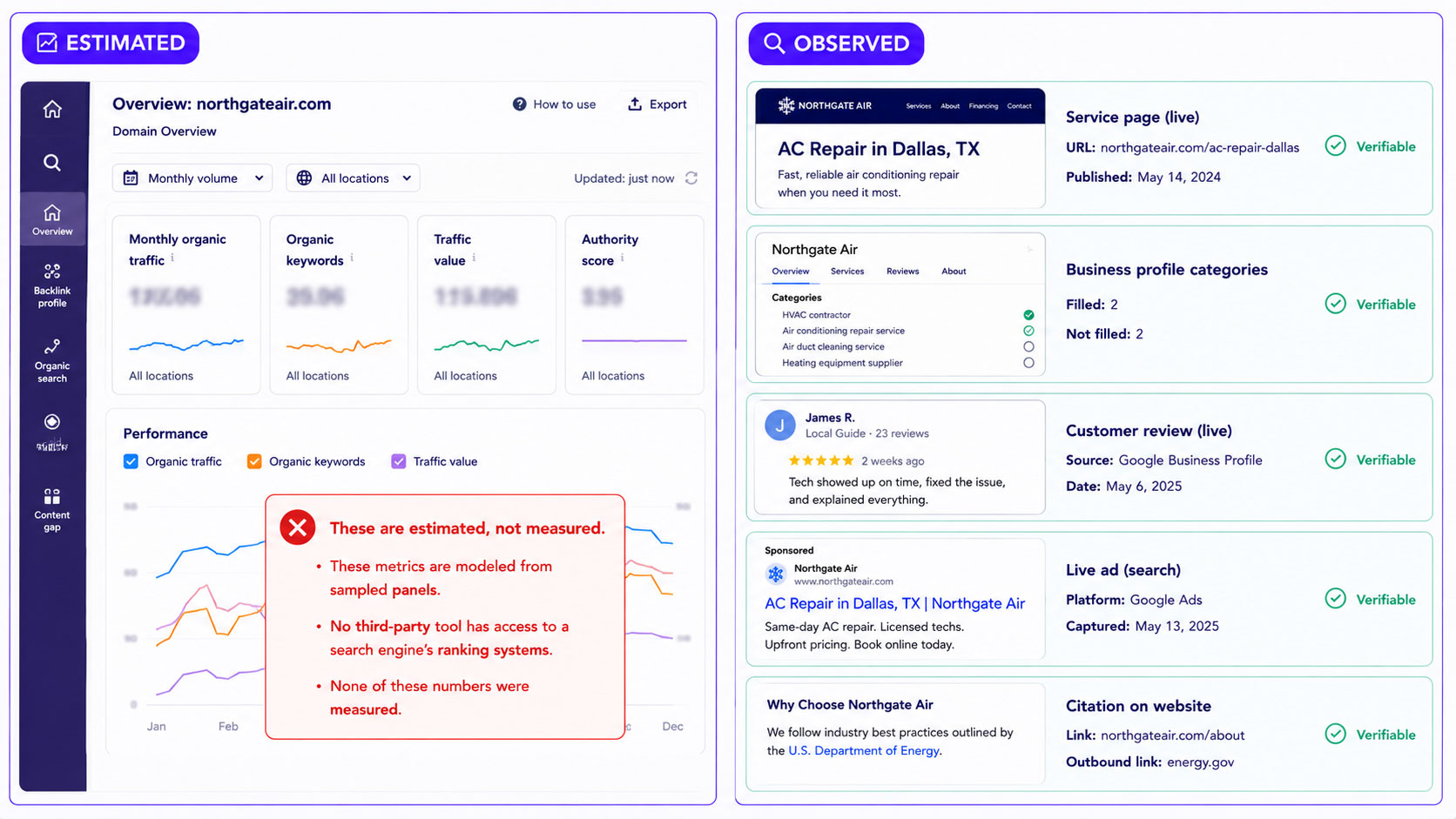
The traffic figures, the keyword counts, the authority scores — all modeled from sampled panels by companies with no access to the systems they are describing. Google says so directly. Meanwhile the things you can actually verify about a competitor go unread, because reading them takes longer than exporting a dashboard.
Built for home services contractors, franchise systems, private equity portfolios and mid-market operators who want to know exactly why the company down the road is getting the calls.
Estimated is not measured. A report that blurs the two is not evidence.
This is the whole discipline, and it is the reason most competitor decks lead to bad decisions. Two categories of finding get presented identically, and only one of them can be checked.
And competitive analysis now has a second front. As an AI-first agency we check which businesses ChatGPT, Google AI Overviews, Perplexity and Gemini name when asked about your category in your market — because that answer increasingly decides who gets shortlisted before a search ever happens. A competitor who outranks you but is never cited by an AI assistant is a different threat from one who is named every time.
Start with what Google says about the tools. Its guidance on evaluating third-party SEO advice is explicit that no external party has access to its internal ranking systems, and that scores and metrics invented by tool vendors are not Google's. That is not an attack on the tools — it is a statement about what they can and cannot know.
So when a competitor report tells you a rival receives a particular volume of monthly organic traffic, that number was inferred from a sampled panel and a model. It may be directionally useful. It is not a measurement, and no amount of decimal places makes it one. The same applies to keyword volumes, difficulty scores, traffic value and every proprietary authority metric in circulation.
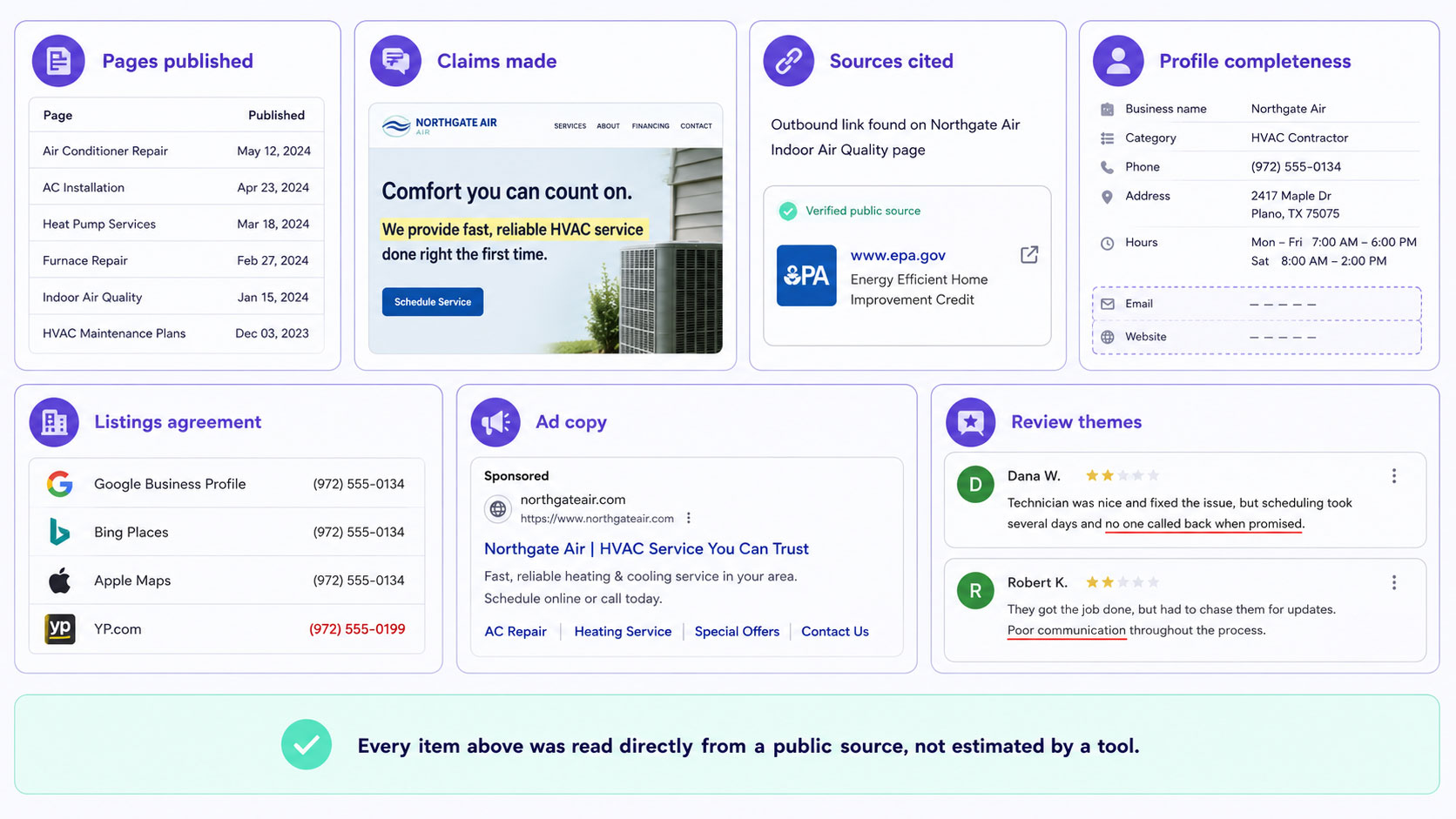
Now look at what nobody bothers to read, all of which is sitting in public. Every page a competitor has published and when. Every claim on those pages, most of which can be checked against a licensing body or a business registry. Every source they cite, if any. Whether their business profile is complete. Whether their listings agree with each other. What their ads actually say. What their reviews say about how they operate.
That material is slower to gather and it is evidence. Our reports separate the two categories explicitly and label every estimate as an estimate — the same discipline we apply to claims about your own business, and the reason we can hand you a finding you are able to check yourself. Related discipline: content writing.
Their marketing claims are checkable. Almost nobody checks them.
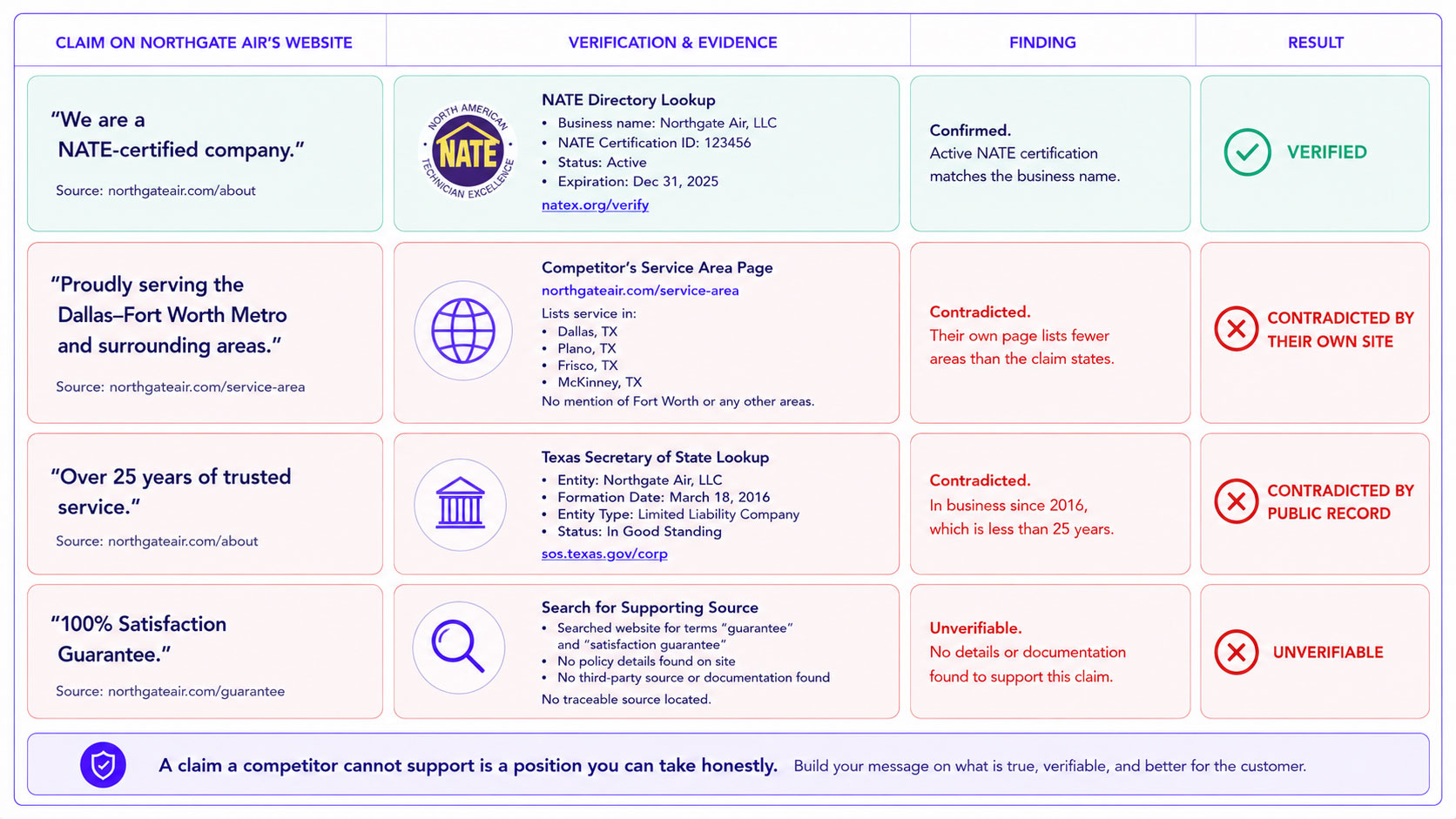
A competitor's own website is the richest evidence source available and the least examined. Every objective claim on it is either supportable, unsupportable, or contradicted somewhere else on the same site.
A dashboard export with commentary
- Estimated traffic, stated as traffic. No label distinguishing the model from a measurement.
- Keyword gap lists. Hundreds of rows, no indication which ones a buyer would actually search before hiring.
- A vendor authority score. Presented as though a search engine assigns it.
- Nobody read their site. Their claims, their sources and their contradictions go unexamined.
- Every finding framed as an instruction. They do X, therefore you should do X.
- Not reproducible. You cannot check any of it yourself.
Findings you can verify without us
- Claims checked against registries. Certifications against the issuing body, years in business against the registration record.
- Internal contradictions surfaced. A service-area claim that their own service-area page does not support.
- Sources followed. What they cite, whether it says what they say it says, and whether they cite anything at all.
- Gaps stated as questions, not keywords. The question a buyer asks that nobody in the market answers.
- Estimates labeled as estimates. Kept, used, and never dressed as measurement.
- Every finding cited. A link, a date, and what was found — so you can repeat the check.
Three questions worth the work. Everything else is a keyword list.
Competitor analysis fails when it has no question attached. Given a question, the same evidence becomes a decision — and these are the three that justify the exercise.
What is unanswered?
Not "which keywords do they rank for that we do not." That produces a list nobody acts on. The useful version is: what does a buyer need to know before hiring, that nobody in this market has written down properly?
- Questions appearing in competitor reviews and comment threads
- Objections your own team answers on the phone every week
- Topics every competitor covers at surface level and none covers well
- Turned into pages per content strategy, written per content writing
Where are they exposed?
Not a campaign against them. The FTC's advertising guidance requires objective claims to be substantiated — by them and equally by you. Finding a claim they cannot support tells you where to make a claim you can, and to document it.
- Certifications against the issuing body's own directory
- Years in business against the public registration record
- Service-area claims against their own service-area page
- Review-related claims against the FTC's reviews rule
What are they doing that works?
A competitor's tactic worked for their offer, their cost base and their buyers. You can see the tactic and none of the three conditions behind it. Copying the visible half of something whose invisible half you cannot see is how budget disappears.
- Does this reflect a business model we share, or one we do not?
- Can we see enough to know whether it is working, or only that it exists?
- Is the finding a documented fact or an estimate?
- Would we do this if they were not doing it? If not, it is not strategy
Seven things about a competitor you can read rather than estimate.
None of this requires a tool subscription. All of it requires someone to actually look, which is why it rarely appears in a competitor report and why it is worth more than what does.
The observable inventory
Every item below is a public fact with a URL and a date attached, which means you can repeat the check yourself and challenge us if we got it wrong.
- Pages published, with dates. What they have written and when tells you where they are investing and what they have abandoned. Publish dates are usually visible in the page or its markup.
- Claims made. Every objective statement on their site, checked against the body that would know — a licensing authority, a registry, or their own other pages.
- Sources cited. Whether they cite anything, whether the source says what they claim, and whether it is current. Most cite nothing at all.
- Profile completeness. Which fields on their business profile are filled and which are empty, per what Google documents as required.
- Listings agreement. Whether the same name, address and phone appear consistently across directories, or whether one of them contradicts the rest — see directory optimization.
- Live ad copy. What they actually promise in paid results, which is where a business states its offer most plainly.
- Review themes. Not the rating — the recurring complaint. Two reviews naming the same operational failure is a finding about how they run, not how they market.
Six rules every teardown runs to — and why each one exists.
Three protect the evidence, two protect you from acting on the wrong finding, and one protects you from us.
Estimates labeled as estimates
Modeled figures are kept and used, and they carry the word estimate every time they appear.
Why: Google states that no third party has access to its ranking systems. An unlabeled estimate is a claim we cannot support.
Every finding carries its source
A URL, a date, and what was found — so any finding can be re-checked without us.
Why: a competitive finding you cannot verify is a finding you are trusting rather than using. It also means you can catch our mistakes.
Claims checked at the source
Certifications against the issuing body, registration dates against the public record, service claims against their own pages.
Why: the FTC's advertising guidance requires substantiation. What we find out about them is also the standard we hold ourselves to.
Findings are not instructions
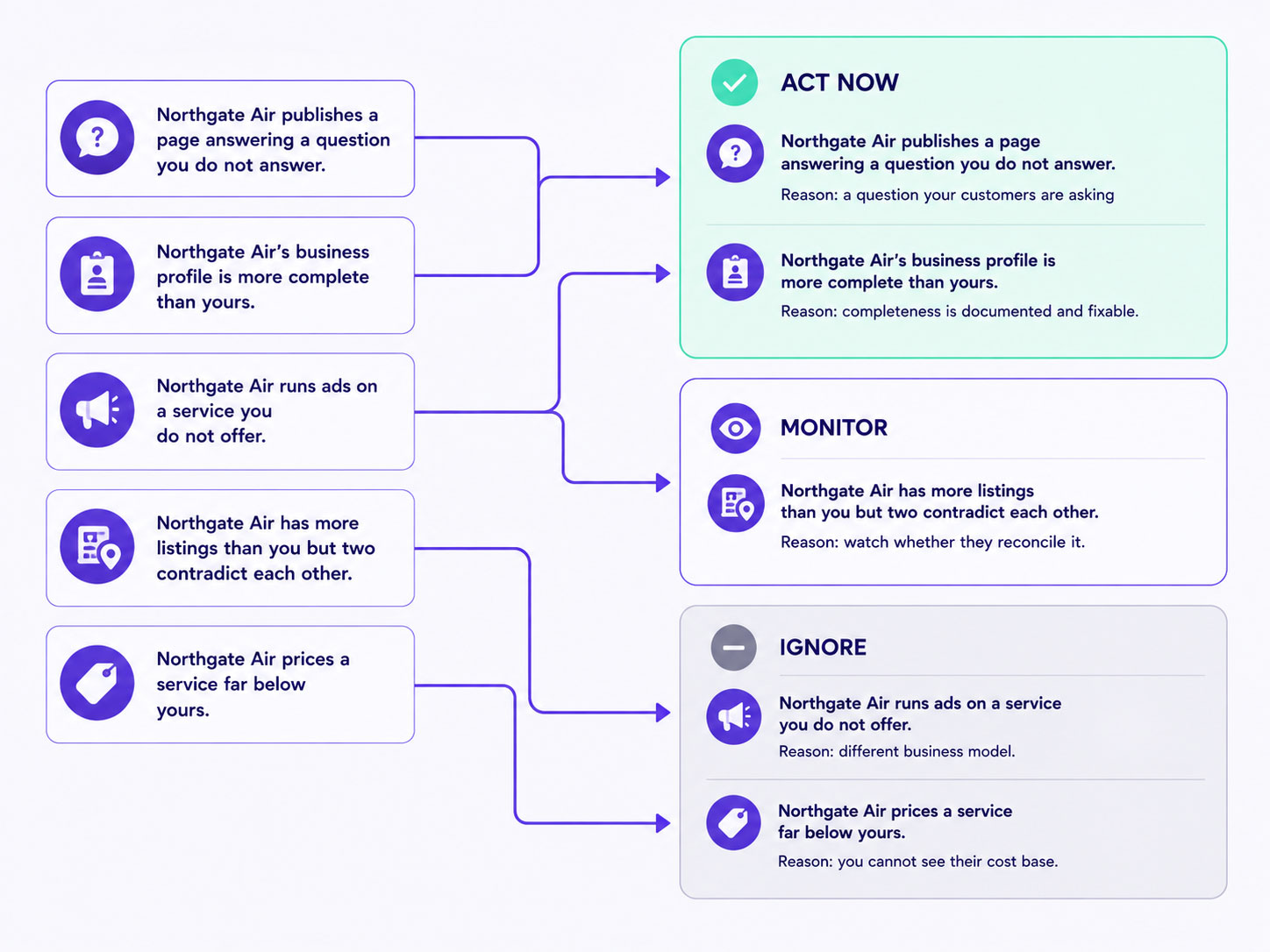
Every finding routes to act, monitor or ignore, with the reason stated — and most route to ignore.
Why: "they do it, so we should" is the most expensive sentence in competitive strategy. You can see their tactic and not their cost base.
Questions, not keyword gaps
Gaps expressed as the question a buyer asks, not as a spreadsheet row.
Why: Google's people-first guidance is about answering a person. A keyword list answers nobody and gets acted on by nobody.
Your own data is the anchor
Comparisons run against your measured analytics, not against an estimate of you produced by the same tool.
Why: comparing two estimates produces a third. Conversions defined per Google's documentation. See CRO.
Most of what we find we will tell you to ignore.
We run this for single-location contractors through to national franchise systems and private equity portfolios. At one location you are studying three rivals; across a portfolio you are studying three hundred, and the pattern that emerges is worth more than any single finding.
A teardown that recommends acting on every finding is a teardown written to justify its own invoice. A competitor running ads on a service you do not offer is information, not an instruction. Their listing count is not a target. Their pricing reflects a cost base you cannot see.
So every finding we hand you routes to act, monitor or ignore, with the reason stated — and the ignore column is usually the longest. That is a harder document to sell and a much better one to run a business on.
The other half of the position is that every finding carries a URL and a date, so you can repeat the check yourself. That is deliberate. A competitive report you cannot verify is a report you are trusting rather than using, and it means you have no way to catch us when we are wrong.
What separates this from a standard competitor report.
Not a competitor teardown of our competitors — a description of where the practices differ, so the choice can be made on substance.
| Practice | Standard competitor report | AllegiantOMNIVIZ™ |
|---|---|---|
| Estimated figures | Presented as measurements | Labeled as estimates every time they appear |
| Their claims | Never examined | Checked against registries and their own pages |
| Their sources | Not looked at | Followed and read, or noted as absent |
| Gap output | A keyword spreadsheet | The questions buyers ask that nobody answers |
| What to do with findings | Implied: copy them | Routed to act, monitor or ignore, with reasons |
| Verifiability | Take our word for it | URL and date on every finding |
| Your side of the comparison | The tool's estimate of you | Your measured analytics |
Four competitor line items you can stop paying for.
Three present inference as evidence. The fourth is a subscription resold as analysis.
Unlabeled traffic estimates. A competitor's monthly organic traffic figure was modeled from a sampled panel by a company that, as Google states directly, has no access to its ranking systems. Useful directionally, indefensible as a fact, and the word estimate costs nothing to add.
Vendor authority scores presented as search engine metrics. These are proprietary inventions, each computed differently, none of them assigned by any search engine. Tracking your own over time is fine. Comparing yours to a competitor's and calling it a competitive gap is comparing two models.
Keyword gap reports as the deliverable. A thousand rows is not a strategy, and it is not acted on. Google's people-first guidance is about answering a person's actual question. Generating a page per row also edges toward the scaled content line.
Monthly competitor monitoring with no question attached. A recurring report nobody reads because nothing in it changes and nothing in it requires a decision. Monitoring earns its cost when it is watching for a specific event you have already decided how to respond to.
The pattern beneath all four: they sell the appearance of rigor — volume, precision, recurrence — in place of evidence somebody actually read.
- Google Search Central — Evaluating third-party SEO advice
- Google Search Central — Creating helpful, people-first content
- Google Search Central — Spam policies for Google web search
- Google Search Central — Technical requirements
- Google Search Central — LocalBusiness structured data
- Google Search Central — Debugging drops in Google Search traffic
- Google Business Profile Help — Representing your business
- Google Business Profile Help — Improve your local ranking
- Google Analytics Help — About conversions
- FTC — Advertising and Marketing Business Guidance
- FTC — Rule on the Use of Consumer Reviews and Testimonials
The questions operators actually ask.
Answered against primary sources where they exist, and answered honestly where they do not.
How accurate are competitor traffic estimates?
Nobody outside the vendors can say precisely, which is itself the answer. Google states that no third party has access to its ranking systems, so every competitor traffic figure is modeled from sampled behavior rather than measured. Treat them as directional — useful for spotting a large gap or a sudden change, not for a number you would put in a plan. The only measured traffic in the exercise is your own, defined per Google's conversion documentation. See CRO.
What is a domain authority score, and does Google use it?
It is a metric invented by a tool vendor, computed differently by each one, and no search engine assigns it. Google's guidance on evaluating third-party SEO advice is worth reading on exactly this point. Tracking your own score over time to see directional movement is reasonable. Comparing yours against a competitor's and calling the difference a competitive gap is comparing two models, and it is the single most common way a competitor report creates a target that means nothing. Related: technical SEO.
What can we actually verify about a competitor?
More than most reports contain. Which pages they have published and when. Every objective claim on their site, checkable against a licensing body, a registry, or their own other pages. Whether they cite sources and whether those sources say what they claim. Whether their business profile carries the details Google documents. Whether their listings agree with each other. What their live ads promise. What recurring themes appear in their reviews. All public, all re-checkable, and all slower to gather than a dashboard export. See directory optimization.
Should we copy what a competitor is doing if it seems to be working?
Usually not, and this is where most competitive budget is wasted. You can see the tactic; you cannot see the offer economics, the cost base or the buyer research behind it. A competitor advertising a service at a price you cannot match may be running it as a loss leader, or may simply be wrong. Our default routing for a finding like that is ignore, with the reason stated. The findings worth acting on are the ones that hold regardless of what they are doing — an unanswered question, an incomplete profile against Google's documented profile requirements. Related: market research.
How is this different from market research?
Competitor analysis studies supply, market research studies demand. This page is about who else is answering the demand and how well — their pages, claims, citations, listings and ads. Market research is about the buyers themselves: who wants this, how many, and in what words they describe it. They inform each other and they are not substitutes, and a competitor teardown cannot tell you whether a market exists — only who is already in it. Google's people-first standard is a reminder that the buyer, not the rival, is the subject.
Is it legal to reference a competitor's claims in our marketing?
Comparative advertising is permitted, and the constraint is substantiation. The FTC's advertising guidance holds that objective claims must be truthful and supported by evidence — which applies to what you say about a competitor as much as to what you say about yourself. In practice, the stronger play is rarely to attack them: it is to make a specific claim you can document, in the place where their claim is thin. That is general information, not legal advice; a lawyer should review comparative copy before it runs. Related: reputation management.
How often should we run a competitive analysis?
When there is a decision waiting on it, and otherwise not on a schedule. A recurring monthly report with no question attached goes unread because nothing in it changes and nothing requires a response. The events that genuinely warrant a look are specific: a new entrant, a competitor's rebrand or site rebuild, your own launch into a new service or area, or an unexplained drop in your traffic — for which Google publishes a structured debugging sequence that should be worked before blaming a rival. See website maintenance.
Who counts as a competitor for this purpose?
Two different sets, and conflating them produces confused findings. Business competitors are the firms your buyers actually consider alongside you. Search competitors are whoever occupies the results for the questions your buyers ask — often national publishers, directories and manufacturers rather than local firms. The second set matters because you are competing for the answer, not only for the customer, and its members frequently offer nothing you sell. Local proximity and prominence factors are documented in Google's local ranking guidance. Related: local SEO.
Can we just use an AI tool to analyze our competitors?
It will summarize what a competitor's site says, quickly and usefully. What it will not do is check whether any of it is true — the certification against the issuing body, the years-in-business claim against the registration record, the service-area claim against their own page. That verification step is the entire value, and it is manual. There is also a volume trap: generating a page per competitor finding approaches what Google's spam policies describe as scaled content abuse. Sourcing discipline is covered under content writing.
What does a competitive teardown actually deliver?
A findings document where every item carries a URL, a date and what was found, so you can repeat any check without us. Estimates are present and labeled as estimates. Findings route to act, monitor or ignore with the reason stated, and the ignore column is usually the longest. The output that most often changes something is the list of questions buyers ask that nobody in the market answers properly, because that becomes pages rather than a spreadsheet — handled under content strategy, on a site that meets the technical baseline.
Find out what your competitors cannot actually support.
A competitive teardown: their claims checked against the bodies that would know, their sources followed, their profiles and listings examined, and the questions your buyers ask that nobody in your market answers. Every finding carries a URL and a date. Findings are yours whether or not we work together.
- Claim audit — every objective claim checked at its source
- Citation review — what they cite, and whether it says what they say
- Profile and listings comparison against documented requirements
- Live ad copy captured and compared to their site's promise
- Review themes — the recurring operational complaint, not the rating
- Unanswered-question list, expressed as questions rather than keywords
Explore the wider program: all services, market research, content marketing, local SEO, SEO and the A.R.C. Report.
We will show you which of your competitors' claims hold up, which contradict their own pages, and which questions nobody in your market has answered.
No cost, no commitment. We will follow up by email or phone to walk you through the findings.

