
Google publishes the rules for this one.
Almost nobody reads them.
Which premises are eligible. What a business may call itself. How many profiles a service-area business gets. What a category actually does. All of it documented, none of it ambiguous — and most profile problems we inherit are violations of a rule that was published the whole time, not a missing tactic.
Built for contractors and multi-location home services operators — HVAC, plumbing, roofing, electrical and the trades, plus the franchise systems and private equity portfolios running dozens or hundreds of locations at once.
Three factors decide the result. You can only touch two.
Nearly every article on this subject paraphrases a paraphrase. Here is the primary source read closely, including a wording detail almost nobody reports correctly.
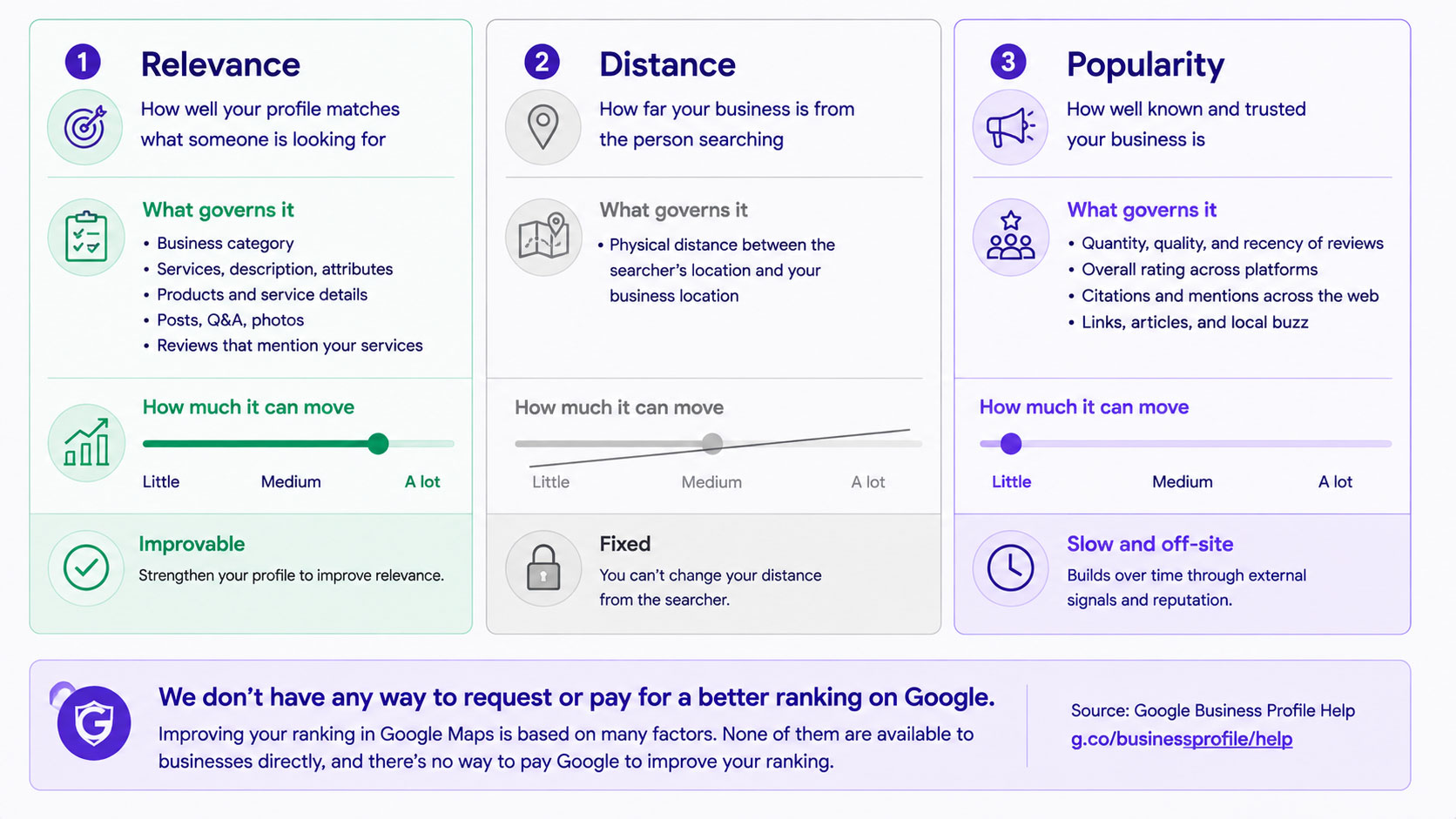
Google's local ranking guidance opens by stating that local results are based mainly on relevance, distance and popularity — and then uses Prominence as the heading for the third. Both words appear. Only one is in the sentence that defines the model, and the industry has been quoting the subhead for years without reading the line above it.
The distinction is small and it is the point. An industry working from summaries repeats summaries. We read the primary source, and on this page every claim links to it.
What the section actually establishes is worth stating plainly. Relevance improves with complete, detailed business information — that is Google's stated remedy, and it is the whole instruction. Distance is geography and cannot be moved by any configuration; any lever sold here does not exist. Prominence is how well known a business is, based partly on links from other websites and on review count and rating.
And the sentence most proposals omit: Google states there is no way to request or pay for a better local ranking, and keeps algorithm detail confidential deliberately. That single line disposes of a large amount of what gets sold under this heading.
There is a second reason profile accuracy has become more valuable than it was three years ago, and it is not a ranking argument. Google documents that its generative features retrieve relevant pages and review the information on them to build an answer, and that using a Business Profile can help a company's products and services be visible in AI responses as well as in ordinary results. A profile is a structured, authoritative statement of what a business is, where it works and what it sells — which is precisely the kind of record a system reaches for when it needs to be confident.
That also changes what a wrong field costs. An out-of-date service list used to mean a missed match in a ranked list. Now it can mean a system stating something inaccurate about your business to a customer who never sees your site at all. Google's generative AI performance report in Search Console is the measured surface for its own AI features; everything beyond that is observation, and we label it as such.
Before optimization, a question nobody asks.
Is the premises eligible for a profile at all? Google answers this explicitly, and a surprising share of the profiles we inherit were never eligible — which makes every hour spent optimizing them an hour spent on a suspension waiting to happen.
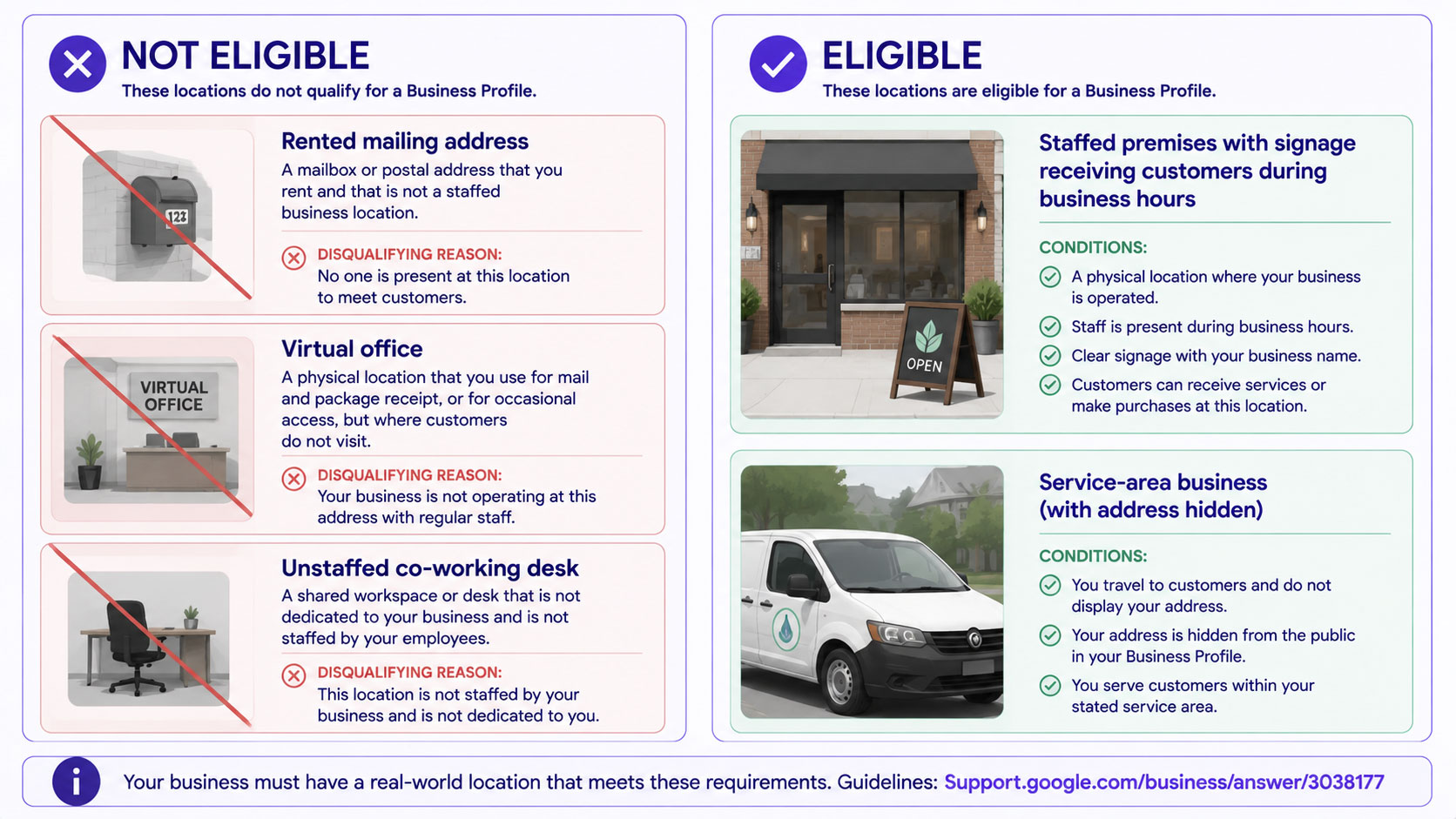
Profiles built on ground that will not hold
- A virtual office. A rented physical mailing address the business does not operate out of is not eligible for a profile.
- An unstaffed co-working desk. An office in a shared space does not qualify unless it maintains clear signage, receives customers during its stated hours, and is staffed during those hours by your business.
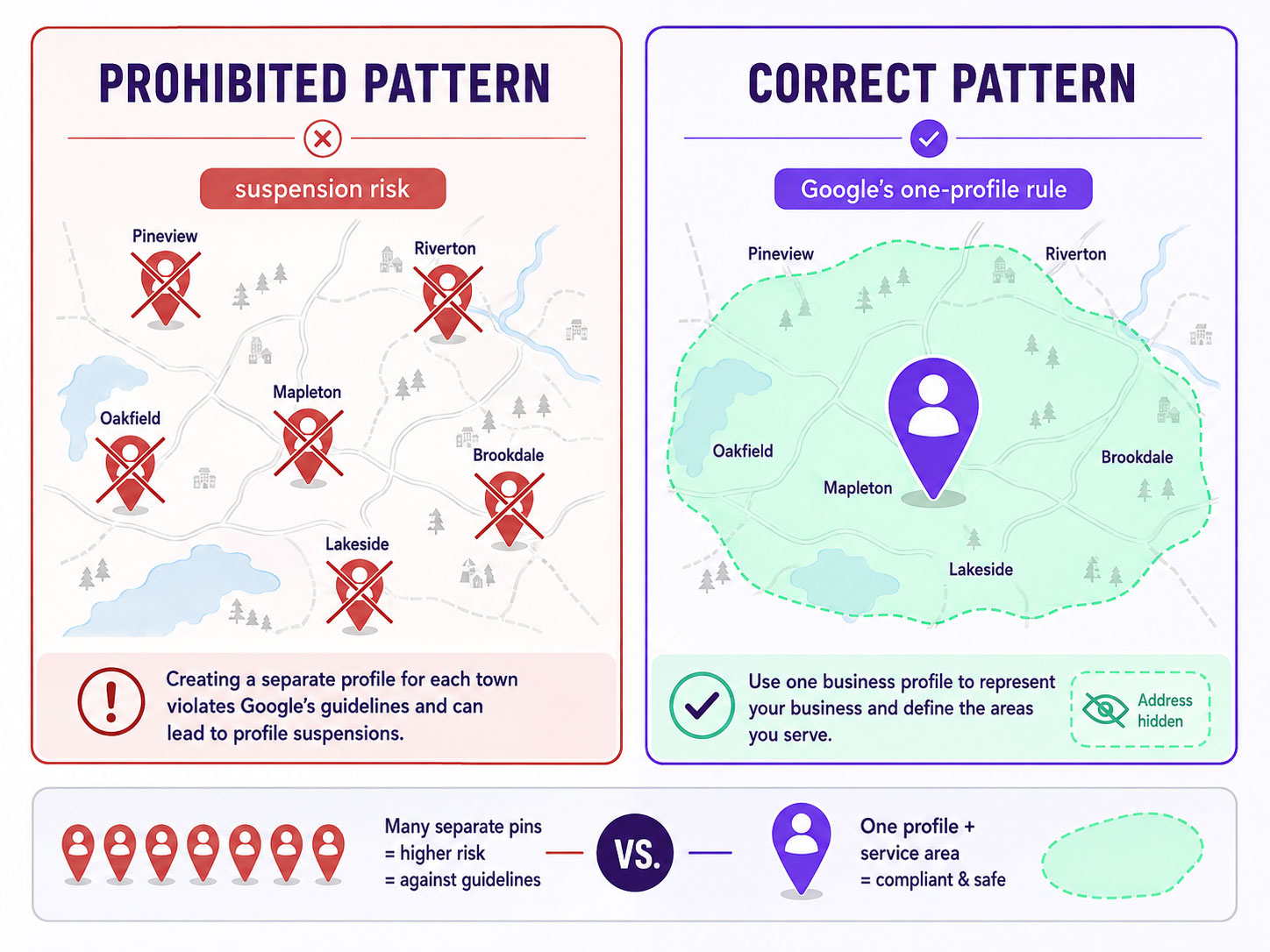
- One profile per town. A service-area business gets one profile for the whole area it serves, not one per place name.
- A padded name. The profile name must reflect the real-world name used on signage and stationery. Appended service keywords are a policy violation, not a tactic.
- An address you do not serve from. Google instructs that if you do not serve customers at your business address, remove the address from the profile.
A profile that can hold weight
- A staffed premises. Signage, customers received during business hours, staffed by your business during those hours.
- A declared service area. Address removed where customers are not served there, area declared truthfully, one profile covering all of it.
- The real-world name. Exactly as it appears on the van, the invoice and the door — which is also what makes citations reconcilable everywhere else.
- Verified. Completed through Google's documented verification process, with the method Google offers for your business type.
- Then optimized. Category, services, hours, attributes, photos — the work that follows eligibility rather than substituting for it.
Three things move relevance. Everything else is noise.
Google's stated remedy for relevance is complete and detailed business information. That sounds vague until you break it into the three fields that carry almost all the weight.
Primary category
The primary category tells Google what the business fundamentally is, and Google documents how categories work and how to choose them. Secondary categories extend reach; the primary one sets the frame.
- Chosen for breadth — a general category that dilutes every specific query it might have matched
- Chosen once at setup and never revisited as the business changed what it sells
- Secondary categories stacked indiscriminately, which describes a business that does nothing in particular
- Category and services describing two different companies
Services and detail
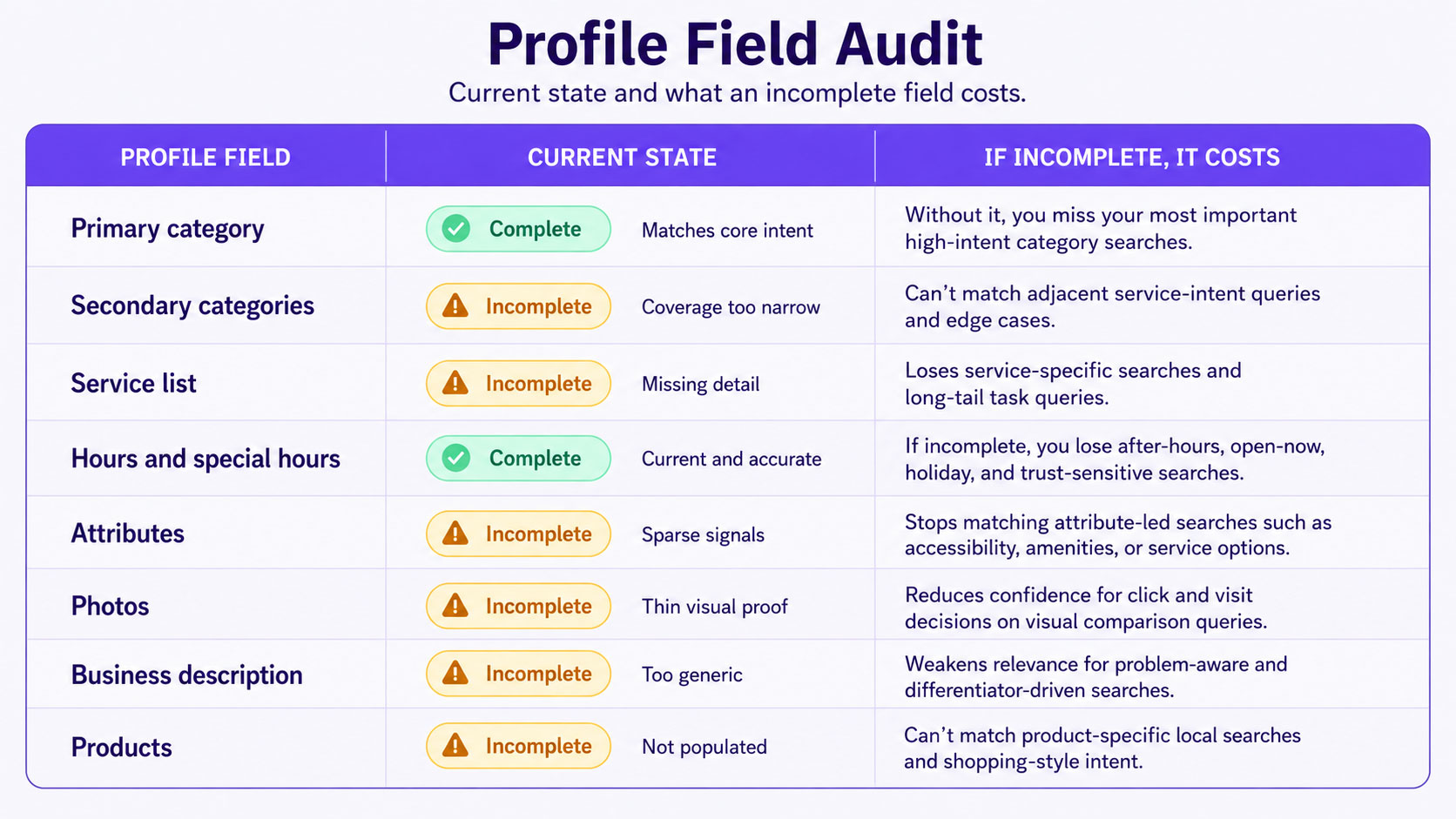
Complete and detailed business information so it can understand the business and match it to relevant searches. Services, hours, special hours, attributes, description, products — each one is a field a query can match against, and each empty one is a match that cannot happen.
- The service list, so the profile can only match its category name
- Attributes that answer real qualifying questions before a call
- Special hours, so holidays quietly show the business as open
- Photos, which are also what a person looks at before deciding
Prominence, honestly
Prominence is how well known a business is, based partly on how many websites link to it and how many reviews it has, and more reviews and positive ratings can help local ranking. It is also the factor that lets a business compete beyond its immediate radius.
- In: genuine links, genuine reviews, listings that agree — see directory management
- In: review volume built by asking everyone, per reputation management
- Out: anything Google's spam policies treat as manipulation
- Out: any promise of position, since Google says ranking cannot be requested or paid for
- Out: review generation conditioned on sentiment, which the FTC final rule prohibits outright
Every empty field is a query you cannot match.
The profile audit is field by field, and the useful output is not a completeness percentage. It is which specific searches each gap is costing you.
What the audit covers
Eligibility is checked before anything else, because optimizing a profile that should not exist is the most expensive kind of wasted effort in this discipline. After that the audit is deliberately unexciting: every field, its current state, and the specific query type that a gap forecloses. Google's framing throughout its guidance is that content and detail should serve the person searching rather than the mechanism reading it, which is the same standard it applies to helpful, people-first content on a website.
- Eligibility. Premises type against Google's stated conditions, service-area declaration against the one-profile rule, and whether the address should be shown at all.
- Name compliance. The profile name against the real-world name on signage and stationery — the most common quiet violation we find.
- Category accuracy. Primary category tested against the queries that actually matter, plus a defensible secondary set rather than a stack.
- Field completeness. Services, hours, special hours, attributes, description and products, with the query type each gap forecloses.
- Photos. Presence, recency and whether they show the work rather than a stock interior.
- Review posture. Volume and rating against the businesses currently ranking, and whether responses add anything.
- Consistency. Whether the profile agrees with the website, the schema and the wider listing set — contradiction is what makes any system hedge.
Six things that get maintained — and what each one is for.
A profile is not a setup task. It decays: hours drift, services change, competitors edit your listing, and Google adds fields nobody fills in.
Category and service review
Revisited as the business changes what it sells, using Google's category documentation rather than guesswork about what sounds broader.
Failure it prevents: a profile still describing the business you were four years ago.
Suggested-edit defense
Profiles can be edited by the public. Hours, categories and even the pin can move without you touching anything, and nobody is notified in a way anyone reads.
Failure it prevents: closed hours on your busiest day, discovered by a customer rather than by you.
Review response
Handled through Google's documented reply tools, adding a specific detail rather than a formula, and flagging genuine policy violations through the documented route.
Failure it prevents: the two things that damage most — silence, and legal threats.
Photo cadence
Real work, added regularly, following Google's photo guidance. A completed job photographed on the day beats a stock image of an office nobody visits.
Failure it prevents: a profile that looks abandoned next to a competitor posting weekly. Photographs also carry alt text and file names that should follow the same descriptive conventions as the site's own, since mobile-first indexing means the mobile presentation is the one that counts.
Site and schema agreement
LocalBusiness markup and the site's own stated details kept identical to the profile, per Google's guidance on establishing business details.
Failure it prevents: markup that disagrees with the profile, which is a contradiction rather than an advantage.
Performance reporting
Calls, direction requests and profile interactions tracked as their own channel, because most profile conversions never reach the website and therefore never reach site analytics.
Failure it prevents: a profile judged on website traffic it was never going to produce.
We check eligibility before we take the work.
We manage profiles for single-location contractors through to national franchise systems and private equity portfolios. One profile or two hundred, the work is the same discipline repeated — and at scale the repetition is precisely where every other agency lets it slip.
It is a short conversation and an unpopular one. If the premises is a virtual office, or there is a profile for every town you serve, the honest answer is that the foundation is wrong and optimizing it makes the eventual loss larger rather than smaller.
An ineligible profile can rank for months and then vanish, taking the reviews and photos with it. Saying so before invoicing costs us engagements. It costs the alternative far more.
Everything on this page links to Google's own documentation, because on this particular subject Google has published nearly everything worth knowing. Where we describe something it has not published, we say that it is observation. That is a harder page to write and a much easier agency to check.
What separates this from a standard profile retainer.
Not a competitor teardown — a description of where the practices differ, so the choice can be made on substance.
| Practice | Standard profile retainer | AllegiantOMNIVIZ™ |
|---|---|---|
| Eligibility | Assumed | Checked against Google's stated conditions first |
| Service-area businesses | A profile per town | One profile, per Google's documented rule |
| Profile name | Keywords appended | Real-world name, because the rule is published |
| Categories | Chosen broad, set once | Accurate, defensible, revisited as the business changes |
| Suggested edits | Noticed by accident | Monitored, because the public can change your listing |
| Ranking promises | Positions quoted | None — Google states ranking cannot be requested or paid for |
| Reporting | Website traffic | Calls and directions as their own channel |
Four profile line items you can stop paying for.
Every one of these contradicts something Google has published. That is an unusually clean test, and this is an unusually easy discipline to check an agency against.
A profile for every city you serve. Google states that a service-area business gets one profile for the whole area it serves. Extra profiles are a suspension risk sold as coverage, and cleaning them up is frequently the first real work in an engagement.
Keywords in the business name. Google requires the profile name reflect the real-world name used on signage and stationery. It is a documented violation, not an edge that a competitor has and you do not.
Guaranteed map pack positions. Google states plainly there is no way to request or pay for a better local ranking. Anyone quoting a position is quoting something the issuing authority says is not purchasable.
Virtual addresses to enter new markets. A rented mailing address is not eligible for a profile, and an unstaffed co-working desk does not qualify. The legitimate route into a market you cannot staff is prominence, which is slower and does not get taken away.
The pattern beneath all four: this is the one discipline where the rules are published in full. An agency selling any of the above either has not read them or is counting on you not having.
- Google Business Profile Help — Tips to improve your local ranking
- Google — Guidelines for representing your business
- Google — Manage service areas for service-area businesses
- Google Business Profile Help — Business categories
- Google Business Profile Help — Verify your business
- Google Business Profile Help — Add photos and videos
- Google Business Profile Help — Read and reply to reviews
- Google Business Profile Help — Prohibited and restricted content
- Google Search Central — Establish your business details
- Google Search Central — LocalBusiness structured data
- Google Search Central — Spam policies for Google web search
- Google Search Central — Optimizing for generative AI features
- Search Console Help — Generative AI performance report
- Google Search Central — Creating helpful, people-first content
- Google Search Central — Mobile-first indexing
- U.S. Federal Trade Commission — Final rule banning fake reviews and testimonials
The questions operators actually ask.
Answered against primary sources where they exist, and answered honestly where they do not.
Should we have a profile for every city we serve?
No. Google's rule for service-area businesses is unambiguous: a business that visits or delivers to customers but does not serve them at its own address can only have one profile for the whole area it serves. Google further instructs that if you do not serve customers at your business address, the address should be removed. Extra profiles per town are a suspension risk rather than a coverage strategy, and removing them is usually the first real task in an engagement. The coverage you actually want comes from prominence and content — see local SEO.
Can we add keywords to our business name to rank better?
No. Google requires that the profile name reflect the real-world name used consistently on signage, stationery and other branding. Appending services to it is a documented violation, and it is also self-defeating in a second way: an inconsistent name is exactly what breaks reconciliation across your other listings, which is what prominence depends on. Competitors doing it are not ahead of you; they are exposed. Consistency work runs through directory management.
Can we use a virtual office or co-working address to enter a new market?
No. Google states that a rented physical mailing address the business does not operate out of — a virtual office — is not eligible for a Business Profile, and that an office in a co-working space does not qualify unless it maintains clear signage, receives customers during business hours, and is staffed during those hours by your business. The honest route into a market you cannot staff is prominence — the factor that lets a business compete beyond its immediate radius — plus content that earns the query. Related: content marketing.
How do we choose the right primary category?
Accurately rather than broadly, which is the opposite of most instincts. Google documents how categories work, and the primary one sets the frame for everything the profile can match. A general category chosen to "cover more" dilutes every specific query it might have won. Secondary categories extend reach, but stacking them indiscriminately describes a business that does nothing in particular. Test the candidates against the queries that actually produce calls, and revisit as the business changes what it sells. See market research.
Can someone else change our profile without telling us?
Yes. Profiles accept public suggested edits, so hours, categories, the pin and other details can change without anyone at the business acting. The notification is easy to miss, and the failure mode is expensive in a specific way — closed hours on your busiest day, discovered by a customer rather than by you. Monitoring for this is a standing task rather than a project, alongside checking that the profile still agrees with the site and its LocalBusiness markup. Related: website maintenance.
Can you guarantee us a spot in the map pack?
No, and Google says why. Its local ranking guidance states there is no way to request or pay for a better local ranking, and that it keeps the details of the algorithm confidential deliberately. Anyone quoting a guaranteed position is quoting something the issuing authority says is not purchasable. What is available: complete and detailed information, which is Google's own stated remedy for relevance; genuine prominence, which is slow; and an accurate baseline so you can see what actually moved. Start with the visibility assessment.
Do photos on the profile actually matter?
They matter to the person deciding, which is reason enough. Google publishes guidance on adding photos and videos and what it expects of them. Our observation, labeled as observation because Google publishes no mechanic here, is that recency and realism do the work: a completed job photographed on the day beats a stock interior nobody will ever visit, and a profile with nothing new in two years reads as abandoned beside a competitor posting weekly. Photography is part of the wider content capture we run.
How much do reviews affect the profile's ranking?
Google is specific here in a way it rarely is: prominence is based partly on how many websites link to the business and how many reviews it has, and more reviews and positive ratings can help local ranking. What it does not publish is a threshold, so any target number you have been quoted is unsourced. Responses matter too, through Google's documented reply tools — and how reviews are generated matters legally, which is covered under reputation management.
Our profile got suspended. What now?
Start by finding the cause rather than appealing blind, because an appeal that does not fix the underlying violation usually fails and burns time. The recurring causes are the ones documented in the guidelines: an ineligible premises, a name carrying keywords, multiple profiles for one service-area business, or a category and address combination that does not match how the business actually operates. Google's representation guidelines and its verification documentation are the two places to work from. Correct the violation first, then appeal. Where the cause was a premises that was never eligible, the recovery path is prominence and content rather than a replacement profile — see local SEO.
How do we know whether the profile is working?
Not through website traffic, which is the most common measurement error here. Most profile conversions never touch the site — a call placed from the listing, a direction request, a click on the hours. Those are the profile's actual output and they need to be tracked as their own channel with call attribution attached. Website analytics will systematically understate a profile that is doing well. Alongside that we track review volume and rating against the businesses currently ranking for your queries, and profile consistency against the site's own stated business details. Related: conversion tracking.
Find out whether your profile is even eligible.
A profile audit: eligibility against Google's stated conditions, name and category compliance, every field with the queries its gaps are costing you, and where you stand against the businesses currently ranking. Findings are yours whether or not we work together.
- Eligibility check against Google's documented premises conditions
- Name compliance against the real-world name rule
- Service-area declaration against the one-profile rule
- Category accuracy tested against queries that produce calls
- Field-by-field completeness with the cost of each gap named
- Consistency check against your site, schema and wider listings
Explore the wider program: all services, local SEO, AI SEO, technical SEO, website design and landing pages.
We will tell you whether your profile is eligible, where it is incomplete, and which specific searches each gap is costing you.
No cost, no commitment. We will follow up by email or phone to walk you through the findings.


