
How to Optimize Your Website for Google’s June 2025 Core Update
Google Just Changed the Rules of the Game: Here’s How to Win
Google’s June 2025 Core Update has finished rolling out, and if you’re not paying attention, your website could already be slipping out of sight. This wasn’t a minor tweak. It was a 16-day overhaul of how Google evaluates websites, and the businesses that adapt fastest will capture the traffic, leads, and revenue their competitors lose.
Here’s the bottom line: Google just moved the goalposts again. If you don’t adjust, you risk losing visibility, authority, and customers in an increasingly cutthroat digital marketplace.
Why This Update Mattered More Than Most
Billions of searches happen on Google every single day. A one-position drop in rankings can mean thousands of visitors, and thousands of dollars, lost. The June update is already reshaping search results, rewarding sites that deliver genuine value and punishing those that cut corners. For businesses that depend on digital visibility, this isn’t just an SEO issue. It’s a growth issue.
What Changed in June 2025
Google’s June 2025 Core Update introduced several critical changes that website owners must understand to maintain their competitive advantage, and doubled down on signals that actually matter to users:
- > Enhanced User Experience Focus: The update places unprecedented emphasis on user experience signals. Google’s algorithms place more emphasis on factors like site navigation intuitiveness, mobile responsiveness, and overall user satisfaction metrics. Websites that provide seamless, engaging experiences are being rewarded with improved rankings.
- > Content Quality and Relevance Standards: The bar for content quality has been raised significantly. Google’s updated systems better identify truly valuable, well-researched content that demonstrates expertise and provides genuine value to users. Thin, superficial, or AI-generated content without human oversight is being systematically demoted.
- > Mobile-First Performance Requirements: With mobile searches continuing to dominate, the update reinforces Google’s mobile-first indexing approach. Websites that fail to deliver exceptional mobile experiences face substantial ranking penalties, regardless of their desktop performance.
- > Site Speed and Core Web Vitals: Page loading speed and Core Web Vitals have become even more critical ranking factors. The update penalizes websites with poor performance metrics while rewarding those that deliver fast, smooth browsing experiences.
- > E-A-T Signal Enhancement: Expertise, Authoritativeness, and Trustworthiness (E-A-T) signals receive enhanced scrutiny. Google’s algorithms have become more sophisticated at identifying authentic expertise and credible sources, particularly for content in sensitive categories like health, finance, and legal advice.
How to See If You’ve Been Hit: Assessing Your Website
Don’t guess; measure. Dive into your analytics from late June through mid-July. Look for sudden traffic shifts, pages that lost rankings, or keywords that slid past page one. Tools like Google Search Console will expose which pages and terms are bleeding visibility. That’s where you need to start. Focus on pages that lost significant traffic, as these likely require immediate attention and optimization.
- > Keyword and Page Impact Assessment: Analyze your keyword rankings to identify which terms were most affected by the update. Pages that dropped from positions 2-10 to beyond page one require urgent intervention, while smaller fluctuations may indicate minor algorithmic adjustments.
- > Google Search Console Insights: Leverage Google Search Console to gain deeper insights into your website’s performance changes. Examine click-through rates, impression data, and any manual actions or security issues that may have emerged during the update period.
Fixing What’s Broken: Actionable Steps for Optimization
This update is a survival test. To stay visible, you need to overhaul how you think about SEO:
Enhancing User Experience (UX)
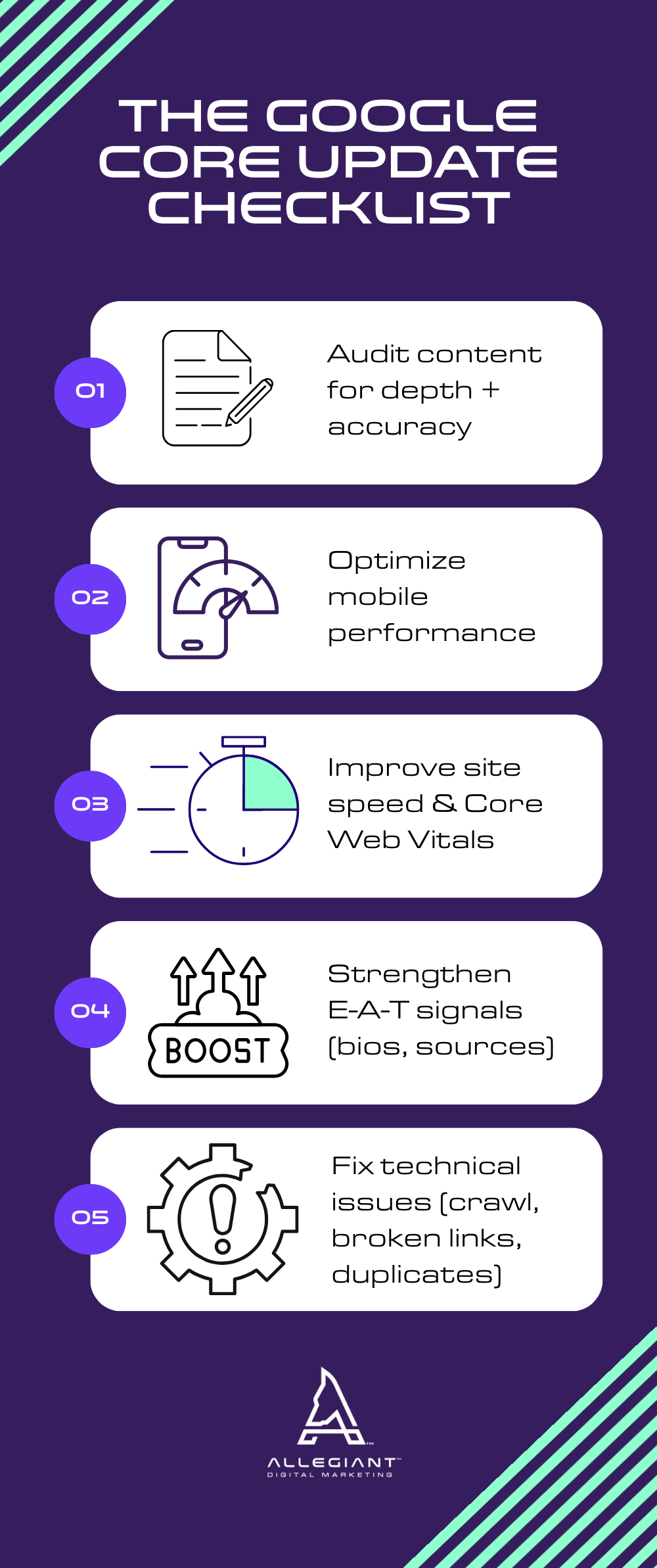
- > Improve Site Navigation: Streamline your website’s navigation structure to help users find information quickly and intuitively. Implement clear menu hierarchies, logical page structures, and prominent search functionality.
- > Mobile Optimization Priority: Ensure your website delivers an exceptional mobile experience. This includes responsive design, fast loading times on mobile networks, and touch-friendly interface elements that work seamlessly across all device types.
- > Speed Optimization: Focus aggressively on site speed improvements. Compress images, minimize HTTP requests, leverage browser caching, and consider upgrading your hosting infrastructure to deliver consistently fast page load times.
Content Optimization Strategies
- > Quality Over Quantity Approach: Audit your existing content and prioritize updating high-value pages rather than creating new content. Focus on depth, accuracy, and genuine user value in every piece of content you publish.
- > Content Freshness and Updates: Regularly update your most important pages with current information, statistics, and insights. Google’s algorithms favor content that remains relevant and up-to-date over time.
- > E-A-T Implementation: Strengthen your expertise signals by adding detailed author bios, showcasing credentials and experience, and including authoritative citations and references throughout your content.
Technical SEO Improvements
- > Mobile-Friendly Verification: Use Google’s Mobile-Friendly Test tool to identify and resolve any mobile usability issues. Ensure your website passes all mobile optimization criteria.
- > Performance Monitoring: Implement comprehensive monitoring for Core Web Vitals, including Largest Contentful Paint (LCP), First Input Delay (FID), and Cumulative Layout Shift (CLS). Address any performance issues immediately.
- > Technical Audit Completion: Conduct a thorough technical audit to identify and fix broken links, crawl errors, duplicate content issues, and other technical problems that may negatively impact your rankings.
Why You Can’t Sit Back
Every algorithm update widens the gap between businesses that adapt and those that lag. If your competitors are already optimizing, they’re not just climbing above you; they’re capturing your customers. The opportunity cost is staggering.
Act Now: Find Out How Allegiant Digital Marketing™ Keeps You Ahead
The June 2025 Core Update is more than just another reshuffle. It’s Google’s clearest signal yet: websites that truly serve users win. If you want to keep your edge, you can’t wait until traffic is gone to start fixing what’s broken.
At Allegiant Digital Marketing™, we don’t just react to Google updates; we anticipate them. With two decades of experience navigating algorithm shifts, we know how to protect rankings, recover lost visibility, and build strategies that thrive in the new search landscape.
Our approach combines deep technical SEO, authoritative content strategy, and continuous performance monitoring. We identify the exact areas where your site is bleeding opportunity and turn them into strengths before your competitors even know what hit them.
Now is the time to take action.
Contact Allegiant Digital Marketing™ today for a post-update site analysis and a proven roadmap to not just recover, but to dominate.