
A free audit that tells you
which findings actually cost you money.
Most free audits are a generated score and a list of every warning a crawler emits. The A.R.C. Report is a findings document — each item states what was found, the URL where we found it, whether it is blocking revenue, and what it would take to fix. You can re-check every line yourself.
Built for home services contractors, franchise systems, private equity portfolios and mid-market operators — one location or two hundred, you get the same findings and the same straight answer about what is actually costing you jobs.
Three short steps. Tell us the site, what you sell, and where to send the findings.
No cost, no commitment. The findings are yours whether or not we work together.
Unlike the automated score reports most agencies send, this is read by a person and written for an operator. We name what is costing you jobs rather than every warning a crawler emits. We hand you the findings whether or not you hire us. We tell you when the problem is your phone handling rather than your marketing, and we say plainly when you do not need an agency at all. Ask whoever audits you now whether they will put any of that in writing — most will not, because an agency that only finds problems it can bill for is not auditing anything.
What Gets CheckedSix things a crawler cannot tell you, because somebody has to look.
Automated tools find warnings. They do not find the phone number that contradicts your listings, or the form that submits and never delivers — and those are the two that cost money today.
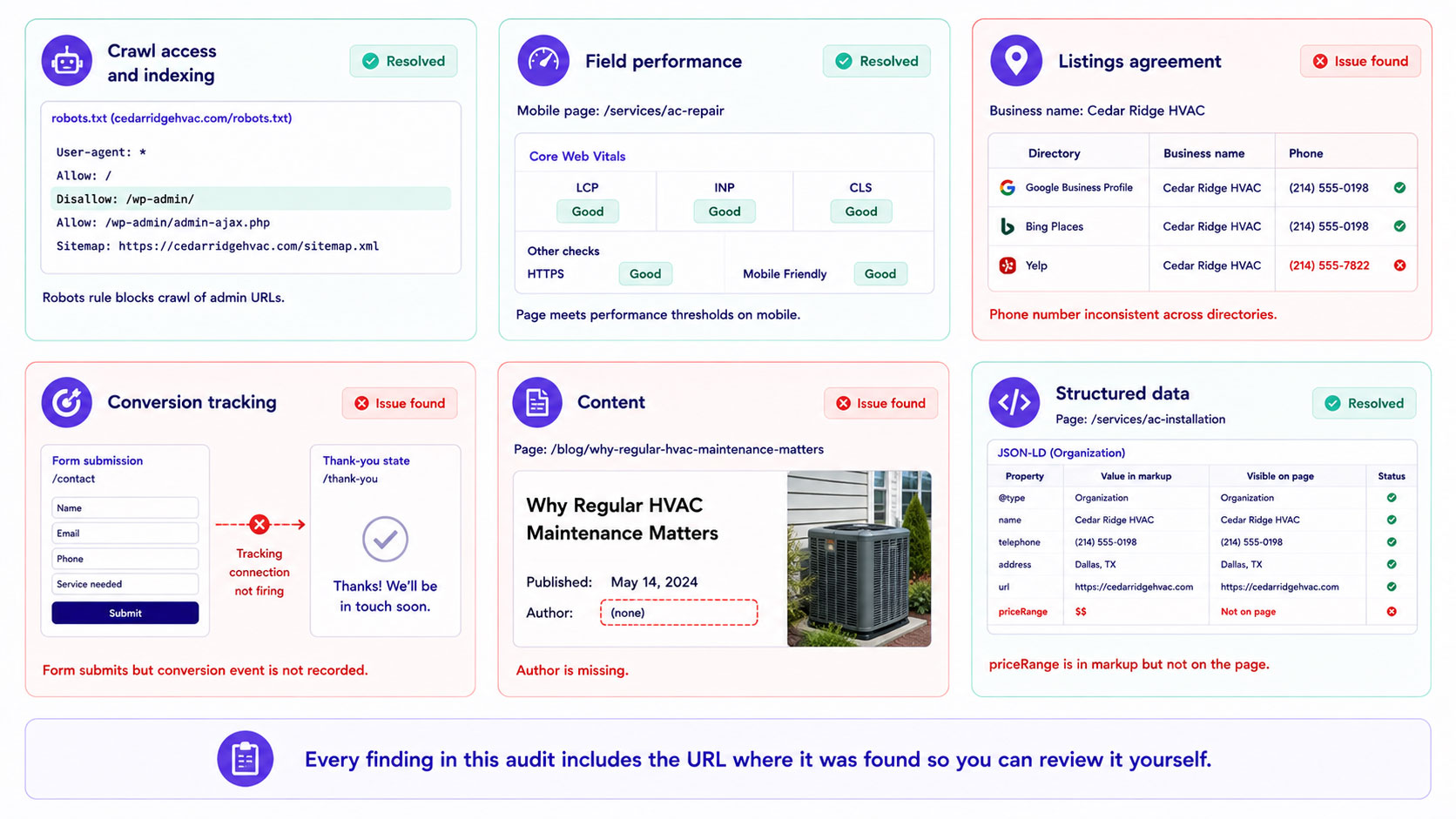
Most agency audits are automated score reports generated in under a minute, engineered to look alarming and produce a sales call. Ours is read by a person. It names what is actually costing you jobs rather than every warning a crawler can emit, it tells you plainly when the answer is that you do not need us, and the findings are yours whether or not you hire us. We will say when the problem is your phone handling rather than your marketing — an agency that only ever finds problems it can bill for is not auditing anything. Ask whoever audits you now whether they will put that in writing.
We run this for single-location contractors through to national franchise systems and private equity portfolios. A two-truck operator and a two-hundred-location system get the same depth of review; what changes is whether the findings roll up to one owner or to an operating partner.
And the audit covers the surface most agencies still do not check. As an AI-first agency we baseline how ChatGPT, Google AI Overviews, Perplexity and Gemini currently describe your business and whether they name you at all when a homeowner asks who to call in your market. That number is increasingly the one that decides who gets shortlisted, and almost nobody is reporting it to you today.
Crawl access and index directives. Whether robots.txt is blocking anything it should not, and whether a template-level noindex is quietly removing pages. This is the highest-value check because it produces no visible symptom — the site looks perfect while it leaves the index.
Conversion tracking, tested rather than assumed. We send a real submission and confirm it arrives. A form that submits successfully and delivers nowhere generates no complaint, because the visitor sees a thank-you message and assumes you have their details. It reads as a slow month. Related: landing pages.
Listings agreement. Whether your name, address and phone say the same thing everywhere, or whether one directory carries a number that stopped ringing three years ago. Nobody counts listings; systems check whether they agree — see directory optimization.
Field performance, both indexes, and content. Core Web Vitals measured from real-world data on the templates that convert, coverage compared across Google and Bing, and whether pages carry a named author and a review date. Google's people-first guidance is the standard we read your content against, and technical requirements the baseline for the rest.
A findings document. Not a score.
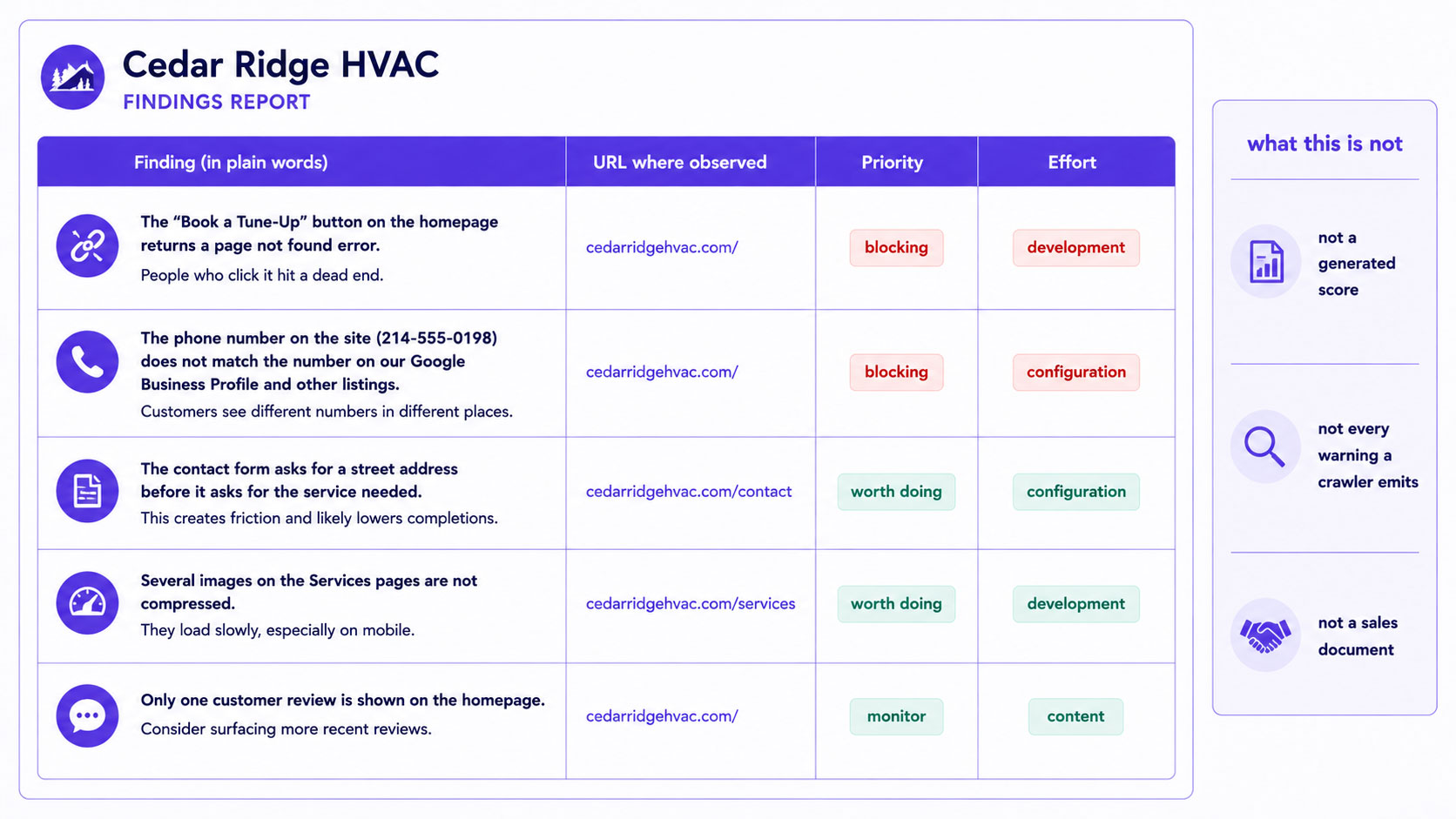
Every line states what was found, where, whether it blocks revenue, and what class of work it would take. Nothing in it is a number we generated to make the report look rigorous.
How each finding is written
The structure exists so you can act without us, and so you can catch us if we get something wrong. Both matter.
- The finding, in plain words. What is actually happening, not a warning code copied out of a crawler.
- The URL where we found it. So you can repeat the check yourself, today, without any tool we used.
- Whether it blocks revenue. Blocking, worth doing, or monitor. Most findings are not blocking, and we say so rather than inflating the list.
- What class of work it takes. Configuration, content, or development — so you know whether it is an afternoon or a project before you ask anyone for a quote.
- What we could not verify. Stated as unverified rather than guessed at. A claim about your business that we cannot support does not go in.
- Estimates labeled as estimates. Third-party figures appear where useful and always carry the word — Google states no external tool has access to its ranking systems.
- One conversation to walk it through. No obligation, and the findings are yours regardless of what you do next.
Before you fill in the form.
Answered against primary sources where they exist, and answered honestly where they do not.
Is it actually free, or is there a catch?
Free, and the findings are yours whether or not we ever work together. What we get out of it is a qualified conversation with someone who now knows what is wrong with their site — which is a better use of our time than cold outreach. There is one follow-up call to walk you through the report; if you would rather just have the document, say so and we will send it. Related: our services. Google's guidance on evaluating third-party offers is a fair lens to point at us.
How is this different from a free scan from an SEO tool?
A tool returns every warning it can detect, weighted by nothing, plus a score it invented. Google states directly that no third-party tool has access to its ranking systems, so those scores are vendor metrics rather than search engine ones. The A.R.C. Report contains findings a person verified — including things no crawler can see, such as whether your form actually delivers or whether your listings contradict each other. See technical SEO.
How long does it take?
A few business days, because parts of it are manual by design. Sending a real test submission through your form and waiting to confirm it arrived cannot be automated, and neither can reading your listings for contradictions. If you have a deadline, tell us on the form and we will say plainly whether we can meet it rather than agreeing and then rushing the checks that matter. The standing-check discipline behind it is described under website maintenance, and the technical baseline is Google's.
Do you need access to our website or analytics?
No. Everything in the report is observable from outside — your pages, your directives, your listings, your field performance and a real submission through your own form. If you choose to share Search Console or analytics access later it makes some findings sharper, but nothing in the free report depends on it, and we would rather not hold credentials we do not need. Related: CRM on collecting only what gets used.
What if the report says our site is fine?
Then that is what it says. A report engineered to always find something urgent is a sales document, and you would be right not to trust the one finding that mattered. We would rather tell you the technical foundation is sound and the real constraint is elsewhere — in the offer, the market, or the follow-up — than manufacture a list. Google's people-first standard is the same principle applied to content. See conversion rate optimization.
Will you contact us afterwards?
Once, to walk you through the findings, by whichever channel you chose on the form. The text-message box on the form is separate, unchecked by default, and carries its own disclosure — if you do not tick it, we do not text you, and replying STOP at any point ends it either way. That is the standard described on our SMS marketing page, and the FCC treats any reasonable revocation method as valid, so a plain reply works too.
Every finding carries the URL where we found it.
Which means you can check any line of the A.R.C. Report yourself, disagree with us where we got something wrong, and act on the rest without hiring anybody. That is deliberate.
- Crawl access and index directives, template by template
- A real test submission through your form, confirmed as received
- Listings and profile agreement across directories
- Field Core Web Vitals on the templates that convert
- Coverage compared across Google and Bing
- Content, author attribution and structured data agreement
Explore the wider program: all services, local SEO, technical SEO, content marketing, website design and AI SEO.
The request form is at the top of this page. Three short steps, and the findings come back to you either way.
Back to the Form →Prefer to talk first? Call us and we will start there instead.

