
Every other investment
ends at your store.
Feed work, organic visibility and paid media all do the same thing: deliver somebody to a page. What happens next is the only part that produces revenue — and on a catalog the failures are systemic, because one template serves thousands of products and a single slow component degrades every one of them at once.
We work with pure-play ecommerce operators, manufacturers with parts catalogs, franchise systems selling product alongside service, medical and aesthetics practices with retail lines, and mid-market and private equity portfolio companies with a commerce arm — a hundred SKUs or a hundred thousand.
You paid for every one of them. Most left before the button.
A shopper who reaches your checkout has already cost you money — in media, in content, in the years of work that made you findable. The gap between arriving and completing is the most expensive stretch of your entire operation, and almost none of it is a marketing problem.
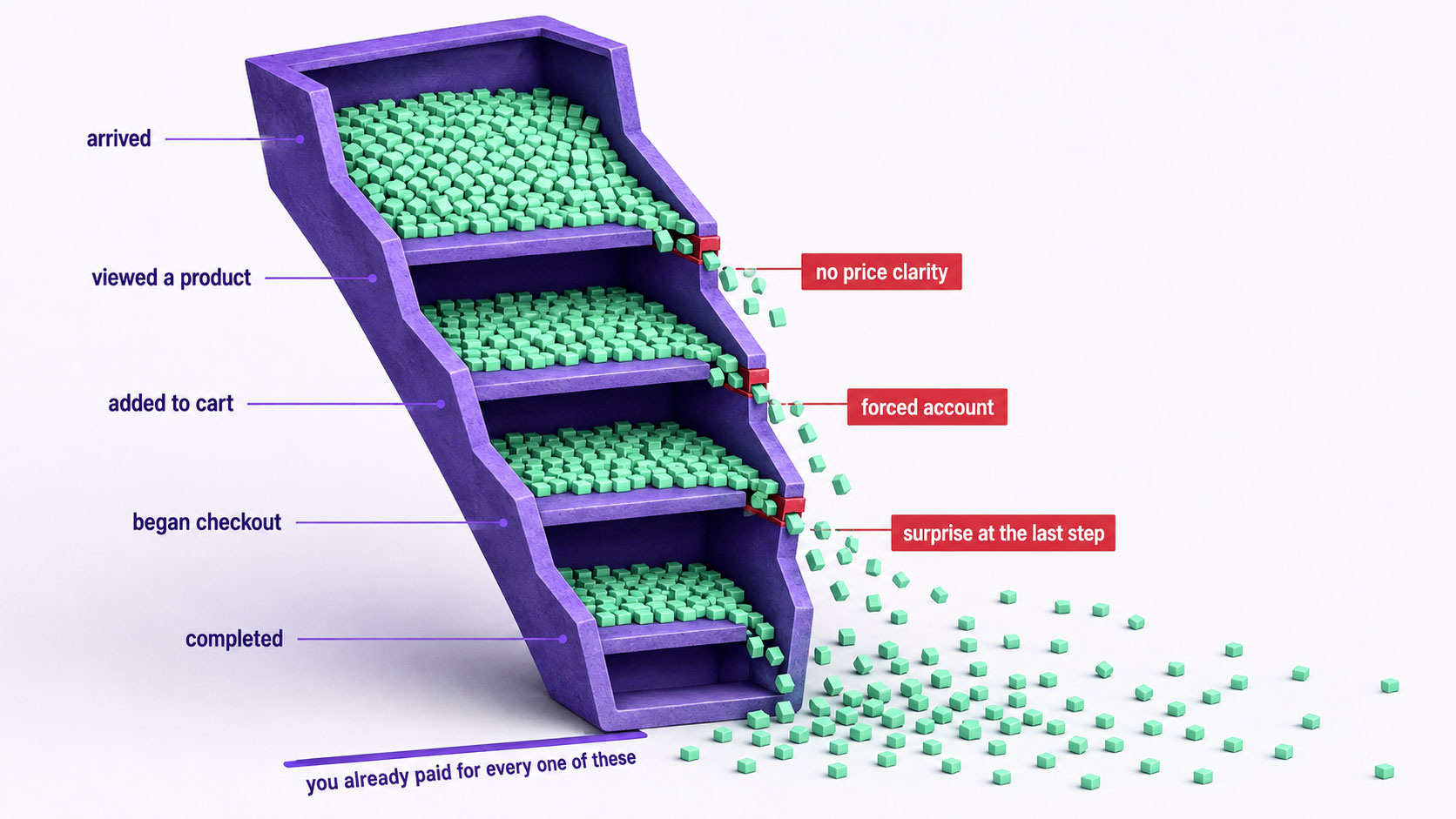
The three biggest leaks are almost always the same, and none of them is subtle. A shipping cost that only appears at the final step, after a shopper has invested five minutes and formed an expectation about price. A forced account before checkout, which protects nothing and asks for commitment before the purchase has been made. And a page that takes long enough to load that somebody with an alternative tab simply uses it.
What makes these expensive is where they sit. They do not reduce traffic, so they never appear in a traffic report. They do not reduce impressions, so paid reporting looks healthy. They reduce the conversion of visitors you have already bought, which is the most costly possible place to lose somebody and the least visible in any marketing dashboard.
On a catalog every one of these is a template problem rather than a page problem. Your product pages are generated from shared logic, so a heavy component or a badly ordered load sequence does not affect one product — it affects the entire range simultaneously. That cuts both ways, and the favorable direction is why store work has such leverage: fix the template once and thousands of pages improve at the same moment.
The AI dimension is genuine here rather than decorative. Assistants increasingly summarize product options before a shopper reaches any store, and they read the same page a person does. A page whose specifications only appear after a script executes, or whose structured data disagrees with the visible content, is harder for them to represent accurately. Building for a shopper and building for a machine mostly turn out to be the same instruction — clear structure, honest detail, content present in the page. Our approach is on the AI SEO agency page, and the catalog data side on ecommerce digital marketing.
One template, two thousand times.
This is the structural fact that separates store design from ordinary web design. You are not designing pages, you are designing the logic that generates them — which means every decision is multiplied by the size of your catalog before anyone sees it.

Flaws multiply silently
- A heavy component added once slows every product in the catalog from that day forward.
- A markup error in the template becomes thousands of pages giving machines the wrong answer.
- Layout that works for one product breaks on the ones with longer names or more variants.
- Nobody tests at scale, because the design was approved on three example products.
- Fixes applied page by page, which never finishes on a catalog of any size.
Improvements multiply too
- The template is the deliverable, tested against the awkward products rather than the flattering ones.
- Structured data generated from the record, so markup and page cannot drift apart.
- Layout proven against edge cases — long titles, many variants, missing images, out of stock.
- Performance budgeted, so a new component has to justify what it costs every page.
- One fix improves the whole catalog at the moment it ships.
Four things we do that most store builders will not.
Each of these makes the build slower, the design less decorative, or the results harder to flatter. That is why they are uncommon, and why we will put all four in writing.
Buying something from your own store, on a phone, on an ordinary connection, is the most informative hour available and it is skipped almost universally. Surprises appear in a specific order and each one has a cost attached.
It also frequently ends the conversation about a redesign, because the three things costing you money turn out to be fixable in the store you already have.
- The full purchase walked end to end, on device, before any design work begins.
- Findings ranked by what they cost rather than by how hard they are to fix.
Speed is not an optimization applied after launch, it is a constraint the build has to live inside. Every component that wants to load early has to justify itself against the things a shopper is waiting for — the image, the price and the button.
Most slow stores are not badly built. They accumulated one reasonable addition at a time, each approved without anyone tracking the running total.
- A performance budget agreed up front and checked before anything ships.
- Third-party scripts inventoried, ordered and removed where they earn nothing.
Long product names, eleven variants, missing images, out-of-stock states, specification tables that run for screens. These are not exceptions in a real catalog — they are the majority, and they are exactly what a showcase design never gets tested against.
A template approved on three flattering products produces thousands of pages nobody would have signed off individually.
- Design reviewed against the hardest items in your catalog before approval.
- Empty and error states designed rather than left to whatever the platform renders.
A store redesign that increases orders and increases returns has not necessarily helped. We validate against completed orders in your commerce platform, net of what comes back, rather than against a conversion-rate figure that stops at the confirmation page.
It also means we can be wrong visibly, which is the point. A change that did not work should be identifiable as such rather than absorbed into a general narrative of improvement.
- Before and after measured in your own order data, not only in analytics.
- Return rates watched alongside conversion, because they move together more often than teams expect.
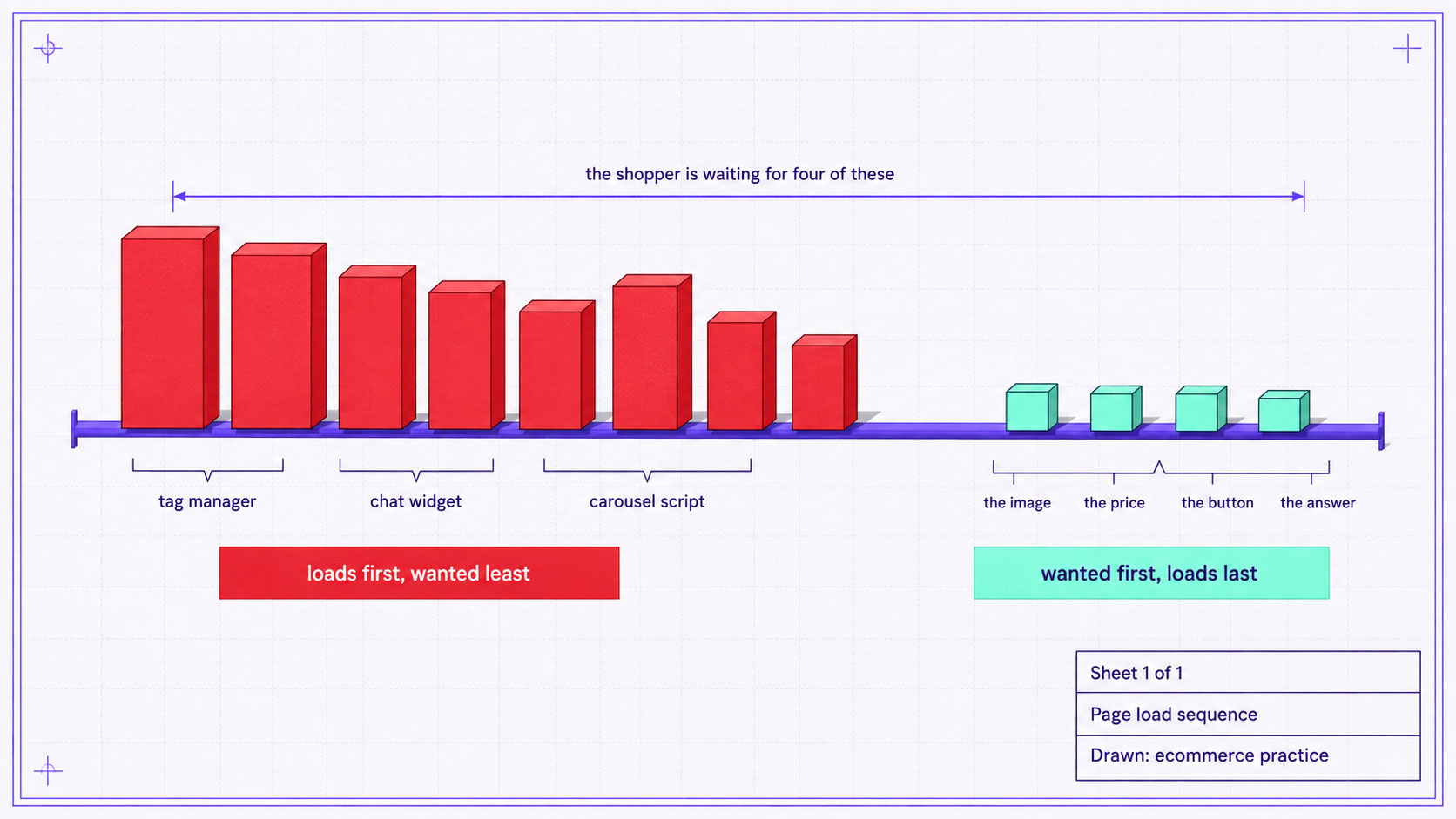
The shopper is waiting for four things. Everything else loaded first.
A product page assembles itself in an order somebody decided, usually by accident. On most stores the things a shopper came for — the image, the price, the button and the answer to their question — arrive after a queue of components they never asked about.
Why sequence matters more than total weight
Total page size gets the attention, but order is what a shopper experiences. A heavy page that shows the product image, price and buy button immediately feels fast. A lighter page that renders a tag manager, a chat widget and a carousel script before any of that feels slow, because the wait is happening in front of the thing they came for.
The published metrics measure this directly. Core Web Vitals cover loading, interactivity and visual stability — and that last one matters more on stores than anywhere else, because a layout that shifts as components arrive is how somebody taps the wrong variant or the wrong button. On a phone, with a thumb already moving, an element appearing late is not a cosmetic issue.
Third-party scripts are where this accumulates. Each one arrives with a reasonable justification — analytics, chat, reviews, personalization, a pixel for a channel somebody tested two years ago. Nobody removes them, because nobody owns the total. An inventory usually finds several loading on every page for a service that was cancelled, and removing those is free performance.
The AI consequence is straightforward and underappreciated. Content that only exists after a script executes may not be read at all by systems that do not run it. A specification table injected after page load is invisible to whatever is assembling a product summary — so the page a shopper sees and the page a machine sees are different documents. Keeping the important content in the page itself solves both problems at once, which is the same conclusion our ecommerce SEO work reaches from the other direction.
- The image — first, because it is what they came to see
- The price — immediately after, with nothing hidden until later
- The button — present and stable, not arriving after a shift
- The answer — specifications and detail in the page, not injected
- Everything else — deferred, and justified against what it costs
- Dead scripts — inventoried and removed, which is free speed
Walk it, fix the template, then prove it in orders.
Most store projects begin with visual direction. We begin by buying something from your store on a phone, because the findings from that hour determine whether you need a redesign or three fixes.
Walk the purchase
- Full checkout completed on a real device, on an ordinary connection
- Every surprise, barrier and dead end recorded in the order it appears
- Third-party scripts inventoried with what each one costs
- Templates tested against the most awkward products in the catalog
Fix the system
- Checkout barriers removed, starting with costs revealed late
- Load order corrected so the image, price and button arrive first
- Product template rebuilt against edge cases rather than showcase items
- Structured data generated from the product record so it cannot drift
Prove it
- Before and after measured in completed orders, not analytics alone
- Return rates watched alongside conversion, because they move together
- Performance budget enforced so gains are not given back next quarter
- Changes that did not work identified as such rather than absorbed
What a store engagement covers
Templates, checkout and performance, with the catalog data underneath it treated as part of the build rather than somebody else's problem. These are the pieces, and each is a practice you can read about and hold us to.
Product template design
The page that becomes thousands — built around what a shopper needs to decide, tested against the hardest products rather than the most flattering ones.
Runs with: website design
Checkout and cart
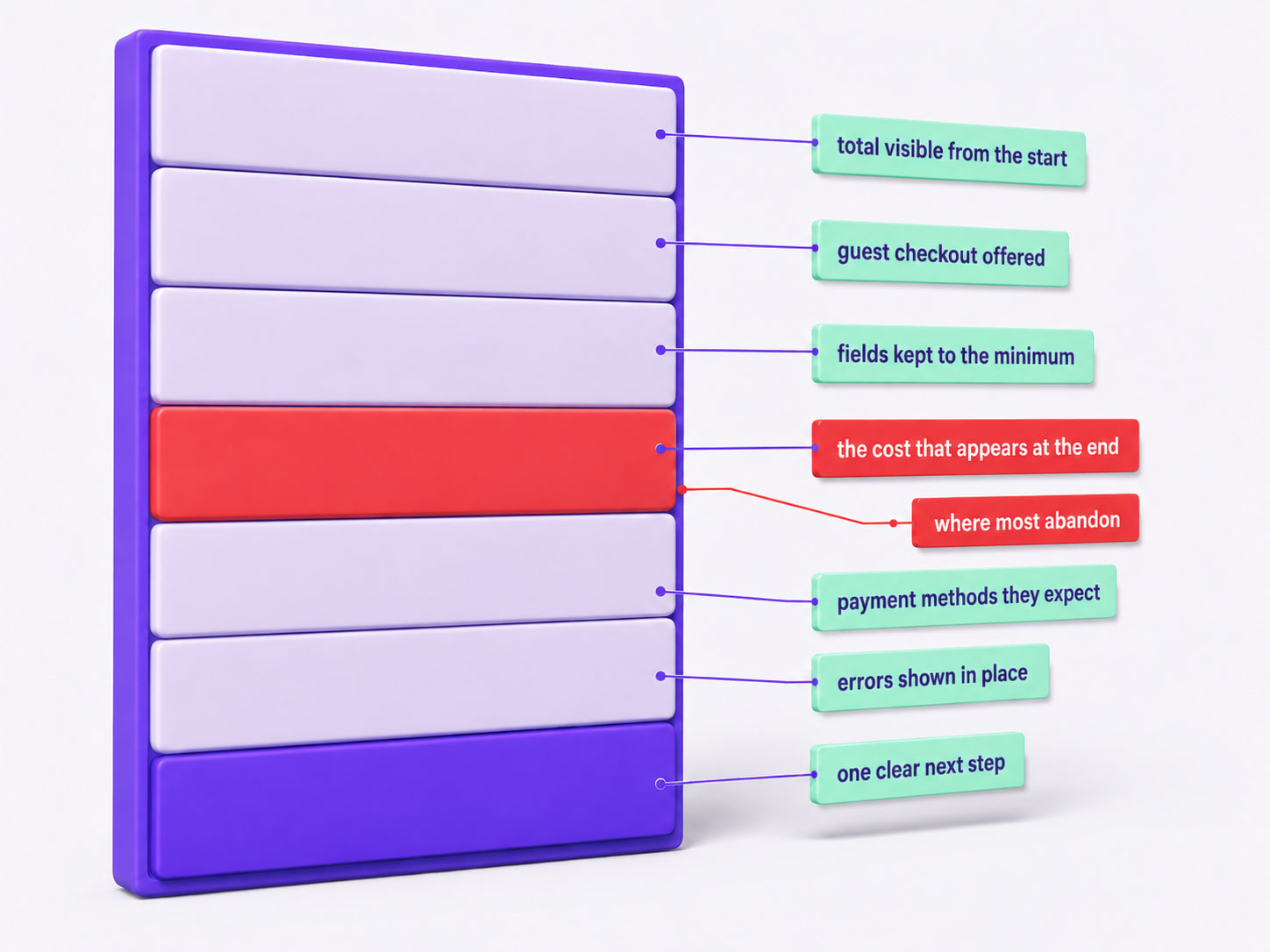
Costs visible early, guest checkout available, fields kept to what is genuinely needed, and errors shown where they happened rather than at the end.
Runs with: conversion rate optimization
Navigation at catalog scale
Category structure, filtering and search that help somebody find one product among thousands without generating crawl problems in the process.
Runs with: ecommerce SEO
Performance and Core Web Vitals
A budget set before the build, script inventory maintained, and load order arranged so the shopper waits for nothing they came for.
Runs with: technical SEO and maintenance
Structured data in the build
Product markup generated from the same record that renders the page, so machine-readable and human-readable facts cannot drift apart over time.
Runs with: catalog management
Measurement that survives launch
Tracking rebuilt as part of the store rather than added afterwards, so paid media and analytics keep working the day the new design ships.
Runs with: ecommerce PPC and CRM
A hundred SKUs or a hundred thousand, the template is the deliverable.
Catalog size changes how much a template decision is multiplied, not whether the method applies. What changes more is how much awkward product data the design has to survive.
We will tell you not to rebuild.
The first thing we do is buy something from your store on a phone. That hour frequently ends the redesign conversation, because the three things costing you money turn out to be a shipping cost revealed too late, a forced account, and a script loading ahead of your product images — all fixable in the store you already have. A full rebuild is the more profitable recommendation and it is often the wrong one.
The rest follows from the same principle. We test templates against your worst products rather than your best. We set a performance budget before the build instead of optimizing afterwards. And we validate changes against completed orders net of returns, which means a change that did not work stays visible rather than being absorbed into a general story about improvement. We built Allegiant as an AI-first agency rather than a traditional shop with AI added on, which in a store means the page a shopper reads and the page a machine reads are the same document.
Store work runs alongside the wider ecommerce program, catalog SEO and the full digital plan. See the work in our case studies.
Six things that keep somebody moving. One that stops them.
Every row below is a decision somebody made, usually years ago, usually for a reason that no longer applies. The last one is the most common and the most expensive.
| Element | How most stores handle it | Allegiant How we handle it |
|---|---|---|
| The total | Assembled as you go | Visible from the start, so nothing arrives as a surprise |
| Account creation | Required before purchase | Guest checkout offered, with an account invited after the order |
| Form fields | Everything the platform allows | Cut to what is genuinely needed to fulfill the order |
| Payment options | Whatever was set up at launch | The methods your buyers expect, reviewed rather than inherited |
| Errors | Shown after submitting | Shown in place, so nobody has to hunt for what went wrong |
| Shipping cost | Revealed at the final step | Shown early — the single most common abandonment trigger |
Take the last row to your own store tonight. Buy something on your phone, with a card, all the way through. Whatever surprised you will surprise the shoppers you are paying to send there.
Four store line items you can stop paying for.
Each is common, each is easier to sell than the alternative, and each solves a problem you probably do not have.
A full rebuild when three fixes would do. It is the most profitable recommendation available and frequently the wrong one. If your leaks are a late shipping cost, a forced account and a slow load order, a redesign fixes them incidentally at many times the price — and introduces new risk in the process.
Design approved on showcase products. A template signed off against three flattering items will break on the forty-word product name, the eleven-variant item and the one with no lifestyle image. Those are the majority of a real catalog, and they are what nobody looked at.
Performance work sold as a phase after launch. Speed is a constraint the build lives inside, not a service applied afterwards. Optimizing a store that was built without a budget means removing things somebody already approved, which is a harder conversation than never adding them.
Conversion-rate improvements reported without returns. A change that increases orders and increases returns has not necessarily helped. Any store report that stops at the confirmation page is measuring intent rather than revenue.
The pattern beneath all four: the most expensive store problems are the ones that never appear in a marketing report.
- Google Search Central — Ecommerce documentation
- web.dev — Core Web Vitals
- Google Search Central — Product structured data
- Google Search Central — Review snippet structured data
- Google Search Central — Consolidate duplicate URLs
- Google Search Central — Creating helpful, reliable, people-first content
- Google Search Central — SEO starter guide
- Google Merchant Center — Product data specification
- Google Ads — About conversion tracking
- Google Search Central — Page experience
- web.dev — Cumulative Layout Shift
- W3C — Web Content Accessibility Guidelines
- FTC — Advertising and marketing business guidance
Ecommerce web design, answered
Straight answers, including the ones that cost us work.
Do we need a full redesign?
Frequently not, and we will say so before quoting one. Most stores lose money at three specific points — a shipping cost revealed at the last step, a forced account, and a load order that puts scripts ahead of the product image. All three are fixable in the store you already have. A redesign is the more profitable recommendation for us and often the wrong one for you. We walk your checkout on a phone first and the findings decide, measured against Google's page experience guidance. Related: conversion work.
Why does checkout matter more than the rest of the store?
Because the shopper has already cost you everything they are going to cost. Media, content and years of visibility work all end at the moment somebody decides whether to complete. Losing them at that point is the most expensive possible outcome and the least visible in a marketing report — traffic is unaffected, impressions are unaffected, and the number that moved sits in your commerce platform rather than in analytics. Google's ecommerce documentation covers the page side of this in detail, and the media you spent getting them there is on our ecommerce PPC page.
How fast does a store actually need to be?
Fast enough that nobody waits for the thing they came for, which is a sequencing question more than a total-weight one. Core Web Vitals measure loading, interactivity and visual stability, and that last one matters most on stores — a layout that shifts as components arrive is how somebody taps the wrong variant. We set a performance budget before the build rather than optimizing afterwards, which is a much easier conversation than removing things somebody already approved. Related: ongoing maintenance.
Should we force account creation at checkout?
No. It asks for commitment before the purchase has happened, it protects nothing you could not capture afterwards, and it is one of the three most common abandonment causes we find. Offer guest checkout and invite the account after the order is placed, when the shopper has a reason to want one. The customer data you were trying to collect arrives anyway, in a system that can actually use it — see CRM integration and how it feeds lifecycle email. Google's people-first guidance points the same direction.
Our product pages look fine. Why would the template be a problem?
Because you are probably looking at the products it was designed against. Templates break on long names, many variants, missing images, out-of-stock states and specification tables that run for screens — and in a real catalog those are the majority rather than the exceptions. We test against the hardest items in your range before approving anything. It is also why product markup should be generated from the record rather than maintained separately, which is covered in catalog management.
How does AI change how a store should be built?
It makes the page a shopper reads and the page a machine reads need to be the same document. Assistants increasingly summarize product options before somebody reaches your store, and content that only exists after a script executes may not be read at all — so a specification table injected after load is invisible to whatever is assembling that summary. Keeping the important content in the page solves the shopper problem and the machine problem simultaneously. Google's guidance on layout stability matters here too, because content arriving late shifts what a person and a parser both see. The same conclusion from the other direction is on ecommerce SEO and our GEO page covers what can honestly be claimed.
Will a redesign hurt our search visibility?
It can, and this is where store rebuilds most often cause damage nobody predicted. URLs change, canonical signals get rebuilt, structured data is regenerated by a new theme, and internal linking is redrawn — any of which can undo years of accumulated visibility. Google's guidance on consolidating duplicate URLs matters enormously during a migration. We plan the mapping before the build rather than after launch, alongside our technical practice.
What about accessibility?
It is part of the build rather than an audit afterwards. The Web Content Accessibility Guidelines are the published reference, and most of what they ask for — clear labels, sufficient contrast, keyboard navigation, meaningful alt text — improves the store for everybody, particularly on a phone. Obligations vary by jurisdiction and by the nature of your business, so your counsel governs your position rather than us; nothing here is legal advice. The same alt-text discipline supports product visibility.
Will our tracking survive a rebuild?
Only if somebody plans for it, and it is one of the most common post-launch failures we are called in to fix. A new store frequently ships with conversion tracking half-configured, which means paid campaigns lose their signal at exactly the moment performance is being judged. Google's conversion tracking documentation sets out what has to be in place. We rebuild measurement as part of the store rather than afterwards, so paid media keeps working the day it launches.
How do you know a change actually worked?
By checking completed orders in your commerce platform, net of returns, rather than a conversion rate that stops at the confirmation page. A change that increases orders and increases returns has not necessarily helped, and in sized or fitted categories that happens more often than teams expect. It also means we can be wrong visibly — a change that did not work stays identifiable rather than being absorbed into a general narrative. Same standard as our conversion practice, and the starter guide is candid about measurement generally.
Do reviews belong on product pages?
Yes, and they should be in the page rather than loaded by a script afterwards, for the same reason specifications should be. Google documents review snippet markup for representing them properly. They answer the questions your product copy did not, which reduces returns as much as it lifts orders — and they are frequently the most persuasive content on a product page precisely because you did not write them. Generation and response is covered in reputation management.
What makes Allegiant different from the store agency we use now?
Three things you can verify. We buy something from your store on a phone before proposing anything, and we will tell you not to rebuild when three fixes would do. We test templates against your worst products rather than your best. And we validate changes against completed orders net of returns, so a change that did not work stays visible. We are also built as an AI-first agency rather than a traditional shop with AI added on. Start with the A.R.C. Report, or read the FTC's advertising guidance against whatever your current agency claims.
Find out what your store is costing you.
The A.R.C. Report covers your whole marketing position. For a store we complete a purchase on a real device, record every surprise in the order it appears, inventory what loads before your product images, and test your template against the hardest products in your catalog. Findings are yours whether or not we work together.
- A full purchase completed on a phone, on an ordinary connection
- Every barrier and surprise recorded in the order a shopper meets it
- Third-party scripts inventoried with what each one costs
- Product template tested against your most awkward items
- Structured data checked against what is visible on the page
- A straight answer on whether you need a rebuild or three fixes
Explore the wider program: ecommerce digital marketing, ecommerce SEO, ecommerce PPC, all services and the A.R.C. Report.
Tell us your platform and roughly how many products you carry, and we will show you where the store is leaking.
No cost, no commitment. We will follow up by email or phone to walk you through the findings.

