
Reach the buyer
before they start searching.
Search finds the handful of buyers looking for you today — a homeowner with a failing system, a facility manager with an aging chiller, a franchise candidate comparing brands, a manufacturer six months from an RFP. Meta is the only channel that reaches the far larger number who will need you this year and have not started looking yet. We run it as an AI-first agency — machine-optimized delivery, AI-assisted creative testing, and every result reconciled against booked jobs rather than platform-reported wins.
A few are searching today. Far more will need you this year.
In any market, the number of buyers actively searching at this moment is small. The number whose equipment is nine years old, whose contract renews next spring, who are quietly evaluating franchise brands, or who have been deferring a capital purchase for two years is very much larger. Search reaches the first group. Paid social is the only channel that reaches the second.
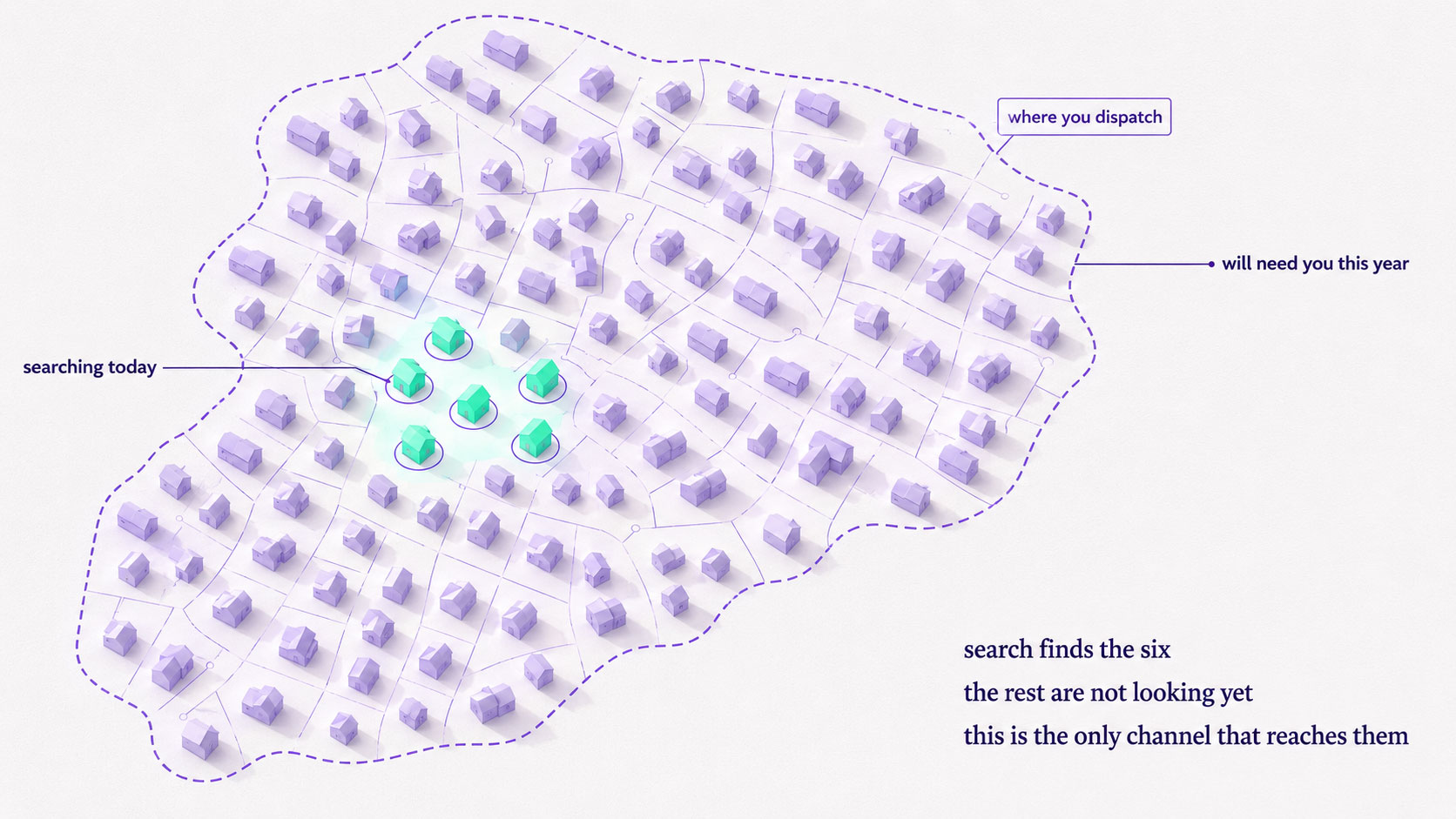
That is the whole argument for the channel, and it is why an operator should think about Meta differently from how a retailer does. You are not competing for a shopper's attention. You are getting your name in front of a buyer early enough that when the need arrives, you are already the company they think of. For a high-ticket remodel, a multi-site rollout or a nine-month capital decision, that head start is often the entire difference.
It is also why paid social is the wrong first purchase for some operators, and we will tell you which you are. If people are already searching for your service and not finding you, the fix is local visibility and paid search. If the phone rings and nobody answers, no amount of awareness spending survives contact with that. Creating demand you cannot yet capture is the most expensive mistake in the channel, and most agencies will happily sell it to you.
Where we differ from every agency you are likely comparing us against is what happens after the campaign runs. Most report impressions, reach and platform conversions — numbers the platform generates about itself. We reconcile against jobs that reached your business, and we report the gap. That conversation is less comfortable in month two and it is the reason our partners stay past year three.
And because we are an AI-first agency, paid social does not run in isolation. The creative, the offers and the audiences feed the same entity work that decides whether AI platforms recommend you when a buyer asks an assistant who to call — which is increasingly how the search half of this equation begins.
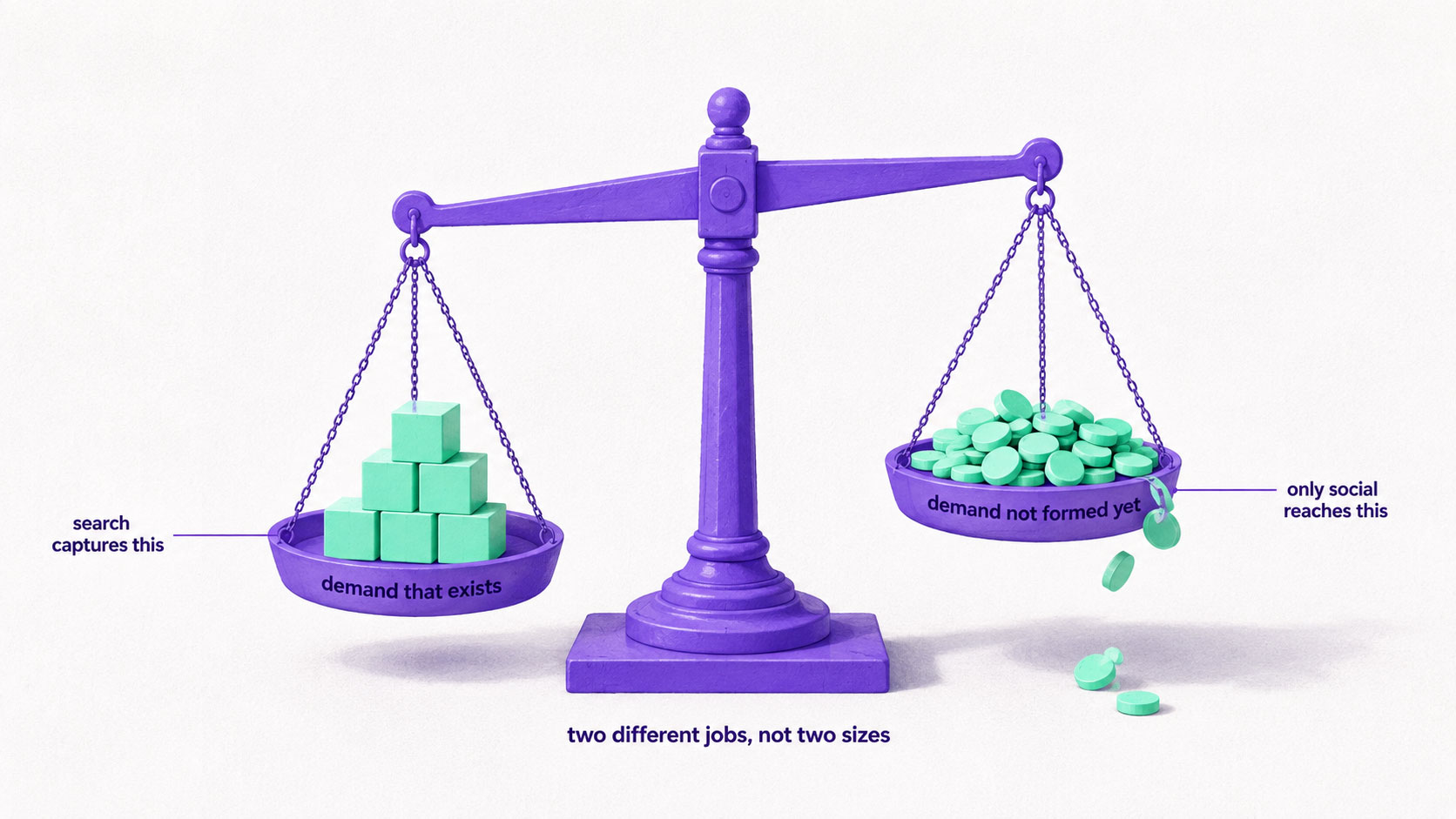
Search captures demand. Social creates it.
These are not competing channels and they are not interchangeable. Running one and calling it a marketing program leaves the other half of your market untouched — and which half depends entirely on what you sell and how long people think before they buy.
Meets the buyer mid-decision
- They already know they have a problem and are choosing between companies.
- Intent is high, competition is direct, and you are paying for the same clicks as everyone else in your market.
- Volume is capped by demand. You cannot buy more searches than exist.
- Best for emergency and replacement work where the decision window is hours.
- Covered in depth on our paid search page.
Arrives before the decision exists
- They are not looking for you, which means the creative has to earn the second of attention.
- Competition is indirect, so a strong offer and real photography out-perform a bigger budget.
- Volume is set by your budget rather than by how many people searched today.
- Best for remodels, replacements, maintenance plans and building a season before it starts.
- Pairs with remarketing and landing pages to close what it opens.
Four things we do that most agencies will not.
These are not features. They are the four places a paid social engagement quietly goes wrong, and each one is a commitment we will put in a contract.
The pixel history and the audiences built from it were paid for by you and describe your customers. Every automated system in the account learned from that history, so rebuilding it costs months of performance you already bought.
Ask any agency you are considering where the account lives. If the answer is their business manager, you are renting your own data, and you will find out the day you leave.
- Account, pixel and audiences created under your business, with our access granted.
- Confirmed in writing before a single dollar is spent.
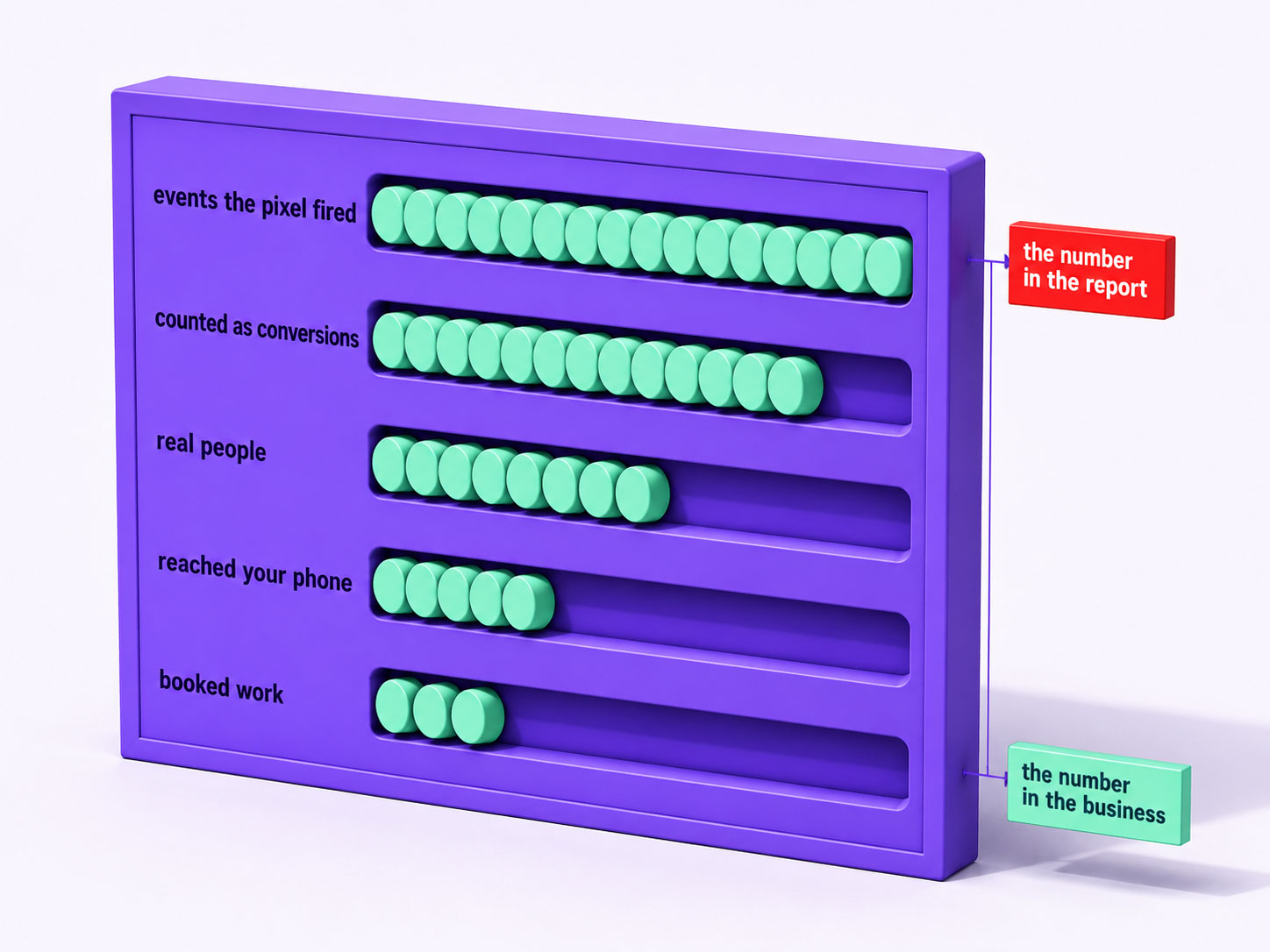
Meta's delivery learns from whatever the pixel counts. A setup counting page views or partial form starts as leads does not fail loudly — it confidently teaches the account to buy more of them, and the report looks excellent.
The test takes an hour and almost nobody runs it: take last month's reported conversions and find them in your CRM. Where the two disagree, the smaller number is the real one.
- Every counted conversion traced to something that reached a human being.
- Booked-job reconciliation in the monthly report, whether or not it flatters us.
The creative that works is the work itself — a finished install, a rebuilt panel, a line running, a crew on site, a before-and-after a buyer recognizes as their own situation. Agencies that came up on ecommerce reach for polish and it reliably underperforms.
We show you how to shoot it on a phone in fifteen minutes a week, because a shoot you cannot sustain is a campaign that dies in month three.
- A repeatable capture routine your crews can actually keep up.
- AI-assisted variant testing across offers and hooks, so learning compounds rather than restarting.
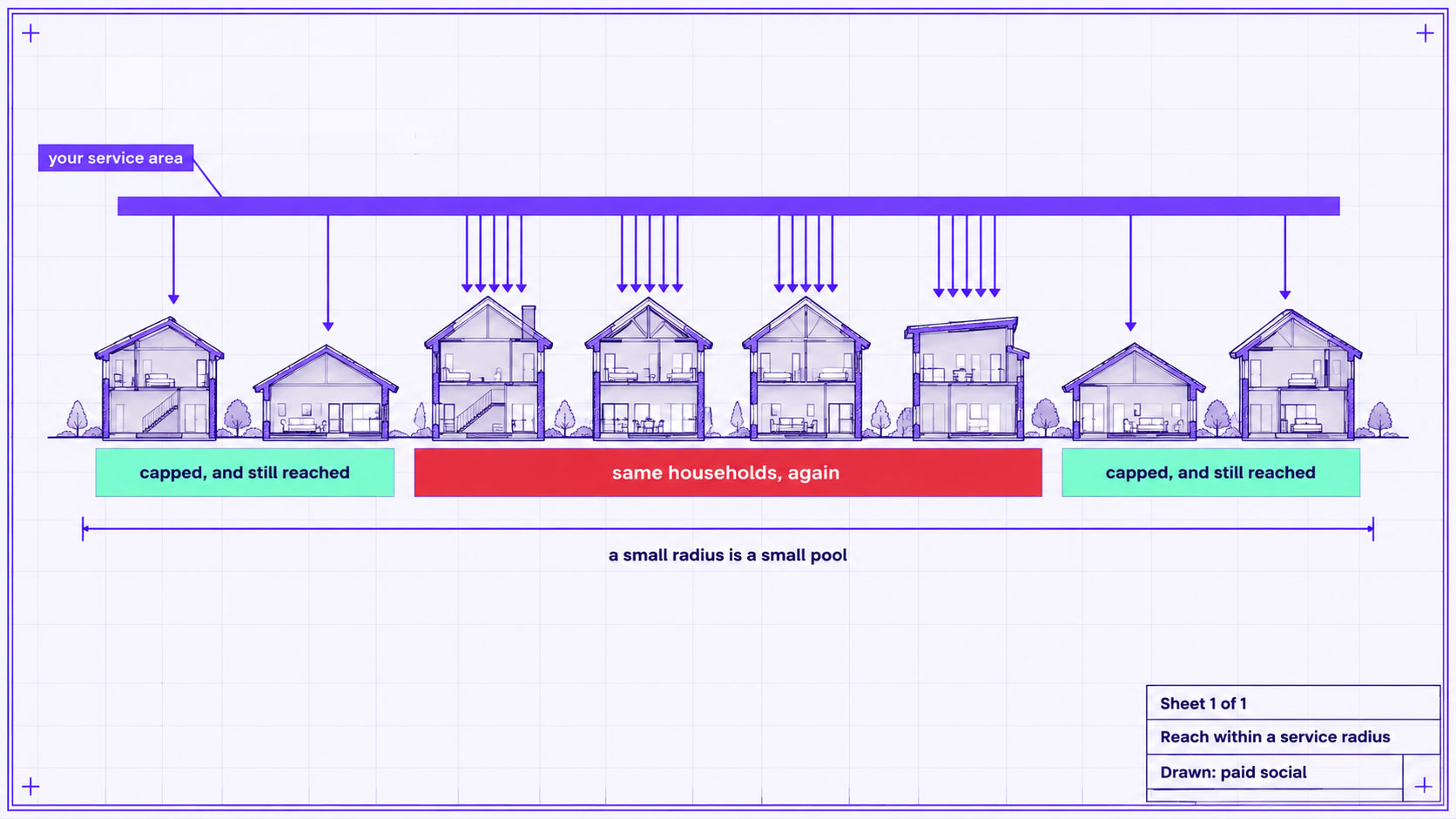
A contractor's service area holds a finite number of households. Spend enough and the same families see the same ad repeatedly, which stops being reach and starts being irritation — a problem a national brand never encounters.
This is the single most common reason a promising contractor account goes flat in month four, and it is invisible in a report that only shows impressions climbing.
- Frequency capped deliberately and creative rotated before fatigue, not after.
- Budget matched to the size of the territory rather than to an arbitrary target.
A national brand has an audience. You have a neighborhood.
Nearly all published paid social advice is written for businesses with unlimited addressable audience. A contractor working a thirty-minute radius operates under a completely different constraint, and it changes almost every setting that matters.
What changes when the pool is small
Frequency becomes the governing number. In a large market you can spend more and reach more people. In a service area you can only spend more and reach the same people more often. Past a certain point additional budget buys annoyance, and the platform will happily keep selling it to you because delivery is still technically working.
Creative fatigue arrives in weeks rather than quarters. The same households seeing the same before-and-after for the fifth time stop registering it. A rotation schedule that would be paranoid for a national advertiser is simply necessary here, which is why we build the capture routine before the campaign rather than after.
And the geography has to match dispatch reality, not ambition. A radius drawn around where you would like to work generates leads you cannot service profitably, and on paid social you pay for every one of them. We set it against where your trucks actually go, then widen it deliberately when capacity allows.
Multi-location operators and franchise systems have the inverse problem — many small pools rather than one — which is a coordination question. We run those as a portfolio, with shared creative and per-location budgets, so a strong market subsidizes a new one on purpose rather than by accident.
- Frequency capped against the size of the actual pool
- Creative rotated on a schedule, before fatigue shows in the numbers
- Radius matched to dispatch, not to ambition
- Budget ceilinged where more spend stops buying more people
- Multi-location run as a portfolio, with deliberate cross-subsidy
- Saturation reported as a finding, not hidden behind rising impressions
Ownership, then creative, then the numbers that matter.
Every engagement starts by establishing what you own and what your current account is actually counting, because both determine whether anything built on top of them can be trusted.
Foundation
- Account, pixel and audience ownership confirmed under your business
- Conversion definitions agreed against what counts as a real lead for you
- Service radius set to where your trucks genuinely go
- Destination checked so the traffic lands somewhere that converts
Creative and offer
- A capture routine your crews can sustain without a producer
- Offers built around your actual margin, not a discount you regret
- AI-assisted variant testing across hooks, formats and audiences
- Frequency capped from launch rather than corrected later
Reconcile and scale
- Reported conversions reconciled against booked jobs in your records
- Saturation and fatigue reported before they show up as decline
- Budget scaled only where the territory can absorb it
- Winning creative fed into remarketing and the wider program
What a Meta engagement covers
Paid social is one channel inside a program. These are the pieces we run alongside it, and every one of them is a service you can read about and hold us to.
Campaign strategy and management
Structure, audiences, budgets, frequency and testing, run against your territory and your capacity rather than against a template.
Pairs with: paid search
Creative production and testing
A sustainable capture routine, edited into ad-ready creative, tested with AI assistance so learning compounds instead of restarting each quarter.
Pairs with: content writing
Landing pages that convert
Paid social sends people who were not looking for you. The destination has to earn a second of attention, and most contractor sites were never built for that job.
Pairs with: landing pages and website design
Lead handling and tracking
Call tracking, form routing and CRM integration, so a lead is followed to its outcome rather than counted at the click.
Pairs with: CRM
Retargeting the people you reached
Awareness that is never followed up is awareness you paid for once. Retargeting closes what the first impression opened.
Pairs with: remarketing
AI visibility across the program
The same brand facts, reviews and content that make paid social work also decide whether AI assistants name you when a buyer asks who to call.
Pairs with: AI SEO and reputation
One truck or two hundred, the discipline is the same.
We serve single-location contractors, regional multi-location operators, national franchise systems and private equity portfolios. The channel works differently at each scale, and the accounting never changes.
An AI-first agency that reports booked jobs.
We built Allegiant as an AI Digital Marketing agency rather than a traditional shop that added AI to a service list. That shows up in how we run every channel — machine-assisted creative testing, delivery optimized against verified outcomes, and the entity and content work that decides whether AI platforms recommend you when a buyer asks an assistant instead of typing a search.
The competitive difference is what we are willing to report. Most agencies show you platform-generated numbers about their own performance. We reconcile against your records and show the gap. We tell you when a channel is wrong, when a budget has hit the ceiling of your territory, and when the problem is not the advertising at all. Those conversations cost us revenue and they are why partners stay.
Paid social sits alongside paid search, SEO, display and the full digital program. See the work in our case studies.
The number in the dashboard and the number in your business.
Every row below is something you can ask your current agency for this week. The last one is the row almost no report contains, and it is the only one that tells you whether the money worked.
| What gets reported | What most agencies show | Allegiant What we show instead |
|---|---|---|
| Reach and impressions | Reported as the headline | Reported as an input, with frequency beside it so saturation is visible |
| Platform conversions | Reported as results | Traced to something that reached a person before it counts |
| Cost per lead | Compared to an industry benchmark | Compared to your own prior months, because benchmarks describe someone else |
| Creative performance | Best performer highlighted | Fatigue curve shown, so rotation happens before decline |
| Territory capacity | Not mentioned | Stated plainly when more budget stops buying more people |
| Booked jobs from the channel | Not reported | Reconciled against your own records every month, gap included |
If you take one thing from this page, take the last row to whoever runs your account now. The answer, and how comfortable they are giving it, will tell you more than any proposal.
Four things you can stop paying for
Every one of these is common, profitable for the agency selling it, and worth nothing to you. We would rather lose the line item than defend it.
Reach and impressions reported as results. They describe how much was bought, not what it did. On a small service area they climb reliably while frequency quietly turns reach into repetition, and a report that leads with them is hiding the number that matters.
Industry benchmark comparisons. Cost-per-lead and click-through benchmarks come from aggregated panels of self-selected advertisers describing someone else's offer, market and creative. Your only meaningful comparison is your own last quarter.
Account access sold as a service. The pixel, the audiences and the history were built with your money and describe your customers. Holding them inside an agency structure and calling it managed access is charging you for a hostage.
Budget scaled past what your territory can absorb. More spend in a saturated service area buys more impressions to the same households. Any agency earning a percentage of spend has an incentive not to mention this, which is exactly why you should ask about it.
The pattern beneath all four: the numbers easiest to grow are the ones least connected to whether your phone rang.
Facebook and Meta advertising for home services, answered
Straight answers, including the ones that cost us work. Ask any agency you are considering the same questions.
Does Facebook advertising actually work for contractors?
Reliably, for the right jobs. It reaches buyers before they search, which suits remodels, replacements, maintenance and service contracts, franchise recruitment and any considered purchase with a long runway. It is weaker for emergency work, where somebody with a burst pipe goes straight to local services ads or paid search. Most home services operators need both, sequenced — capture first, then create demand once you can absorb it. If your phone already rings and nobody answers it, fix that before either.
How much should we spend on Meta ads?
Enough to reach your service area at a sensible frequency, and not a dollar past that. The ceiling is set by how many households are in your territory, not by a percentage of revenue or an industry rule of thumb — spend beyond it and you are buying repeat impressions to the same families. We work the number out from your radius and your capacity during the audit, and we will tell you when you have hit it. An agency earning a percentage of spend has every reason not to.
Our leads look cheap but they never book. Why?
Usually the pixel is counting something that is not a customer — a page view, a partial form start, a duplicated event — and delivery is confidently optimizing toward more of it. Take last month's reported conversions and find them in your CRM; where the two disagree, the smaller number is real. The other common cause is a destination that does not convert, which is a landing page problem rather than an advertising one.
What creative works best for a home services business?
Your actual work. Before-and-afters a buyer recognizes, crews or lines on site, a finished install, a short clip of the owner or an engineer explaining what goes wrong at year nine. Polished stock imagery consistently underperforms for the trades, which surprises agencies that came up on ecommerce. The constraint that matters is sustainability — we build a capture routine your crews can keep up in fifteen minutes a week, because a shoot you cannot repeat is a campaign that dies in month three.
Our ads did well for two months and then dropped. What happened?
Almost certainly frequency. A contractor's service area holds a finite number of households, so the same families see the same ad repeatedly and stop registering it — a problem a national advertiser rarely hits. It is invisible in a report that only shows impressions climbing. The fix is capping frequency from launch, rotating creative on a schedule rather than after decline, and accepting a budget ceiling matched to the territory. That is why we build the capture routine before the campaign.
Who should own the ad account and the pixel?
You should, and it is worth checking today rather than the day you leave. The pixel history and audiences were paid for by you and describe your customers, and every automated system in the account learned from them — rebuilding that costs months of performance you already bought. We build in your business manager with our access granted, confirmed in writing before launch. Ask any agency you are considering where the account lives; the answer is revealing. Same position we take on your data in the CRM.
Are there rules that limit who we can target?
For most home services work, no — advertising a service call, a replacement or a remodel sits outside the restricted categories. Two edges catch contractors: advertising financing on a job can fall under credit, and advertising open roles for technicians falls under employment. Both carry federal obligations independent of the platform, and both change what targeting is available. We settle which applies from your actual offer before the account is built, and where it is genuinely arguable we say so and point you to counsel rather than picking the convenient reading.
How does this fit with SEO and AI search?
Closely, and that is a large part of why we run it. Paid social builds familiarity and generates the reviews, branded searches and content signals that feed your organic and AI visibility. When a buyer later asks an assistant who to call, the businesses AI platforms name are the ones with a consistent, corroborated presence — which paid social contributes to directly. We run it inside one program with SEO and AI SEO rather than as an isolated channel.
We are a multi-location operator. Does this scale?
It scales well and it changes shape. Instead of one audience you have many small ones, so the work becomes coordination — shared creative produced once, per-location budgets set against each territory's size, and brand-level control over what runs where. Run properly, a strong market can subsidize a new one deliberately. We do this for franchise systems and private equity portfolios, with the same reconciliation standard applied at every location so roll-up reporting means something.
What makes Allegiant different from the agency we use now?
Three things you can verify rather than take on faith. Your account and pixel are yours from day one. Every monthly report reconciles platform conversions against jobs that reached your business, gap included. And we tell you when to stop — when the territory is saturated, when the channel is wrong, or when the problem is not advertising at all. We are also built as an AI-first agency rather than a traditional shop with AI added on, which shapes how the whole program runs. Start with the A.R.C. Report and judge us on the findings.
See what your paid social is actually producing.
The A.R.C. Report covers your whole marketing position. Where Meta is in the plan, we check who owns your account and pixel, whether the conversions being reported correspond to booked jobs, and whether your budget has passed what your territory can absorb. Findings are yours whether or not we work together.
- Account, pixel and audience ownership — who actually holds them
- Reported conversions reconciled against work that reached your business
- Frequency and saturation against the size of your service area
- Creative fatigue and whether rotation is keeping ahead of it
- Service radius compared to where your trucks genuinely go
- A straight answer if paid social is the wrong spend for you right now
Explore the wider program: all services, paid search, SEO, AI SEO and the A.R.C. Report.
Tell us your trade and the markets you serve, and we will tell you what your paid social is buying.
No cost, no commitment. We will follow up by email or phone to walk you through the findings.

