
Earn the citation
when AI writes the answer.
When ChatGPT, Google AI Overviews, Perplexity or Gemini answers a buyer's question, a handful of sources get cited and everyone else is invisible. Generative Engine Optimization is the discipline of becoming one of those sources — built on published research, executed with the same rigor we bring to traditional SEO, and measured honestly.
Buyers stopped clicking through. The answer became the destination.
Generative engines — the AI systems behind ChatGPT, Google AI Overviews and AI Mode, Perplexity, Gemini and Microsoft Copilot — do not hand your buyer ten blue links. They read a set of sources, write one answer, and cite the sources they trusted. If your business is in the citations, you are in the conversation. If it is not, a competitor is.
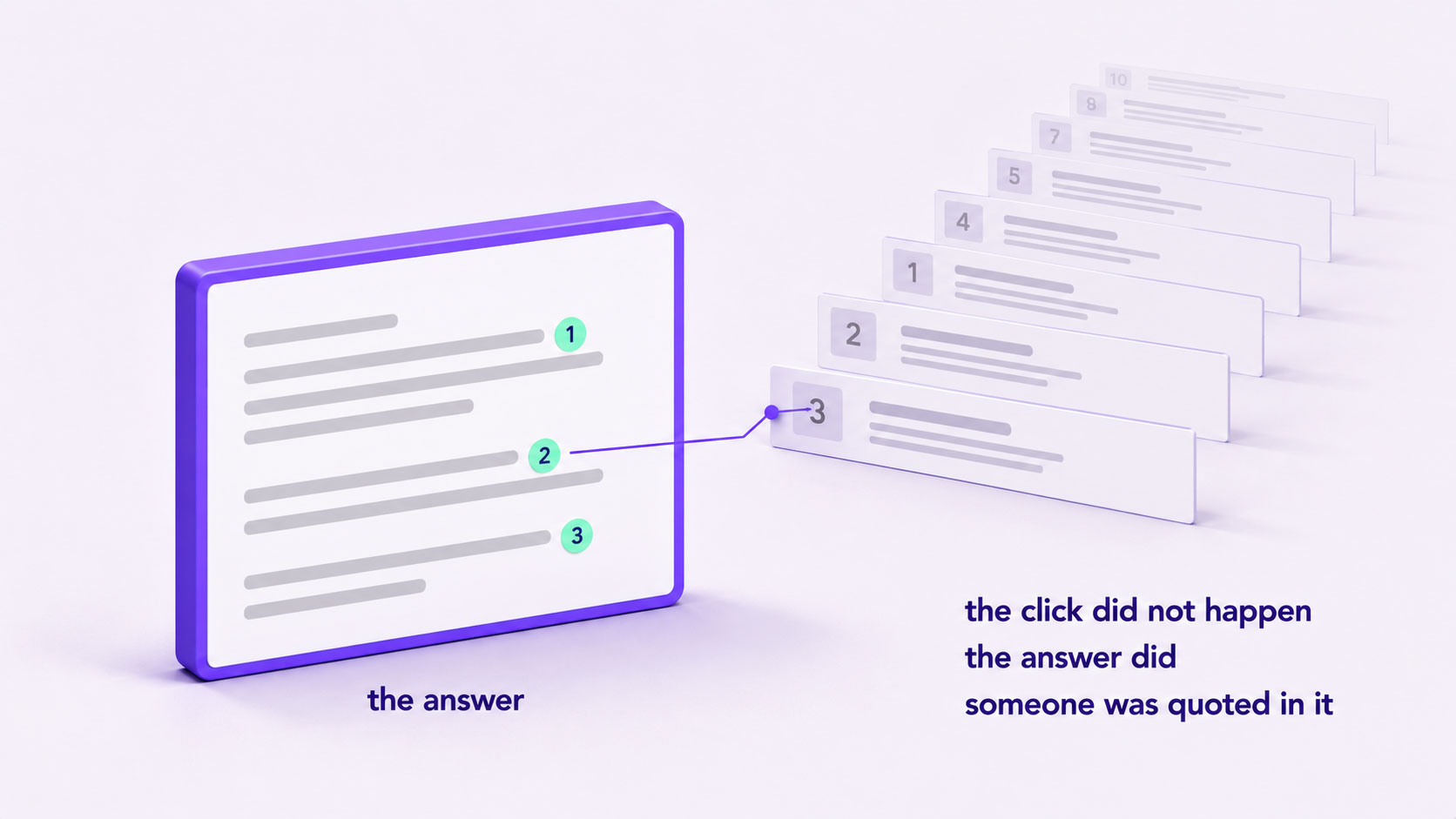
The scale of that shift is measurable, not theoretical. ChatGPT passed 800 million weekly active users by mid-2025, per data cited in Semrush's 2025 AI search study. And Semrush projects AI search visitors will surpass traditional organic visitors in 2028, with each of those visitors converting at 4.4 times the rate of a traditional organic visitor. Fewer visits, worth far more each: that is the trade generative engines are forcing, and it rewards the businesses that get cited.
Two of those numbers deserve a second read. Almost 90% of the pages ChatGPT search cites rank outside the top twenty in traditional results — meaning citation visibility is a genuinely different contest from ranking, one you can win without owning position one. And half the links in ChatGPT 4o responses point to business and service websites like yours, not just forum threads and news sites. The seats at the table exist.
One of the four numbers above is a projection and we have labeled it as one. The 2028 crossover has not happened; it is a modeled expectation published by a research team, and it belongs in a plan as an assumption rather than in a report as a fact. We would rather show you the label than let a forecast quietly become a finding.
Generative Engine Optimization is how you earn one of those seats, and it works alongside — never instead of — the technical and content foundations you have already built, including the site itself. If the crawl is broken or the content is thin, no amount of citation work compensates, which is why GEO engagements start with technical health rather than with tactics.
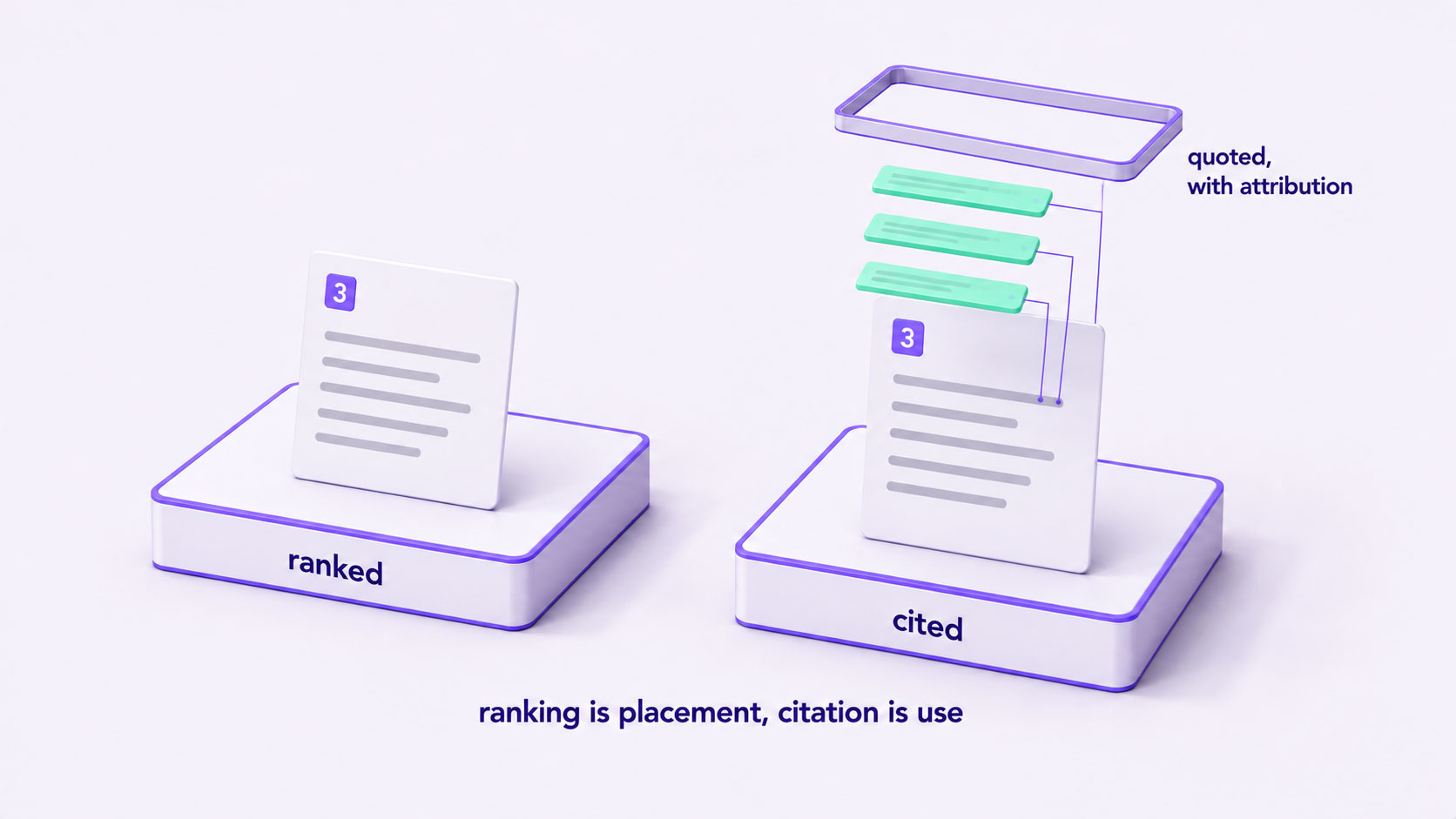
Ranking is placement. Citation is use.
These are two different contests and they are won differently, which is the single most useful thing to understand about this discipline — because it means a business that cannot realistically take position one can still be the source an engine quotes.
A position in a list
- Won by relevance and authority against everyone else competing for the same query.
- Rewards incumbency. The sites already at the top are hardest to displace, and displacing them is the whole job.
- Measured by position, which is a number that exists whether or not anybody clicked.
- The click is the outcome. If the reader does not click, the ranking produced nothing.
- One page, one slot. Ten results, and the tenth is worth a fraction of the first.
A passage the engine used
- Won by being quotable — a clear claim, in one passage, with its source named and its date visible.
- Open to challengers. Almost 90% of pages ChatGPT search cites rank outside the traditional top twenty.
- Measured by citation share across a tracked prompt set, against named competitors.
- The mention is the outcome. The reader may never visit, and your business is still the recommendation.
- Several sources per answer. There is more than one seat, and they are not allocated by rank.
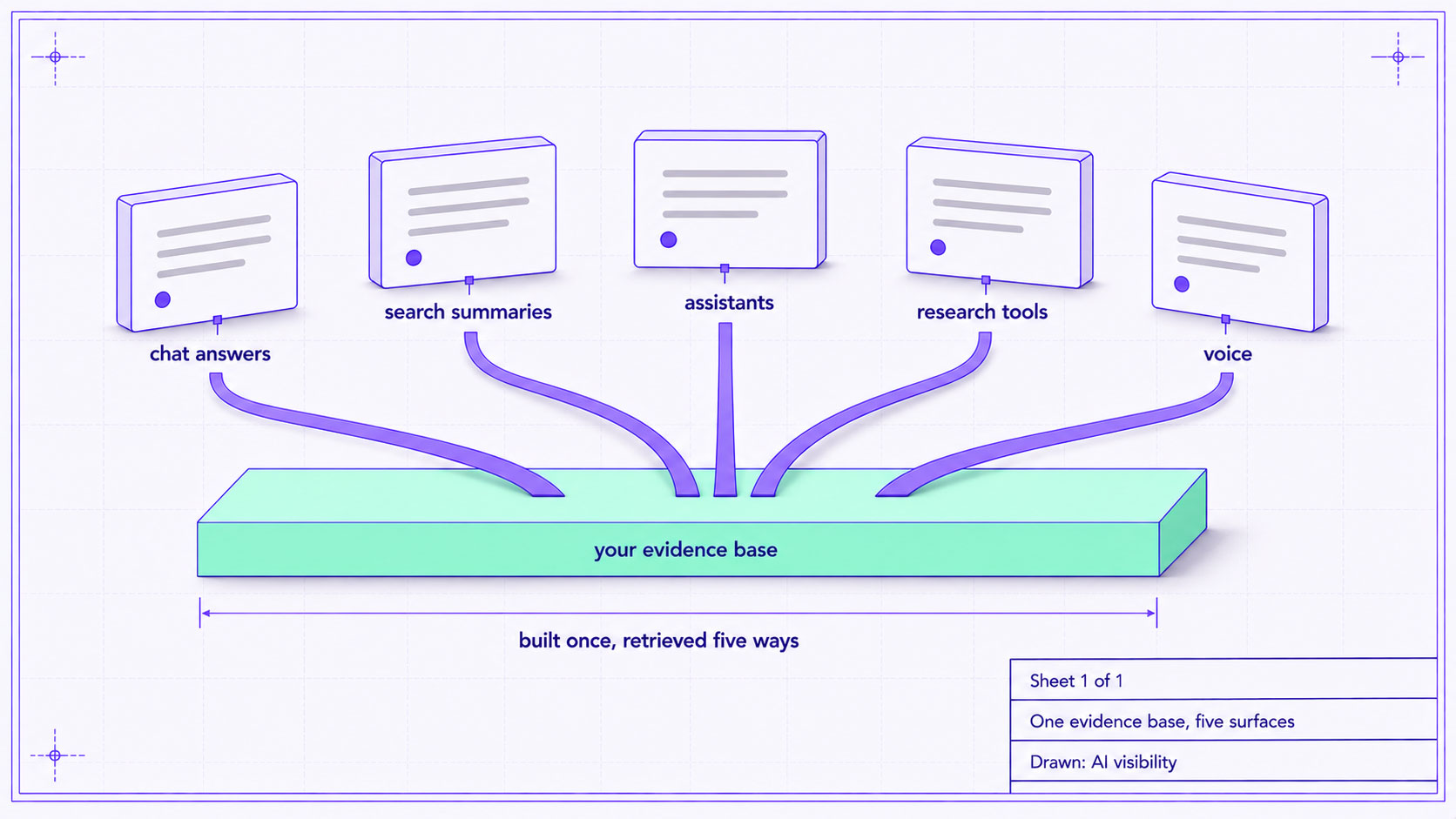
One discipline, five surfaces where your buyers now ask.
Each generative engine gathers, weighs and cites sources differently. A serious GEO program treats them as distinct channels with shared foundations — not one checkbox.
Citation behavior favors clear, chunkable content and recognized entities — and its cited pages frequently rank outside the traditional top twenty, which makes it winnable ground for challengers.
That is the most actionable fact on this page. A business that will not realistically reach position one for a competitive term can still be the source quoted in the answer to it.
- Self-contained passages that answer one question completely, so a fragment survives extraction.
- Entity consistency, so the engine can be confident which business it is naming.
AI answers layered onto the world's dominant search engine. Google's own documentation says standard SEO best practices are what qualify you — no special files, no secret markup. Your fundamentals are the entry fee.
This is worth reading before buying anything sold as an AI-specific technical product. Where a vendor claims a proprietary file or tag is required, the platform's own documentation is the thing to check first.
- The fundamentals, done properly — crawlability, structure, content quality, intent alignment.
- Nothing exotic, because the documentation does not describe anything exotic.
A citation-first answer engine where every claim carries a visible source. Dense, well-attributed, factually precise content earns placement here — exactly the content quality bar we build to.
It is also the easiest surface on which to check your own work, because the sources are shown rather than inferred, which makes it a useful early read on whether an evidence base is landing.
- Claims that name their source in the sentence rather than in a footnote nobody extracts.
- Precision over reach — a narrower claim you can support beats a broad one you cannot.
Google's and Microsoft's assistants, plus the platforms still emerging. Entity clarity and consistent brand facts across the open web keep you legible to all of them — work that compounds instead of fragmenting.
This is the argument against per-engine tactics. Chasing each new surface separately produces work that expires; building one clean, consistent entity produces work that carries to the next engine automatically.
- One set of brand facts, identical everywhere an engine might look.
- Directory accuracy and profile consistency as entity work, not as listings admin.
GEO is one lane of AI visibility. Here is exactly where it sits.
"AI SEO" gets used as a catch-all, and sloppy definitions produce sloppy strategy. At Allegiant, Generative Engine Optimization has a precise job: earning citations and presence inside AI-generated answers.
Four lanes, one strategy
Generative Engine Optimization is a sibling discipline to three others we practice, each with its own page because each has its own intent, tactics and measurement. Traditional SEO earns rankings and clicks in classic search results — crawlability, content quality, links and intent alignment, the foundation generative engines still draw from when they select sources, owned by our SEO agency practice.
Answer Engine Optimization structures content to win direct-answer surfaces — question-and-answer formats, featured-answer targeting and extraction-ready page architecture. Closely related, distinct focus: see our Answer Engine Optimization service. LLM Optimization shapes how large language models themselves represent your brand — entity consistency, brand-fact accuracy, and presence in the sources models learn from and retrieve. That model-facing work lives on our LLM Optimization page.
Generative Engine Optimization is the citation lane: when a generative engine composes an answer to a buyer's question, GEO is the work that makes your pages the ones it reads, trusts and names. All four disciplines run together inside our AI SEO agency program under the OMNIVIZ™ framework — one strategy, four coordinated lanes, zero duplicated effort.
The reason the distinction matters commercially is that the four lanes fail differently. A page can rank and never be cited. A brand can be described accurately by a model and never appear in an answer. Buying one lane and calling it AI visibility is how programs end up busy and invisible at the same time.
- Traditional SEO — rankings and clicks in classic results
- Answer Engine Optimization — direct-answer surfaces and extraction
- Generative Engine Optimization — citations inside composed answers
- LLM Optimization — how models represent your brand
- One evidence base feeding all four rather than four separate efforts
- One measurement frame, so the lanes can be compared honestly
A 30/60/90 rhythm engineered for visible progress.
Every GEO engagement starts with your actual baseline — where you are cited today, where you are absent, and why — so the plan is built on your data, not a template.
Baseline and foundations
- Citation audit across the five major AI platforms
- Entity and structured-data review against how engines resolve you
- AI crawl-access check, because a blocked agent cites nobody
- Content inventory scored for citation-worthiness
Build and earn
- Answer-first restructuring of the pages that carry your revenue
- Evidence-rich content production with sources named in the sentence
- Entity reinforcement across everywhere an engine looks
- Citation-network outreach where engines actually draw from
Measure and compound
- Citation share, AI-referred sessions and lead quality against the day-one baseline
- What earned citations gets scaled; what did not gets rebuilt and re-checked
- Competitor citation movement reported alongside your own
- The numbers and the reasoning, not one without the other
Our Generative Engine Optimization services, pillar by pillar
Allegiant's GEO engagements run on the five pillars of the OMNIVIZ™ framework. Nothing exotic, nothing hand-waved — five workstreams with named deliverables and inspectable output.
Entity Authority Building
Generative engines cite entities they can verify. We build and reinforce your entity footprint — consistent organization facts, aligned profiles, directory accuracy and the authority signals that make an engine confident naming you.
Related: directory accuracy
Answer-First Content Architecture
Pages restructured so the answer leads and the evidence follows — extraction-ready headings, self-contained passages and the direct-response patterns generative engines quote.
Built with our content writing team, never bolted on.
Multi-Source Citation Network
Engines trust sources that other trusted sources reference. We earn your presence in the publications, profiles and reference points engines actually draw from — aimed at machines and humans alike.
Related: reputation and content strategy
Technical AI Readiness
Crawl access for AI agents, clean structured data, fast server-rendered content, and zero JavaScript walls between engines and your pages.
Rides on the same technical SEO discipline that protects your Google visibility.
AI Visibility Monitoring
Monthly citation audits across ChatGPT, AI Overviews, Perplexity, Gemini and Copilot: where you were named, where competitors were named instead, and what changed.
Measurement is a pillar here, not an afterthought.
Grounded in the research
The foundational GEO study — Aggarwal et al., presented at ACM KDD 2024 — measured visibility gains of up to 40% in its generative-engine benchmark, with verifiable statistics, credible quotations and cited sources among the strongest-performing optimizations.
That is the playbook we execute: evidence-rich content, honestly sourced.
Ask an assistant who to call, and it names a specific business.
Ask an AI assistant for the best HVAC company nearby and it recommends businesses by name. Those recommendations are earned the GEO way: verified entity facts, consistent profile data, genuine review signals and locally relevant content engines can trust. For franchise systems and multi-location operators the work multiplies but the discipline is identical — every location needs its own clean entity, and the brand needs one consistent story across all of them.
We measure what can be observed and label the rest.
GEO measurement is younger than rank tracking, and anyone selling you a single magic score is selling. We measure four families of evidence, reviewed monthly: citation share — how often your brand and pages are named in AI answers to a tracked prompt set, against named competitors; AI-referred sessions — analytics-verified visits arriving from ChatGPT, Perplexity, Gemini, Copilot and AI Overviews click-throughs; entity health — the accuracy and consistency of your brand facts everywhere engines look; and assisted revenue — conversions and lead quality from AI-sourced visitors.
Where attribution is genuinely murky — and in AI search it sometimes is — we say so in the report rather than dressing up a guess. That is the same evidence-first standard we apply on every engagement we publish, and it is why operators stay.
GEO runs alongside the rest of the program — all services, paid search, ecommerce SEO — under one strategy rather than as a separate initiative.
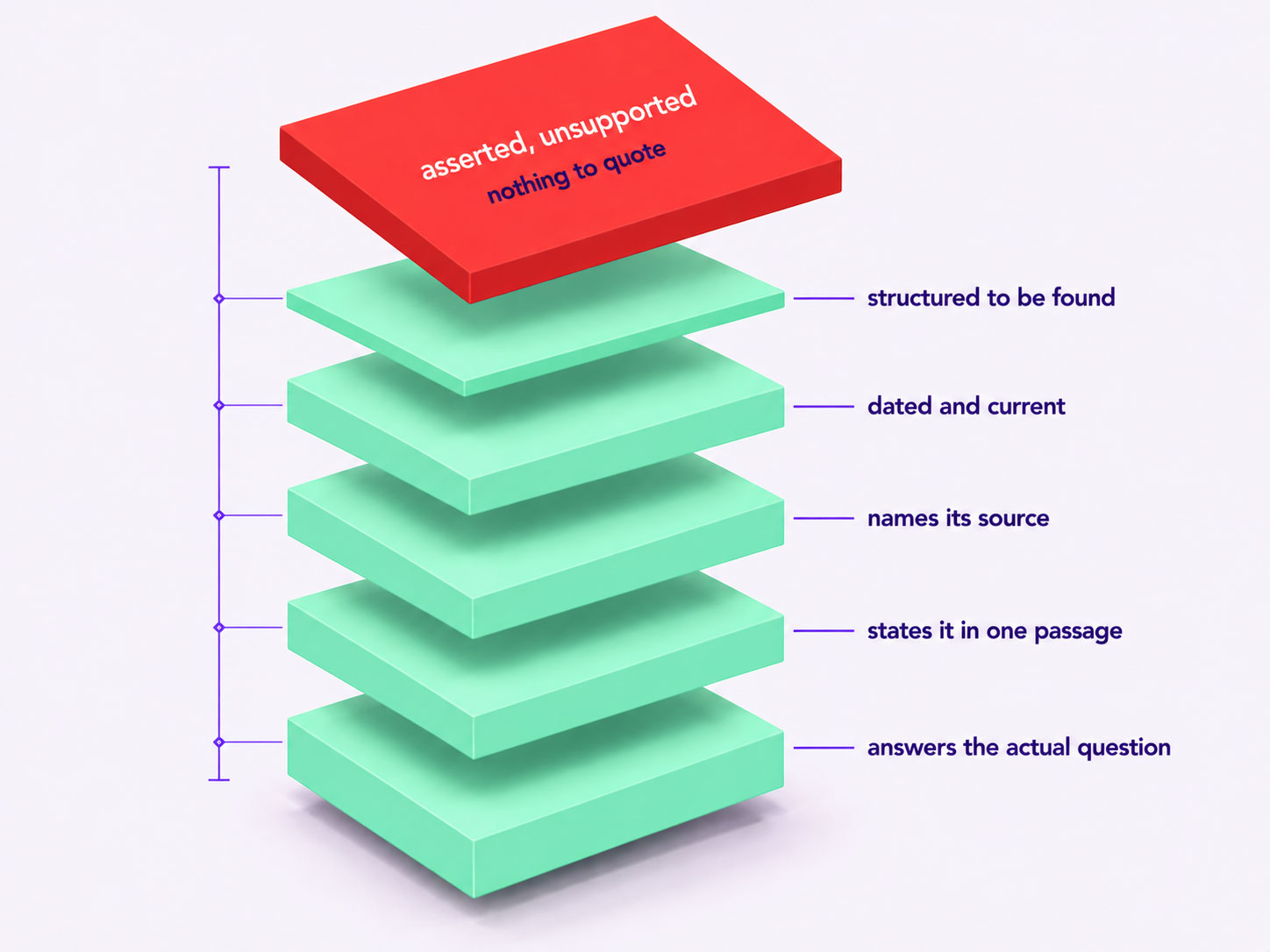
Engines do not quote pages. They quote passages.
That distinction changes how content gets built. A page can be excellent as a whole and contain nothing an engine can lift, because every useful claim depends on three paragraphs of context the extractor will never carry with it.
| What we measure | What usually gets sold | Observable What we report instead |
|---|---|---|
| Citation share | A single AI visibility score | How often you are named in answers to a tracked prompt set, against named competitors |
| AI-referred sessions | Estimated AI traffic | Analytics-verified visits, counted rather than modeled |
| Entity health | Not measured at all | Accuracy and consistency of your brand facts everywhere engines look |
| Assisted revenue | Traffic reported as outcome | Conversions and lead quality from AI-sourced visitors |
| Attribution gaps | Quietly filled in | Stated in the report as unresolved, because in AI search they sometimes are |
The last row is the one that separates a measurement program from a dashboard. Everything above it can be counted. That one is about what happens when a number cannot be produced honestly, and the answer most of the industry gives is to produce it anyway.
Four GEO line items you can stop paying for.
This discipline is new enough that the market has not settled, which is exactly the condition in which unsupportable products sell well. Four we will not offer.
A single AI visibility score. Citation behavior differs by engine, by prompt and by week. Compressing that into one number produces something that moves reassuringly and cannot be acted on, and anyone selling you a single magic score is selling.
Guaranteed citations or guaranteed placement in AI answers. The engines select sources by mechanisms they do not publish and change without notice. Nobody controls the inputs required to guarantee an outcome. What can be committed to is method: the evidence gets built, the entity gets cleaned, and the citation share gets measured against named competitors.
Proprietary AI files and secret markup. Google's own documentation says standard SEO best practices are what qualify content for its AI features — no special files, no secret tags. Where a vendor claims otherwise, the platform's documentation is the thing to check before the invoice.
Traffic estimates presented as measurement. AI-referred session estimates from third-party panels are modeled from samples. Your own analytics count actual arrivals. We report the counted number and label the modeled one, and where the two disagree the smaller one is the real one.
The pattern beneath all four: a young discipline rewards confident claims, which is precisely why this one needs conservative ones.
- Aggarwal et al. — GEO: Generative Engine Optimization, ACM KDD 2024 (arXiv)
- Google Search Central — AI features and your website
- Semrush — AI Search and SEO traffic study, 2025
- Semrush — AI Visibility Index
- Google Search Central — Creating helpful, reliable, people-first content
- Google Search Central — Introduction to structured data
The questions operators ask before investing in Generative Engine Optimization
Every answer below rests on published research or platform documentation, linked so you can check it without taking our word for it.
What is Generative Engine Optimization?
It is the discipline of earning citations and presence inside AI-generated answers. When ChatGPT, Google AI Overviews, Perplexity or Gemini composes a response, it reads a set of sources and names the ones it trusted. GEO is the work that makes your pages the ones it reads, trusts and names. The term comes from the foundational study by Aggarwal et al., presented at ACM KDD 2024, which measured visibility gains of up to 40% in its generative-engine benchmark. It sits alongside traditional SEO rather than replacing it.
How is Generative Engine Optimization different from traditional SEO?
Traditional SEO wins a position in a list; GEO wins a mention inside an answer. The contests are related but not the same — almost 90% of the pages ChatGPT search cites rank outside the traditional top twenty for related queries, per the Semrush AI Search Study. That means citation visibility is winnable ground for a business that cannot realistically displace the incumbent at position one. The foundations still matter, which is why GEO starts with technical health rather than tactics.
What is the difference between GEO, Answer Engine Optimization and LLM Optimization?
Three lanes with different jobs. GEO earns citations inside composed AI answers. Answer Engine Optimization structures content to win direct-answer surfaces — question-and-answer formats and extraction-ready architecture. LLM Optimization shapes how the models themselves represent your brand: entity consistency and brand-fact accuracy. They share an evidence base and fail differently, which is why we run them as coordinated lanes under one strategy rather than as separate products. Google's documentation is a useful reality check on all three.
Which AI platforms does Generative Engine Optimization target?
ChatGPT and OpenAI Search, Google AI Overviews and AI Mode, Perplexity, Gemini and Microsoft Copilot, plus the platforms still emerging. Each gathers, weighs and cites sources differently, so a serious program treats them as distinct channels with shared foundations rather than one checkbox. Entity clarity and consistent brand facts keep you legible to all of them, which is work that compounds instead of fragmenting — and it is the same directory and entity discipline that supports traditional visibility. Semrush's AI Visibility Index tracks the surfaces publicly.
How do AI engines choose which sources to cite?
Not by publishing their selection mechanism, which is worth saying plainly. What the GEO study measured is that verifiable statistics, credible quotations and cited sources were among the strongest-performing optimizations in its benchmark. That points at a consistent shape: a claim stated clearly in one passage, with its source named and its date visible, is easier to lift than the same claim spread across three paragraphs — which is why our content team writes for extraction rather than for flow alone. Google's guidance on helpful, people-first content points the same direction.
How long does Generative Engine Optimization take to show results?
The baseline exists within thirty days; movement in citation share generally takes longer and varies by how much entity and technical work has to happen first. Our engagements run a 30/60/90 rhythm — audit and foundations, then build and earn, then measure against the day-one baseline — so you can see progress before you see outcomes. Anyone quoting you a guaranteed timeline is describing a system whose selection mechanism they do not control — Google's own AI features documentation describes qualification, not scheduling. The same honesty about timelines applies to organic search.
Can Generative Engine Optimization help my business appear in ChatGPT recommendations?
That is precisely the target, and it is more winnable than most operators expect. Half the links in ChatGPT 4o responses point to business and service websites rather than to forums and news sites, per the Semrush AI Search Study — the seats exist. Earning one means clear chunkable content, a verifiable entity, and evidence an engine can quote. What nobody can offer is a guarantee, because the selection mechanism is neither published nor stable. Related: how we write for extraction.
Does Generative Engine Optimization replace my existing SEO program?
No, and a vendor proposing that it does has misread the mechanism. Generative engines still draw on the same foundations classic search rewards — crawlability, content quality, links and intent alignment. Google's own documentation says standard SEO best practices are what qualify content for its AI features. GEO adds a citation lane on top of that foundation; it does not stand in for it. Both run inside our AI SEO agency program as coordinated lanes.
How do you measure Generative Engine Optimization results?
Four families of evidence, reviewed monthly: citation share against named competitors on a tracked prompt set; AI-referred sessions, analytics-verified rather than estimated; entity health, meaning the accuracy of your brand facts everywhere engines look; and assisted revenue from AI-sourced visitors, who convert at 4.4 times the rate of traditional organic visitors per Semrush's published research. Where attribution is genuinely murky we say so in the report rather than dressing up a guess — the same standard we apply to conversion measurement.
Do I need special schema, an AI text file, or new markup to appear in AI Overviews?
No. Google's documentation states that standard SEO best practices are what qualify content for its AI features — no special files, no secret markup. Ordinary structured data helps machines understand your pages and is worth doing on its own merits, but it is not an AI-specific product. Where a vendor claims a proprietary file is required, check the platform's documentation before the invoice. Our technical SEO practice handles the real version of this work.
Does Generative Engine Optimization work for local and multi-location businesses?
Strongly, and it is one of the clearest applications. Ask an assistant for the best HVAC company nearby and it names specific businesses — recommendations earned through verified entity facts, consistent profile data, genuine review signals and locally relevant content. For franchise systems the work multiplies but the discipline is identical: every location needs its own clean entity and the brand needs one consistent story, which is structured-data work as much as content work. That is a program we already run at scale for franchise Partners alongside local SEO.
What does Generative Engine Optimization cost?
It depends on how much entity and technical work has to happen before citation work can land, which is why we baseline first and quote second. A business with clean structured data, consistent brand facts and solid content is a different engagement from one where AI agents are blocked at the crawl. The free audit establishes which you are before anybody discusses scope. What we will not do is quote from a package sheet without looking, or price against a benchmark drawn from somebody else's market, and the published research is a starting point rather than a quote — the reasoning is on our research page.
What makes content citation-worthy to a generative engine?
Being quotable in a fragment. Engines do not quote pages, they quote passages — so a claim that depends on three paragraphs of surrounding context will not survive extraction, however good the page is. The GEO study found verifiable statistics, credible quotations and cited sources among the strongest-performing optimizations. In practice: answer the actual question, state it in one self-contained passage, name the source in the sentence, keep it dated and current. That is what our content team builds to.
Is Generative Engine Optimization a fad?
The behavior it responds to is not. ChatGPT passed 800 million weekly active users by mid-2025, and Semrush projects AI search visitors will surpass traditional organic visitors in 2028 — a projection, labeled as one, not a finding. What is durable underneath the projections is that people are asking questions in a place that returns one answer with a few named sources. Whichever engines win, that shape rewards businesses whose evidence is quotable. The work also improves ordinary search visibility, so it is not a bet on one outcome.
Why choose Allegiant Digital Marketing for Generative Engine Optimization?
Because we will show you the parts we cannot measure. Our reporting names citation share against competitors, counts analytics-verified AI sessions rather than estimating them, and states attribution gaps as unresolved instead of filling them in. We also removed a widely circulated AI-traffic statistic from this page because its published figures were internally inconsistent — we would rather carry fewer numbers than one we cannot defend. You can see how that standard reads across published engagements and the rest of our services. The research is public; the discipline is in applying it honestly.
Find out where AI already stands on your business.
The free audit baselines your technical health, rankings and AI visibility — including where generative engines cite you today and where competitors are cited instead. Findings are yours whether or not we work together.
- Citation baseline across the five major AI surfaces
- Where competitors are named and you are not
- Entity and structured-data review against how engines resolve you
- AI crawl-access check, because a blocked agent cites nobody
- Content inventory scored for citation-worthiness
- A straight answer on what has to be fixed before citation work can land
Explore the wider program: AI SEO agency, answer engine optimization, LLM optimization, traditional SEO and the Allegiant blog.
Tell us the business and the questions your buyers ask, and we will show you who the engines name today.
No cost, no commitment. Questions first? We will follow up by email or phone to walk you through the findings.

