
You paid for the click.
Then sent it to a page with nine exits.
A homepage is built to let anyone go anywhere. A landing page is built to let one person do one thing. Sending paid traffic to the first is the most common and most expensive mistake in this discipline — the visitor arrived asking a specific question and landed somewhere that answers forty of them.
Built for home services contractors, franchise systems and private equity portfolios — where paid traffic arrives on a page that has to earn a phone call in about four seconds.
A landing page now serves two audiences. We build for the homeowner and for the AI systems that summarize and recommend businesses — clear answers, clean structure, honest specifics — because the page that converts best is usually the page most likely to be cited.
We build landing pages inside an AI-first program: AI-assisted variant testing to find the hook faster, structured content so AI search engines can read and cite the page, and AI-verified conversion tracking so the winning variant is judged on booked jobs. Most agencies test headlines; we test against your CRM.
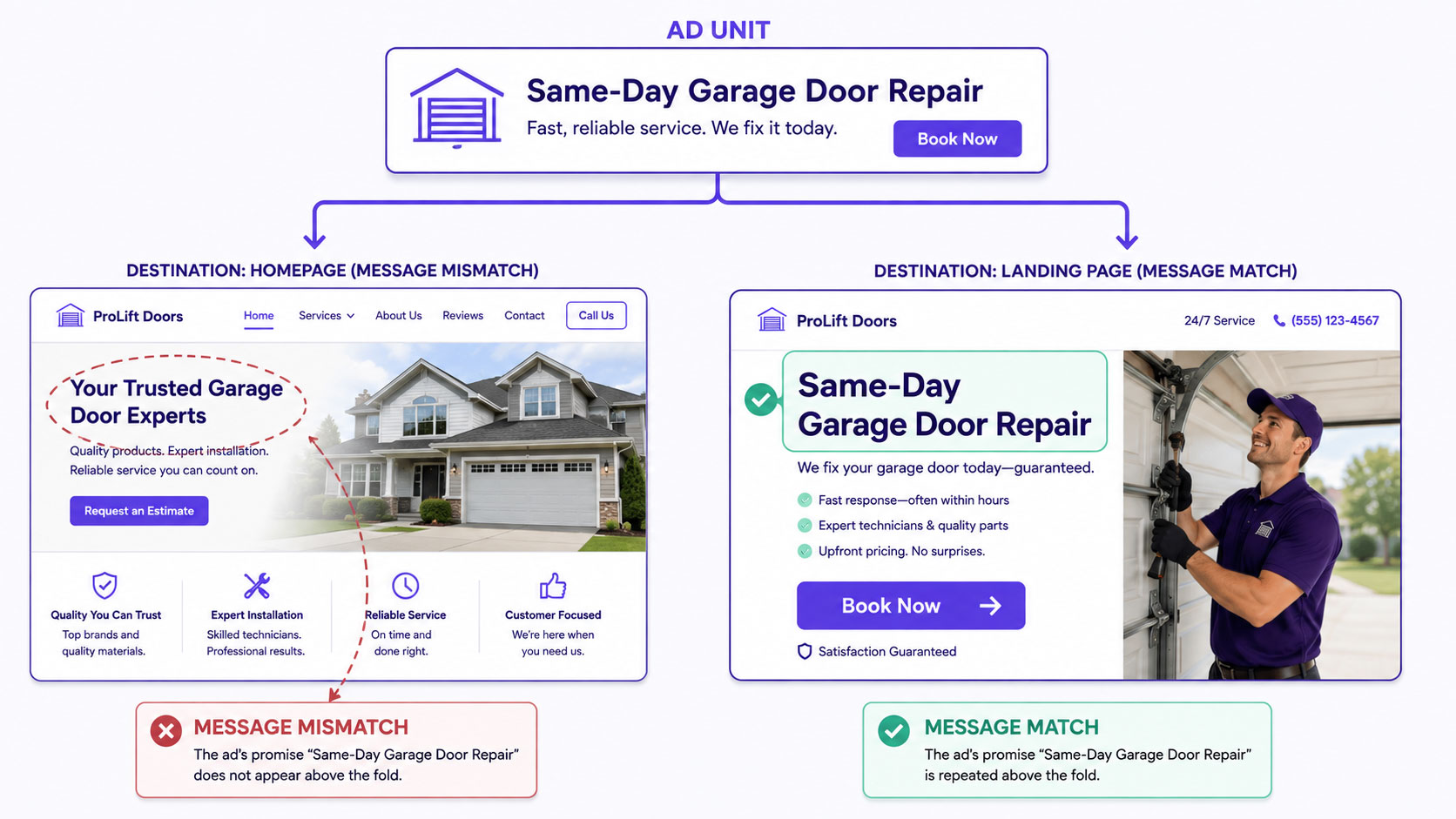
The promise in the ad has to be the first line on the page.
Not similar. Not on-brand. The same promise, in recognisable words, above the fold. Everything else on a landing page is downstream of whether the visitor believes they are in the right place.
And a landing page now has a second audience. As an AI-first agency we build pages that both convert a homeowner and read cleanly to the AI systems that increasingly summarize and recommend businesses. Clear answers, structured content and honest specifics do both jobs at once — which means the page that converts best is usually also the page most likely to get cited.
Message match is the cheapest fix available and the one most often skipped, because it lives between two teams. The person writing the ad and the person building the page are frequently not the same person, and nobody owns the seam. The ad promises same-day service on a specific repair; the page opens with a mission statement.
The visitor's first question is not should I buy. It is am I in the right place, and they answer it in about four seconds using the headline and nothing else. A page that fails that question does not get a chance to make its argument, however good the argument is.
The second question follows immediately: am I the right person for this? Qualifying detail early — who this is for, what it costs in time, what happens next — filters out visitors who would have bounced anyway and reassures the ones who stay. Pages that hide qualification until after the form convert more people and fewer buyers.
Then the mechanics have to hold up. Core Web Vitals are reported from real-world field data rather than a lab score, and Cumulative Layout Shift covers the specific irritation of a page moving under someone's thumb as they reach for a button. On a page you are paying per visit for, that is not a search problem. It is the visit you already bought, discarded at the last inch.
A site page serves everyone. That is exactly the problem.
Both of these are legitimate pages doing legitimate jobs. Only one of them should ever receive paid traffic, and the difference is not design quality — it is how many things the page is allowed to be.
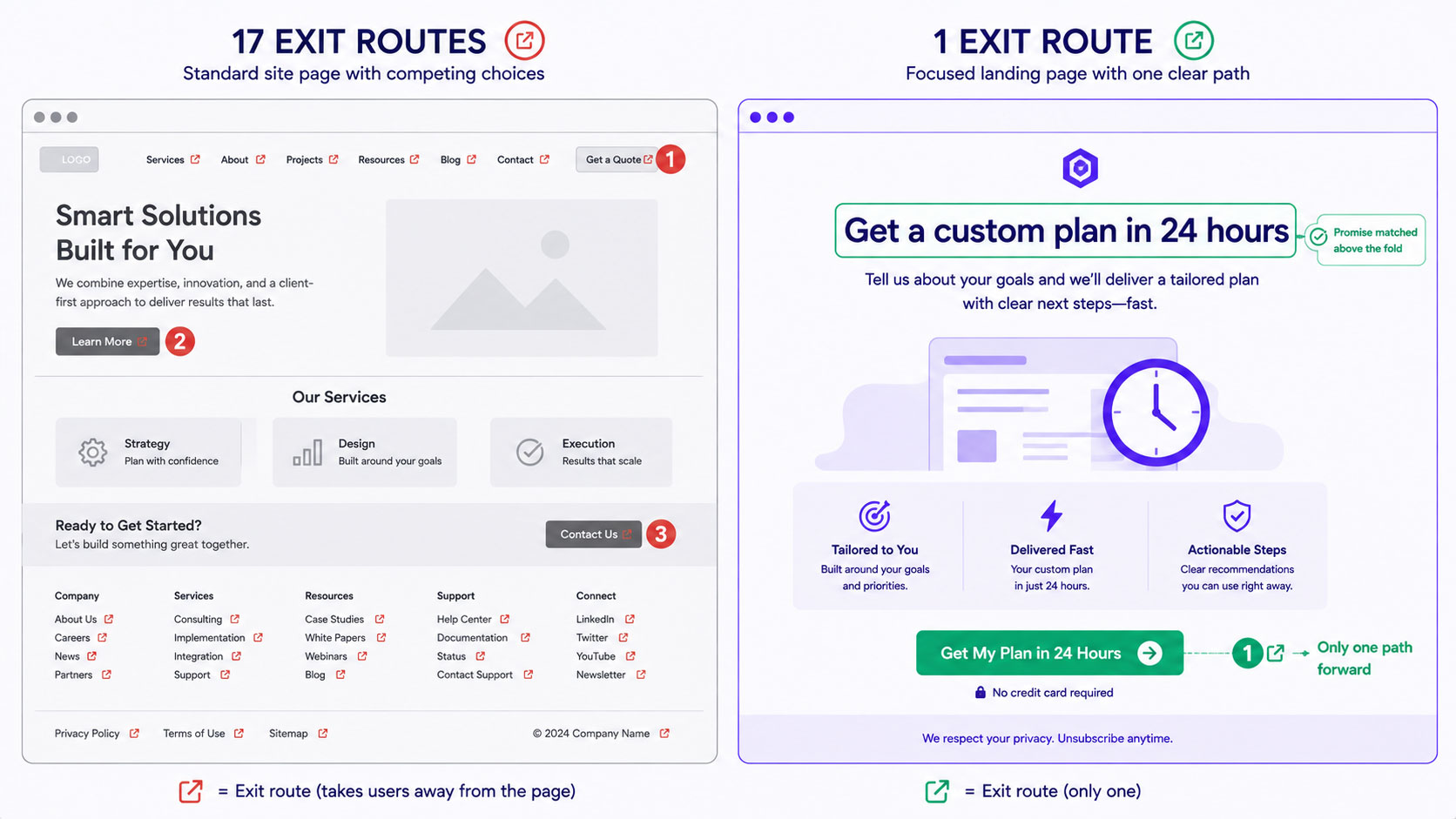
Nine ways out, all of them working as intended
- Navigation. Present by design, because an organic visitor may want a different service entirely.
- Footer. Careers, about, privacy, social — every one a legitimate exit for somebody.
- Competing actions. Call, form, chat, download, newsletter. All reasonable; together they are a menu rather than an instruction.
- Breadth. Written to serve several intents, so it addresses none of them fully.
- Measurement. Traffic from many sources, so no single number means anything on its own.
- The result. A good page, and the wrong destination for a click you paid for.
One way forward, and it is obvious
- No navigation. Nothing to explore. The visitor arrived for one thing and the page is about that thing.
- Minimal footer. Legal and contact only — what is required, not what is available.
- One action. Repeated down the page rather than competing with alternatives.
- Narrow. Written for the exact query that produced the click, which is why one campaign often needs several pages.
- Measurement. One source, one outcome, so the number actually means something.
- The result. A page that is useless to most visitors and excellent for the one it was built for.
Three failure points, and none of them is the copy.
Copy gets the blame because it is the visible layer. In the reviews we run, the losses concentrate in three places that nobody looked at, because none of them shows up in a design review.
The form
Forms designed at desktop width and never completed one-handed on a real phone. Google indexes from the mobile version, and paid traffic arrives there too, so the mobile form is the real form.
- A required field asking for something nobody has to hand — an account number, a model code
- Fields collected because a CRM has a column, not because anyone will use them
- No keyboard type set, so a phone field opens a full alphabet
- Validation that clears the whole form on a single error
The phone number
On service pages a large share of conversions are calls, and a call placed from an untracked number is a conversion that happened and was never counted. Every downstream decision — which campaign to keep, which page to rebuild — is then made on a number that is systematically low.
- Number is a tappable link, not text a visitor has to memorise
- Calls attributed to the page and campaign that produced them
- Tracking numbers implemented without fragmenting the canonical number across listings
- Call outcome recorded, so a lead and a wrong number are not counted alike
The thank-you state
It is where conversion tracking usually fires, so a broken thank-you state means the campaign appears to produce nothing. It is also the last impression before a wait, and "we'll be in touch" tells the visitor nothing about how long or what happens next.
- Fire the conversion reliably, on a state that cannot be reached without converting
- Say when contact will happen and by which channel
- Stay noindexed, since it exists only for people who already converted
- Give a next step for the impatient — a number to call now
A page you pay per visit for gets checked before the spend starts.
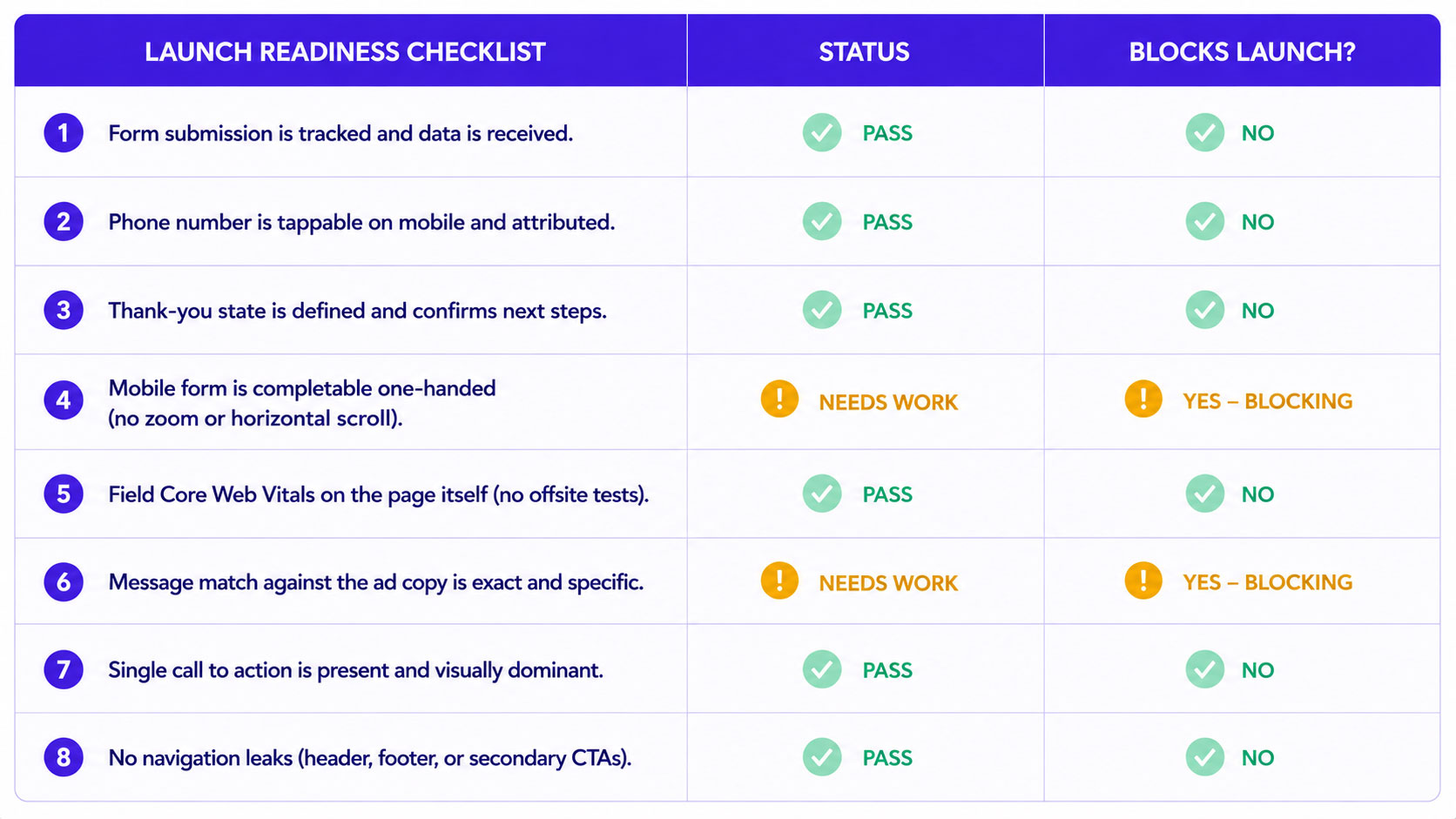
Every item below has produced a campaign that appeared to fail. Two of them block launch outright, because running paid traffic into either one wastes money in a way that cannot be recovered afterwards.
What the pre-launch check covers
The two blocking items are tracking and the mobile form. Everything else can be improved after launch; those two mean the spend produces either no data or no leads.
- Conversion tracking live. Form submissions firing on a state that cannot be reached without converting, verified by an actual test submission. Blocks launch.
- Mobile form completable. Filled in one-handed on a real device, not a resized browser window, including the keyboard type on every field. Blocks launch.
- Call tracking attributed. Number tappable, calls attributed to page and campaign, outcomes recorded.
- Message match. The ad's promise present in the page's first line, checked against the live ad copy rather than the brief.
- Single action. One call to action, repeated rather than competing, with no navigation and no stray footer links.
- Field performance. Core Web Vitals measured on the page itself, on mobile, from real-world data.
- Thank-you state. Defined, noindexed, stating when contact happens and offering an immediate alternative.
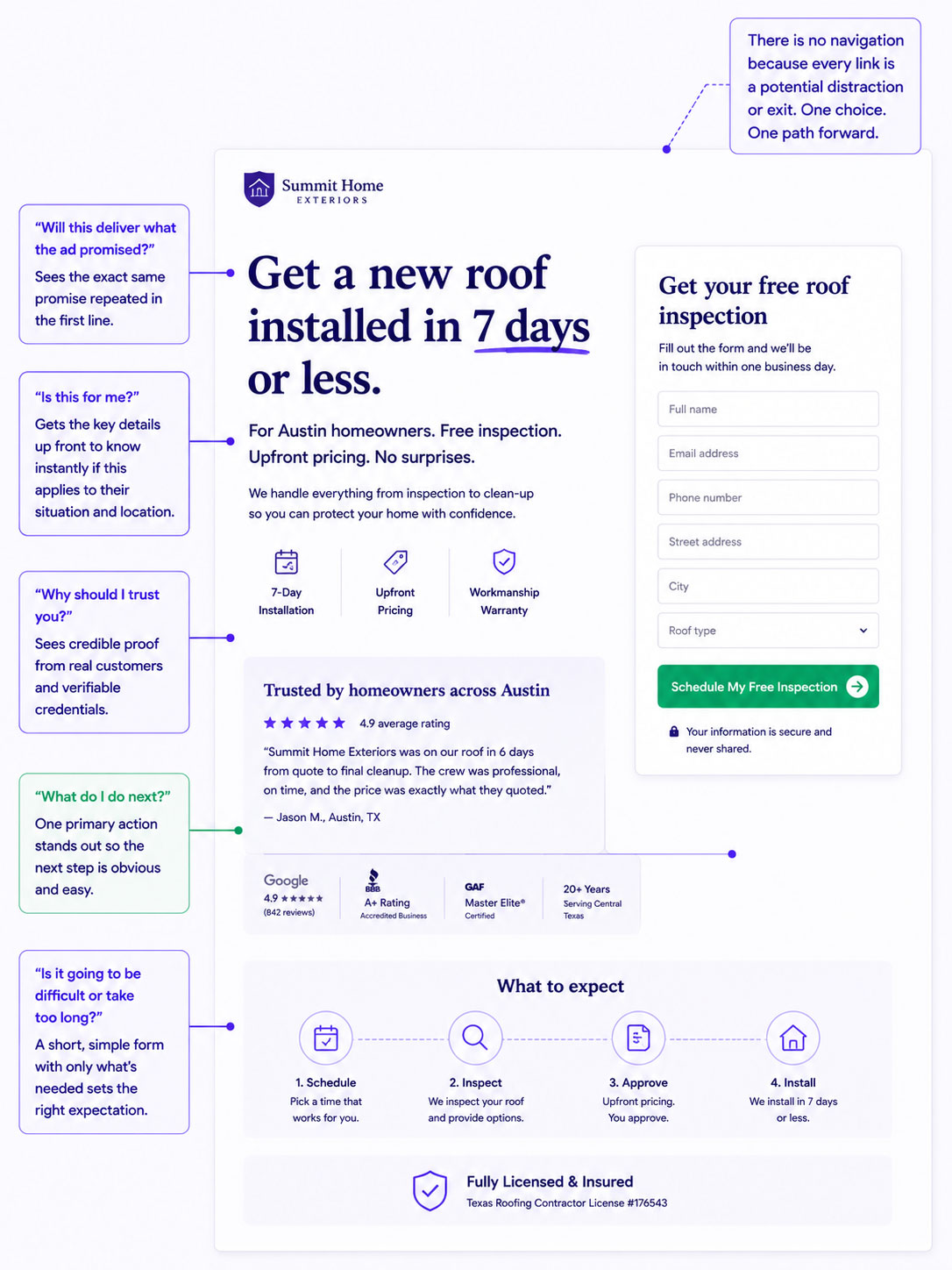
Six elements, each answering one objection.
A landing page is not a shorter website. It is a sequence of answers to the objections a visitor raises in order, and every element earns its place by removing one of them.
The restated promise
The ad's exact claim, in the first line, in words the visitor recognizes from what they clicked.
Objection it answers: am I in the right place. Fail this and nothing below it is read.
The qualifying detail
Who this is for, what it involves, and what it does not cover — stated early rather than discovered after a form.
Objection it answers: am I the right person. It filters out visitors who would have wasted a call anyway.
Proof only you have
A specific outcome, a named certification, a real photograph of real work. Google's people-first standard asks whether the content shows genuine first-hand experience.
Objection it answers: why should I believe you. Stock imagery and "trusted by thousands" answer nothing.
One call to action
The same action, repeated at the points where a visitor becomes ready, described as what happens rather than as a verb.
Objection it answers: what happens if I act. "Get a quote" is a promise; "submit" is a chore.
A form you would complete
The fewest fields that let you respond usefully. Every additional field is a decision to trade volume for qualification, and it should be made deliberately.
Objection it answers: is this worth the effort. Testing whether it is belongs to conversion rate optimization.
The technical floor
Fast on a phone against field data, no layout shift under a thumb, and indexing directives set deliberately per Google's technical requirements.
Objection it answers: none — it is what lets the others be read at all. See technical SEO.
We will not launch a page that cannot be measured.
We build these for single-location contractors and for national franchise systems and private equity portfolios. One page or two hundred, the discipline is identical — and at portfolio scale a single validated template lifts every market at once.
Two items on the pre-launch check block a go-live: conversion tracking verified by an actual test submission, and a form completed one-handed on a real device. Both are unglamorous, neither is in anyone's design review, and skipping either means the campaign spends money and produces no usable answer.
The failure mode is specific and expensive. Untracked calls make a working campaign look dead, so it gets paused. A broken mobile form makes a well-targeted campaign produce nothing, so the targeting gets blamed. In both cases the wrong lever gets pulled for months.
Every claim on this page links to the authority behind it. Where we describe a pattern no authority publishes — what a visitor checks in four seconds — we say that it is observation. That is a harder page to write and a much easier agency to check.
What separates this from a standard landing page build.
Not a competitor teardown — a description of where the practices differ, so the choice can be made on substance.
| Practice | Standard landing page build | AllegiantOMNIVIZ™ |
|---|---|---|
| Paid traffic destination | The homepage or a service page | A page built for the exact query that produced the click |
| Message match | On-brand, not matched | The ad's promise in the first line, checked against live ad copy |
| Navigation | Inherited from the site | Removed — one path forward |
| Form | Every field the CRM has a column for | The fewest fields that allow a useful response |
| Call tracking | Added later, if raised | Attributed before launch, or launch waits |
| Mobile testing | Browser resized to phone width | Completed one-handed on a real device |
| Thank-you state | A default page, unreviewed | Defined, noindexed, and carrying the conversion |
Four landing page line items you can stop paying for.
Two are unsupportable on the evidence. Two are real practices that get sold as something they are not.
Conversion rate guarantees. No issuing authority publishes conversion benchmarks by industry, so there is nothing to guarantee against. Any figure quoted as an industry standard traces back to a vendor survey of that vendor's own customers. What can be committed to is a baseline you can check and a page that is measurable from day one.
Template libraries sold as strategy. A layout that worked for another business worked for that business's buyers and that business's offer. It is a reasonable starting point and it is not a result. Whether it works for you is a question for testing, not for a slide.
Hundreds of near-identical pages, one per keyword. Beyond the wasted effort, Google's spam policies define scaled content abuse as generating many pages primarily to manipulate rankings rather than to help people, and its guidance warns that a high quantity of pages does not make a site higher quality. Distinct offers deserve distinct pages; phrasings do not.
A page with no tracking, launched to meet a date. This gets sold implicitly rather than explicitly, by treating instrumentation as a phase two. Traffic bought against an unmeasured page produces spend and no learning, which is the most expensive combination available.
The pattern beneath all four: a landing page is the one asset where you are paying for every single visitor. That changes what counts as an acceptable shortcut.
- Google Search Central — Core Web Vitals
- Google Search Central — Understanding page experience
- web.dev — Largest Contentful Paint
- web.dev — Cumulative Layout Shift
- Google Search Central — Mobile-first indexing
- Google Search Central — Block indexing with noindex
- Google Search Central — Website testing and Google Search
- Google Search Central — Spam policies for Google web search
- Google Search Central — Technical requirements
- Google Search Central — Creating helpful, people-first content
- Google Analytics Help — About conversions
The questions operators actually ask.
Answered against primary sources where they exist, and answered honestly where they do not.
Can we just send our ads to the homepage?
You can, and it is the most common way paid budget is wasted. A homepage is built to let anyone go anywhere, which is correct for organic traffic and wrong for a click you bought against one specific query. The visitor arrived asking one question and lands somewhere answering forty. Our observation, labeled as observation since no authority publishes attention data, is that the first thing checked is whether the promise from the ad appears on the page — not whether the company looks credible. Measurement of the difference belongs to conversion rate optimization. Google's own framing of content built for people rather than for a mechanism is the closest published standard.
How many form fields should we have?
The fewest that let you respond usefully — and understand that each additional field is a deliberate trade of volume for qualification, not a free addition. The faults we find most are fields collected because a CRM has a column and required fields asking for something nobody has to hand. Whether a specific field is worth its cost is a testable question, and Google's conversion documentation covers how the outcome should be counted. Test design sits under CRO rather than here.
Should landing pages be indexed by Google?
It depends on the page's job, and it should be decided deliberately rather than by default. A page built only to receive paid traffic and duplicating an existing service page is usually better noindexed, and thank-you states always should be. A page carrying substantial unique content may deserve to be indexed and earn organic traffic as well. What matters is that the directive is chosen, not inherited — Google's technical requirements set the baseline. Related: technical SEO.
Will duplicate landing pages hurt our SEO?
Producing hundreds of near-identical pages, one per keyword, can. Google's spam policies define scaled content abuse as generating many pages primarily to manipulate rankings rather than to help people, and its guidance separately notes that a high quantity of pages does not make a site higher quality. A handful of pages for genuinely distinct offers is not that. The test is whether the pages differ in substance or only in a phrase. Consolidating an existing set is usually the first fix — see content strategy.
How fast does a landing page need to be?
Faster than a site page, because you are paying for every visitor who waits. Core Web Vitals are reported from real-world field data rather than a lab score, Largest Contentful Paint defines what is being timed, and Cumulative Layout Shift covers the page moving under a thumb mid-tap. Google's page experience guidance frames these as part of a good experience rather than one ranking dial — which on a paid page is the point. Related: website design.
Can we run A/B tests on landing pages without SEO risk?
Yes, within published conditions. Google's website testing guidance states that running A/B and multivariate tests is not itself a problem, and sets out the requirements: do not cloak, use temporary rather than permanent redirects for split tests, use canonical tags correctly on variants, and run tests only as long as necessary. The failure is showing crawlers one version and users another, which the spam policies name as cloaking. Whether you have the volume to resolve a test is a separate question, covered under CRO.
Why do our calls not show up in the campaign reporting?
Almost always because the phone number is not attributed. On service offers a large share of conversions are calls, and a call from an untracked number is a conversion that happened and was never counted — so a working campaign looks dead and gets paused. Google's conversion documentation covers the counting mechanics; the definition of what counts is yours to set. Tracking numbers also need implementing without fragmenting your canonical number across listings, which is why it coordinates with directory management.
What should the thank-you page actually say?
When contact will happen, by which channel, and what to do if that is too slow. "We'll be in touch" answers none of those. Technically it matters more than it looks: it is usually where conversion tracking fires, so a broken thank-you state makes a campaign appear to produce nothing, and it should sit on a state that cannot be reached without converting. It should also carry noindex, since it exists only for people who already converted. Related: website maintenance.
What conversion rate should we expect?
Nobody can tell you honestly. No issuing authority publishes conversion benchmarks by industry, so every figure in circulation traces back to a vendor survey of that vendor's own customers, usually undated and without methodology. What is real is your own baseline, measured on your own traffic, and whether a specific change moved it. Google's guidance on content made for people rather than for a mechanism is the closest thing to a published standard here, and it is about usefulness rather than a number. Baseline setting runs through the audit.
How many landing pages do we need?
One per genuinely distinct offer or audience, not one per keyword. If two pages would say the same thing with a phrase swapped, they should be one page — and building them separately edges toward what Google's spam policies describe. If two offers have different buyers, different objections and different proof, they need different pages, because a page serving both serves neither. In practice most accounts need fewer pages built better rather than more. Start with an A.R.C. Report or a paid search review.
Find out what happens after the click you paid for.
A landing page review: message match against your live ad copy, what your mobile form actually does on a real device, whether your calls are being counted, and how fast the page is where it is used. Findings are yours whether or not we work together.
- Message match checked against your live ads, not the brief
- Mobile form walked one-handed on a real device
- Call attribution — whether calls are counted and to which page
- Conversion tracking verified by a real test submission
- Field Core Web Vitals on the landing page itself
- Exit audit — every route off the page that is not the conversion
Explore the wider program: all services, paid search, conversion rate optimization, website design, content writing and local SEO.
We will show you what a visitor sees in the first four seconds, what your mobile form does on a real phone, and whether your calls are being counted at all.
No cost, no commitment. We will follow up by email or phone to walk you through the findings.

