
Most writing dies in the edit.
The specifics are what got removed.
An operator says the part failed at eleven months and the manufacturer covered it. It reaches the page as "we stand behind our work." The sentence that survived is true, generic and worthless — and the one that was cut is the only thing on the page a competitor could not have written and a model could not have generated.
Answer first. Then earn the rest of the page.
Strategy decides what to publish. This page is about the other half — how the sentence is actually built, because a good subject written badly is indistinguishable from a bad subject.
Start with what is not required, because a lot of budget goes there. Google states there is no ideal page length, no requirement to chunk content into small pieces, and no need to rewrite in an AI-friendly voice. Word-count targets and "AI restructuring" are both solutions to problems the issuing authority says do not exist.
What remains is craft. Google's helpful-content guidance asks whether a reader leaves satisfied, whether the piece demonstrates first-hand expertise, and whether the sourcing invites trust. Those are writing problems, not strategy problems, and they are decided sentence by sentence.
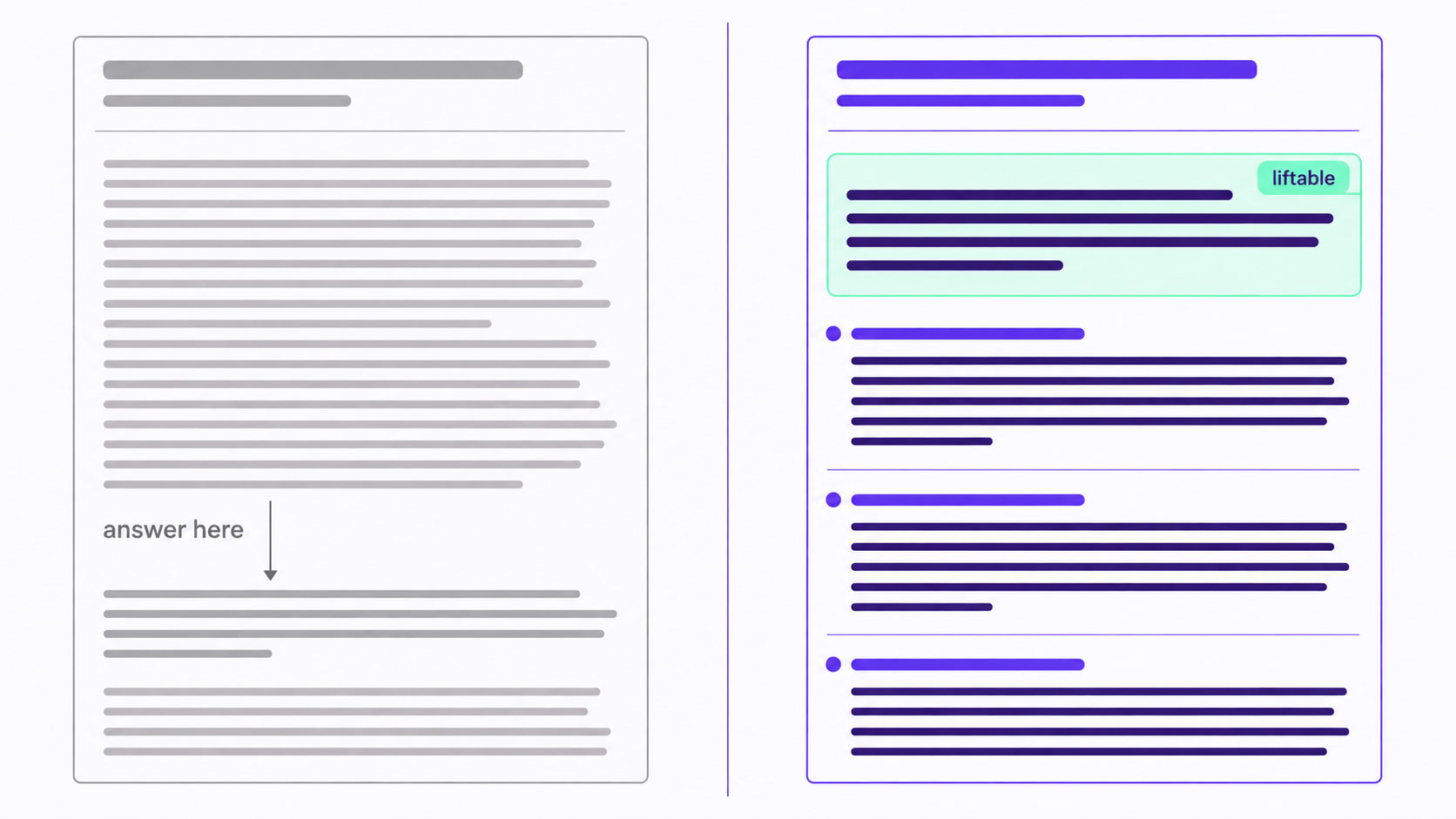
The structural rule we work to is answer-first: the question gets answered in the opening paragraph, and everything after it is the evidence, the exceptions and the detail. That serves the reader who wanted a number and got one. It also happens to produce passages that can be lifted whole without losing their meaning — which matters now that a page competes to be quoted as well as ranked, though how any given system selects a passage is not documented and we treat it as observation.
The opposite structure — eight hundred words of context before the payoff — is a habit inherited from print, where the reader had already committed. Online they have not, and neither has anything reading on their behalf.
What the operator said. What got published.
This is the failure we correct most often, and it is rarely a bad writer. It is a good writer applying a house style that was designed to make copy safe and ends up making it interchangeable.
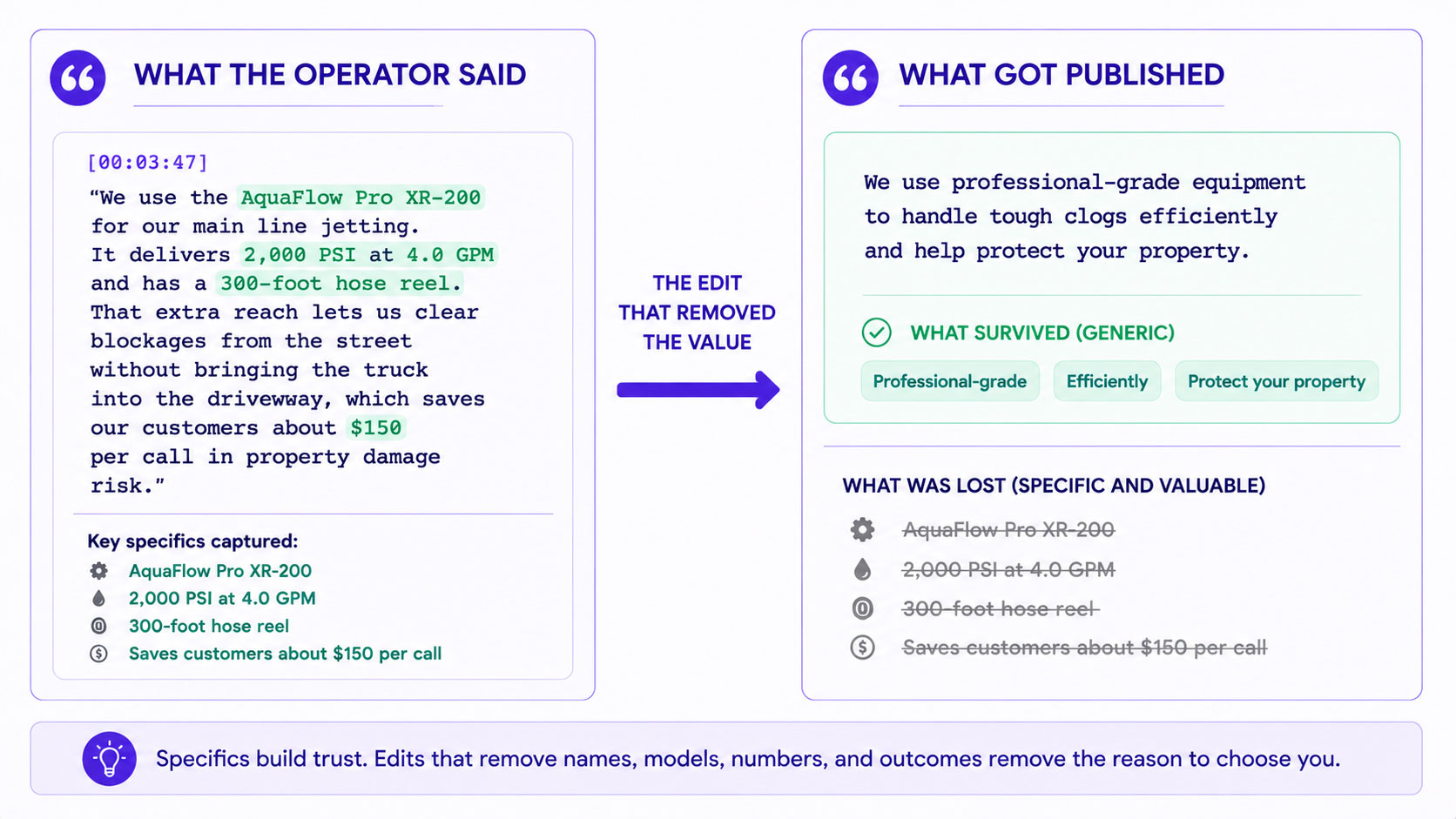
"We stand behind our workmanship"
- What happened to the number. "Eleven months" became "after some time," because the specific felt like a liability.
- What happened to the name. The named component became "the unit," because nobody wanted to appear to criticise a supplier.
- What happened to the cost. A figure became "at no additional expense to the customer."
- What happened to the exception. "Unless it was installed before the code change" was cut for being confusing.
- What is left. Four sentences that could appear on any competitor's site with the logo swapped.
"The heat exchanger failed at eleven months"
- The number stays. Eleven months is a fact a reader can use to judge whether their own situation is normal.
- The name stays. Naming the component is not criticism; it is the detail that makes the account credible.
- The cost stays. With the caveat attached, because a figure without its conditions is the claim that gets falsified.
- The exception stays. The exception is usually the most useful sentence on the page — it is what nobody else bothered to write down.
- What it produces. A page only you could have published, which is the entire basis of the E-E-A-T argument.
Three origins. There is no fourth.
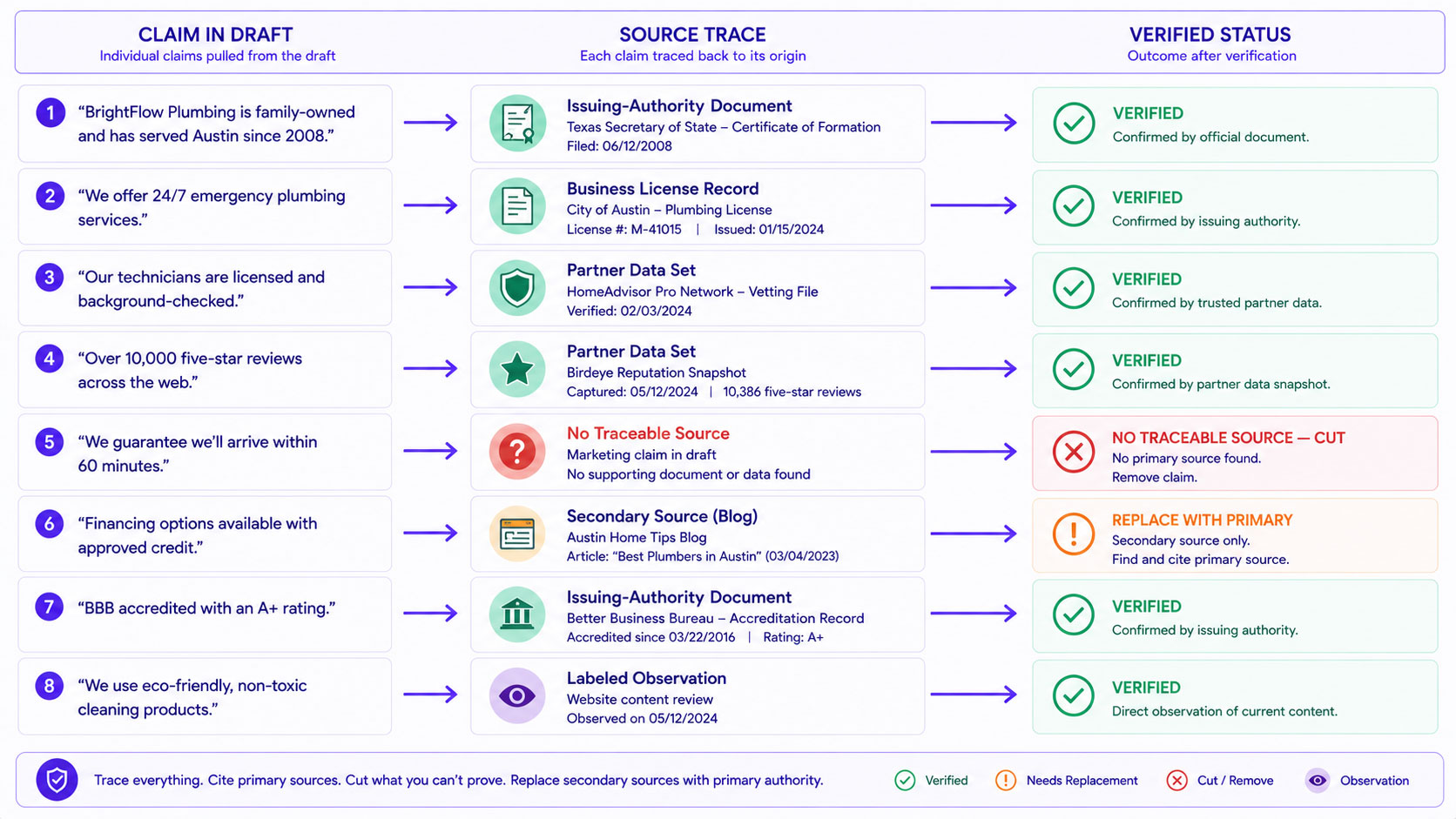
Every factual assertion in a finished piece traces to one of these, and the tier is stated rather than implied. A claim that fits none of them is cut before drafting rather than softened into vagueness afterwards.
Documented
The body that actually publishes the fact — a regulator, a standards body, a platform documenting its own behavior. Not an article about the documentation. The exact wording is read, because topic-level agreement is not the same as the source supporting your specific sentence.
- A statistic cited to a blog that cited a blog that named nobody
- A figure with no date, so a 2016 number reads as current
- A vendor's summary standing in where the authority's own page exists
- "Studies show" with no study named — the most common failure of all
Your own data
Google's guidance asks whether content demonstrates first-hand expertise and depth of knowledge — whether it shows you actually did the thing. Only this tier can. It is also the only material on a page that a competitor cannot reproduce and a model cannot generate, because neither was present.
- Recorded conversation with whoever holds the knowledge, transcribed in full
- Mined for the specifics the operator did not think were interesting
- Figures confirmed with the person who gave them before publication
- Operator sign-off on the specifics — they usually catch one thing, and it is usually the number
Labeled observation
Where a pattern is real and no authority has published a mechanic — how a retrieval system selects a passage, for instance. Writing it as though it were documented is the failure. Writing it as an observation, and saying so in the sentence, is honest and still useful.
- The label appears in the sentence, not in a disclaimer nobody reads
- The basis is stated — across how many engagements, over what period
- No implied causation where only correlation was observed
- If it cannot be phrased honestly, it does not go in — see content strategy
Every claim traced before a word is drafted.
Sourcing after writing is how unsupportable sentences survive — by the time anyone checks, the paragraph has been built around the claim and removing it means rewriting the section. So the inventory comes first.
How a claim gets cleared
This is the step that separates writing from typing, and it is the step most production processes skip entirely because it produces no visible output.
- Inventory before drafting. Every factual assertion the piece will make, listed as a claim, before any prose exists.
- Origin assigned. Each claim tagged documented, partner data, or observation. A claim with no available origin is cut at this stage, when cutting is free.
- The four checks. For documented claims: the source resolves, its text supports the exact sentence, it is the current version, and the authority matches the claim type.
- Read, not skimmed. Topic-level agreement is not support. A page about a subject frequently does not say the specific thing being attributed to it.
- Dates carried. A figure without its date is a claim that quietly becomes false. Old sources are replaced rather than presented as current.
- Cold review. The draft is read against the inventory afterwards by someone who did not write it, checking each claim survived the drafting intact.
- Operator sign-off. Specifics confirmed by the person who supplied them before anything publishes.
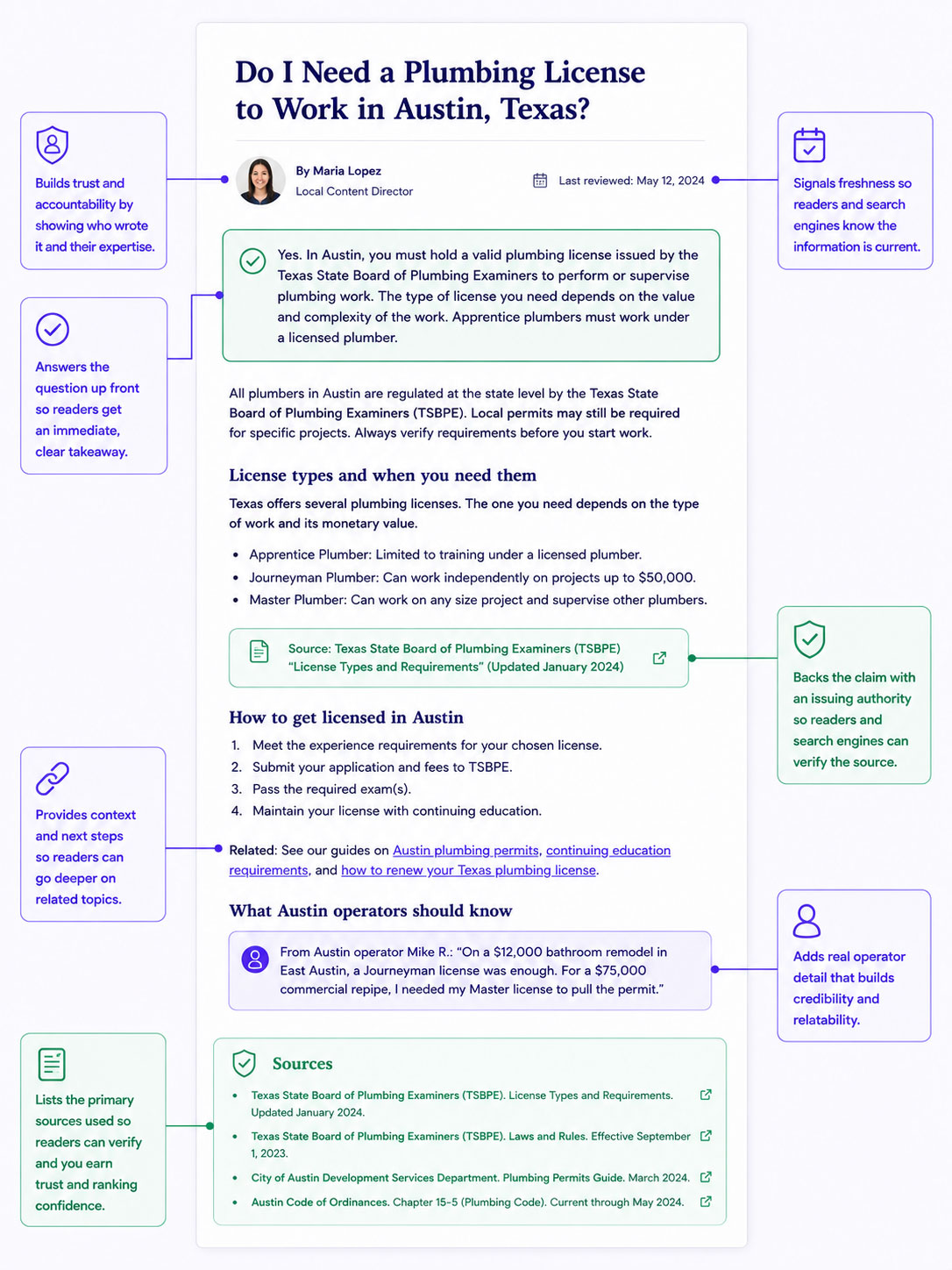
Six rules every piece is written to — and why each one exists.
Not a style guide about tone. These are the six decisions that determine whether a page is useful, and each one exists because breaking it produced a specific failure we had to fix.
Answer in the first paragraph
The question gets answered before the context, not after it. Evidence, exceptions and detail follow.
Why: the reader who wanted a number gets one, and the passage becomes coherent enough to be quoted without distorting. Google is explicit that no ideal length exists — so length is spent on substance rather than preamble.
Specifics survive the edit
Numbers, named components, costs, conditions and exceptions are protected in editing rather than smoothed away.
Why: they are the only part a competitor cannot republish. Removing them is what turns a genuine account into the commodity content Google names as the failure case.
One claim, one source
Each assertion carries its origin, and where it is documented the link goes at the point of use rather than in a footnote nobody follows.
Why: Google's helpful-content guidance asks whether sourcing invites trust. A citation three screens away from its claim does not.
Named author, review date
A real person accountable for the claims, with the date the page was last reviewed rather than the date it was first published.
Why: it tells a reader who is answerable and how current the page is — and it is the only part of the E-E-A-T conversation that costs nothing to implement.
Written for the person first
No keyword density targets, no phrase repetition, no writing aimed at a mechanism. Google's people-first standard is the test applied.
Why: Google states its systems understand synonyms and meaning, which is also why generating a page per phrasing wastes budget and risks the scaled content line.
Titles and descriptions written
Written deliberately rather than auto-generated. Google explains it may replace a poor title link with something else, and documents how snippets are formed.
Why: it is the cheapest work available — it changes what a person sees before deciding to click, on pages that already exist. See landing pages.
We will cut a claim rather than soften it.
We write for single-location contractors and for national franchise systems and private equity portfolios — a two-truck plumbing company and a two-hundred-location operator need the same thing from a page, which is a clear answer written by someone who understands the trade. Scale changes the volume, not the standard.
The soft version is always available. A statistic nobody can trace becomes "many businesses report." An outcome that happened once becomes "customers often see." Both sentences are technically defensible and both are a way of keeping a claim you could not support.
Ours get cut instead. That produces shorter drafts, harder interviews and a page where every sentence can be traced to something — which is the only version that survives being checked by a customer, a competitor or a regulator.
The previous version of this page carried exactly one citation: a content-preference survey from February 2016, hosted on a content delivery network, undated in the text. That is the failure this rebuild corrects, and stating it here is cheaper than being asked about it.
What separates this from a standard writing retainer.
Not a competitor teardown — a description of where the practices differ, so the choice can be made on substance.
| Practice | Standard writing retainer | AllegiantOMNIVIZ™ |
|---|---|---|
| Where the brief starts | A keyword and a word count | A recorded interview with someone who did the work |
| Sourcing | After drafting, if at all | A claim inventory cleared before drafting |
| Unsupportable claims | Softened into vagueness | Cut |
| Specifics in editing | Smoothed for house style | Protected — they are the only unrepeatable part |
| Structure | Context first, answer late | Answer first, evidence after |
| Attribution | Generic or absent byline | Named author, review date, operator sign-off |
| Titles and descriptions | Auto-generated | Written to a fixed standard and mirrored into schema |
Four writing line items you can stop paying for.
Three contradict something Google has published. The fourth is simply a way of charging for volume.
Word-count packages. Google states there is no ideal page length. A 1,500-word minimum guarantees padding on subjects that needed 600 and truncation on subjects that needed 4,000. Price the interview, not the word count.
"AI-optimized" rewriting. Not needed. Google states its systems understand synonyms and general meaning, and that content does not need to be chunked or rewritten for AI features. Any line item priced as AI restructuring is priced against a requirement the issuing authority says does not exist.
Keyword density targets. A relic. Writing to a repetition quota produces prose a reader can feel, and Google's people-first standard asks the opposite question. Generating a separate page per phrasing also edges toward scaled content abuse.
Writing without access. A piece produced from a form and a competitor's page can only restate what is already published. If nobody at the business can spare forty-five minutes, the honest position is that the piece will not carry first-hand expertise and should not be commissioned as though it will.
The pattern beneath all four: they are all ways of producing volume without access. Access is the expensive part and the only part that produces something unrepeatable.
- Google Search Central — Creating helpful, reliable, people-first content
- Google Search Central — Optimizing for generative AI features
- Google Search Central — AI features and your website
- Google Search Central — Spam policies for Google web search
- Google Search Central — Influencing your title links
- Google Search Central — Control your snippets in Search
- Google Search Central — Article structured data
- Google Search Central — Consolidate duplicate URLs
- Google Search Central — SEO starter guide
- Google Search Central — Evaluating third-party SEO advice
- Google Search Central — Technical requirements
- Search Console Help — Generative AI performance report
The questions operators actually ask.
Answered against primary sources where they exist, and answered honestly where they do not.
How long should a page be?
As long as the substance requires, and Google says so directly: there is no ideal page length. A word-count minimum guarantees padding on a subject that needed 600 words and truncation on one that needed 4,000, and padding is visible to a reader within two paragraphs. The useful constraint is the interview: a piece runs as long as there is something only you can say. What we price is the access, not the volume — the reasoning behind that sits in content strategy.
Do we need to write differently now that AI reads our pages?
No, and Google is explicit. Its guidance states there are no additional requirements or special optimizations to appear in AI Overviews or AI Mode, no requirement to chunk content, and no need for an AI-friendly voice. What does help is ordinary good structure — answering the question near the top rather than after a long preamble — because that serves the reader first. Our observation, labeled as observation, is that the same structure produces passages coherent enough to be quoted without distorting. See AI SEO.
Can you write it without interviewing us?
We can produce competent prose from a form and a competitor's page. It will restate what is already published, because there is nowhere else for it to come from. Google's helpful-content guidance asks whether a piece demonstrates first-hand expertise and depth of knowledge, and nothing produced without access can. Forty-five minutes of recorded conversation per piece is the entire ask. Where that genuinely is not available, the honest position is that the piece should not be commissioned as though it will carry experience it cannot. Related: market research.
What happens to a claim you cannot source?
It gets cut, at the inventory stage, before the paragraph is built around it. The alternative every process reaches for is softening — "many businesses report," "customers often see" — which keeps an unsupportable claim while making it technically defensible. The four checks applied to a documented claim are that the source resolves, its text supports the exact sentence rather than the general topic, it is the current version, and the authority matches the claim type. Google's own guidance on evaluating third-party claims is a fair lens to point back at us. Related: competitor analysis.
Should we use AI to draft content?
For structure, tightening and second drafts, it is a tool like any other, and Google's position concerns quality rather than production method. What it cannot do is supply the figure you saw on a job last March, because it was not there. So the division we work to is that a model can help shape the writing and cannot originate the substance. The risk to watch is volume: generating a page per phrasing edges toward what the spam policies call scaled content abuse, and Google notes a high quantity of pages does not make a site higher quality. Where that has already happened, consolidation is the fix — see content strategy.
Does keyword density still matter?
No. Google states its systems understand synonyms and general meaning, which is also why writing a separate page for every phrasing of one question is wasted budget. Writing to a repetition quota produces prose a reader can feel, and it fails the people-first test Google actually applies. Where multiple pages already exist on one subject, the fix is consolidation — Google selects one canonical per cluster regardless of which you would have chosen. That work runs through technical SEO.
Who should be named as the author?
A real person who is accountable for the claims — usually the operator whose experience the piece rests on, or the person who reviewed it. Google's helpful-content guidance asks whether content presents information in a way that makes a reader want to trust it, including background on the author or the publishing site. A named author with a review date costs nothing to implement and is one of the few E-E-A-T signals entirely within your control. A generic company byline on a piece full of first-hand detail wastes the strongest thing about it. Google's guidance on who is behind the content is the standard we apply. See also reputation management.
Should the title and meta description be written by hand?
Yes, and it is the cheapest work available. Google explains it generates title links from page content and may use something other than your tag when the tag is weak, and it documents how snippets are formed. Writing both deliberately changes what a person sees before deciding to click, on pages that already exist and already rank. Every page we produce ships with both written to a fixed standard and mirrored into the page's structured data so the two cannot drift apart. Related: landing pages.
What structured data should content carry?
Deploy it where the page genuinely warrants it — Article markup for articles, and business markup where business details are stated — for rich-result eligibility and entity clarity. That is the honest reason. What it is not is an AI unlock: Google states structured data is not required for generative AI search and that no special schema exists for it. Markup also has to agree with what the page actually says, or it becomes a contradiction rather than an advantage. Technical deployment sits under technical SEO.
How do we know the writing is working?
In two layers kept apart. The measured layer is Search Console, including its generative AI performance report, plus conversions attributed to the pages that produced them. The observed layer is sampling assistants on a fixed question set to see which sources get named — genuine signal, not a ranking metric, since Google states no third-party tool has access to its internal systems. Google also warns that meeting every requirement does not guarantee indexing or serving, so nobody should promise an outcome. Start with an A.R.C. Report.
Find out which of your claims can actually be traced.
A content review: every factual assertion on your key pages followed back to its origin, the ones that trace to nothing, the specifics that were edited out, and where your pages answer late. Findings are yours whether or not we work together.
- Claim inventory across your key pages, each tagged by origin
- Unsourceable and stale claims identified, with replacements suggested
- Structure review — where the answer arrives, and how late
- Specificity audit: what only you could have written, and what any competitor could
- Author, review date and attribution check
- Titles and descriptions measured against a fixed standard
Explore the wider program: all services, content marketing, local SEO, website design, conversion rate optimization and website audit.
We will show you which claims on your pages can be traced to a source, which cannot, and which specifics were edited out of the ones that could.
No cost, no commitment. We will follow up by email or phone to walk you through the findings.

