
Nobody publishes what converts.
Which is why the benchmarks are all made up.
Google documents speed, mobile behavior and how to run a test without tripping its spam policies. It documents nothing about what makes a person call you. There is no issuing authority for conversion — so every "average conversion rate for your industry" on a competitor's page is a number with no source behind it, and the only real evidence is your own.
Built for home services contractors, franchise systems and private equity portfolios — where a small lift in booked jobs from the same traffic is worth more than any amount of extra spending.
Conversion work is AI-first here. We look at what an AI assistant told a homeowner before they arrived, because a visitor who came pre-recommended by ChatGPT or an AI Overview converts differently from one who arrived cold — and treating them the same leaves the easiest wins untouched.
The visit is the expensive part. Everything after it is nearly free.
You already paid for the click, the ranking, the citation or the call. What happens in the ninety seconds after arrival costs almost nothing to change and decides whether any of that spend produced anything.
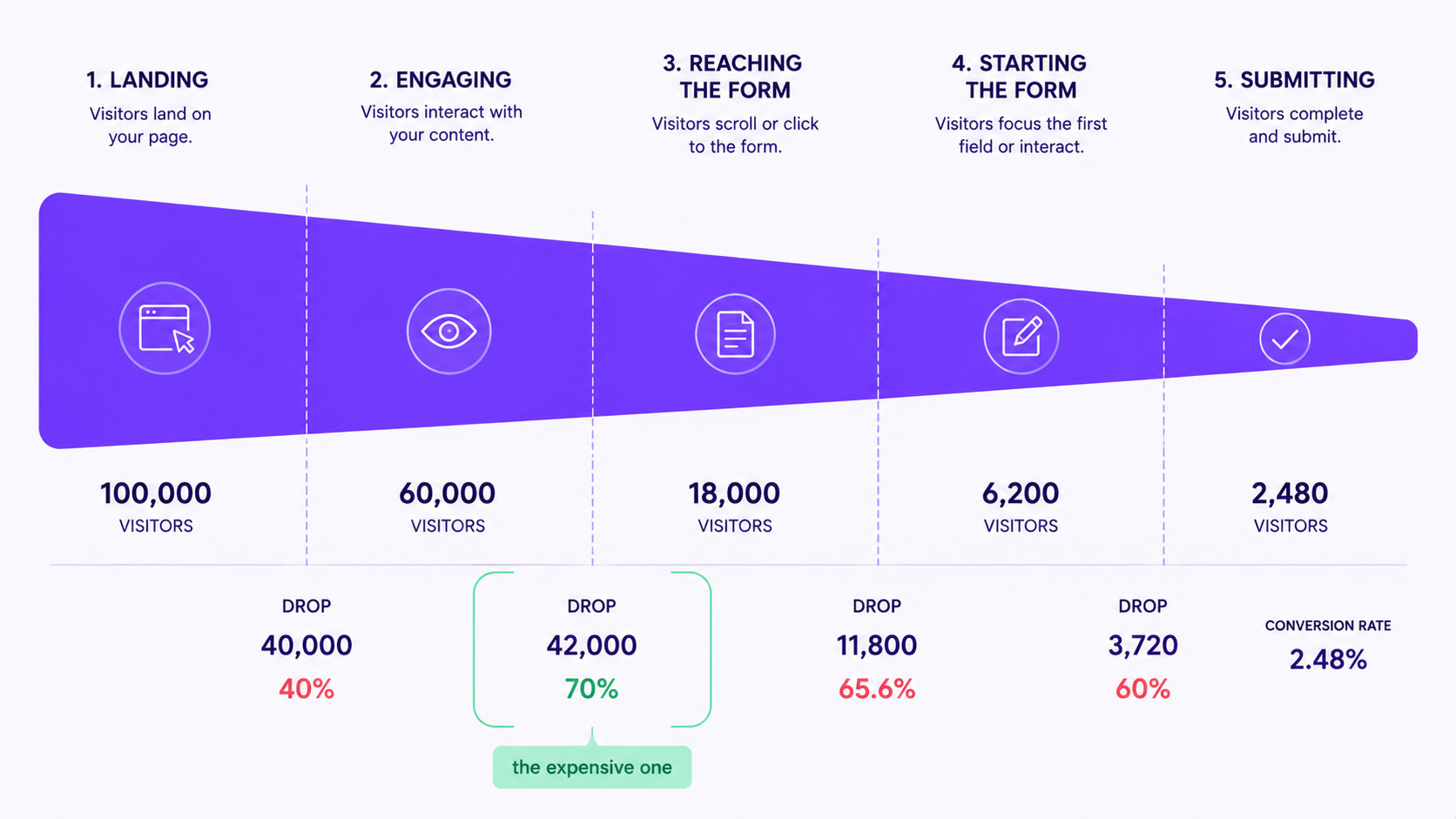
And conversion work now starts earlier than the page. As an AI-first agency we look at what a homeowner was told before they arrived — whether an AI assistant named you, what it said, and whether the page then delivers on it. A visitor who arrives already recommended converts differently from one who arrived cold, and treating them identically leaves the easiest gains on the table.
Here is the honest position, stated before anything is sold. Conversion is the one discipline in this business with no issuing authority. Google publishes Core Web Vitals, its page experience guidance, how mobile-first indexing works and what it permits during website testing. It publishes nothing about what wording moves a person to pick up a phone, because that is not its job.
So when an agency quotes you an industry average conversion rate, ask where it came from. The honest trail usually ends at a vendor blog quoting a survey of that vendor's own customers, undated, with no methodology. It is not a benchmark. It is a number in a slide.
What replaces it is unglamorous and much more useful: your traffic, your forms, your calls, measured before and after a change you can describe. That is a smaller claim than a benchmark and it is the only one that survives being checked.
The work that is documented — speed, mobile behavior, not breaking your own indexing while you test — we do against the source. The work that is not documented, we test. Nothing gets asserted because it sounds right.
One of these is a decision. The other is a preference.
Both columns describe changing a button, a headline or a form. The difference is entirely in whether anyone will be able to say afterwards what it did.
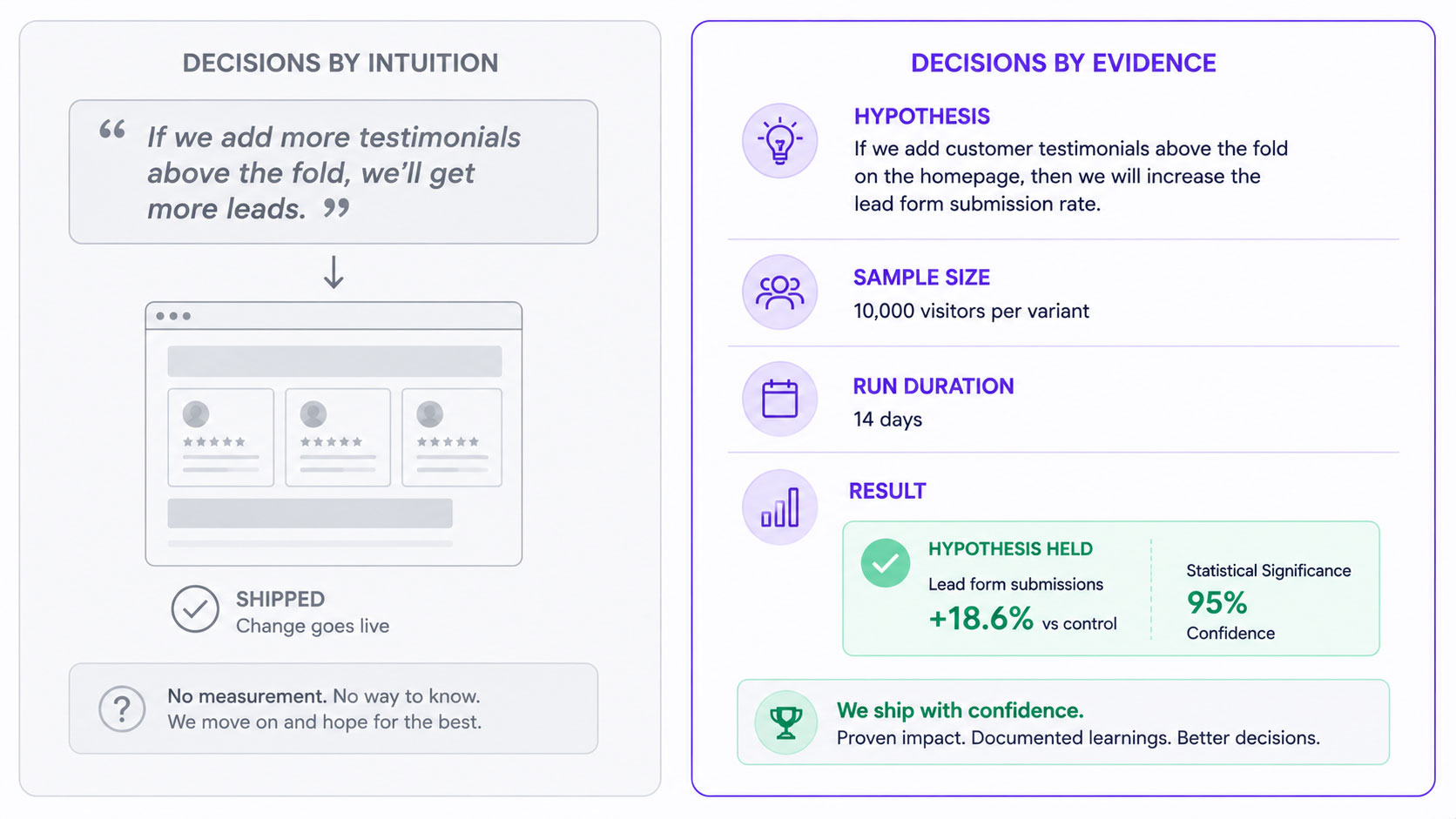
"Let's make the button orange"
- Origin. Somebody senior saw it on another site, or read that orange converts.
- Rollout. Shipped to everyone at once, on a Tuesday, alongside three other changes.
- Measurement. Conversions compared to last month, which had different traffic, different weather and a holiday in it.
- Result. Numbers went up, so the button worked. Or numbers went down, so something else must have happened.
- What you learned. Nothing transferable. The next decision starts from the same place.
"We think the form is losing people at step two"
- Origin. Session data showed abandonment concentrated on one field, and three call transcripts mentioned it.
- Hypothesis. Written before the build: removing the field will raise completed forms without lowering lead quality.
- Rollout. Split, one change at a time, run to a pre-agreed sample size rather than stopped when it looks good.
- Result. It held, it did not, or it was inconclusive — and inconclusive is a real answer that gets reported as one.
- What you learned. Something about your buyers that applies to the next twenty decisions.
Three parts of conversion work have a source. Use it.
Most of CRO is undocumented and has to be tested. These three are not — Google publishes them, and doing them wrong causes damage that no amount of testing recovers.
Speed, measured properly
Core Web Vitals are reported from real-world data, and the Largest Contentful Paint documentation defines exactly what is being measured and when. Its page experience guidance frames these as part of a good experience rather than one ranking dial.
- Optimizing the homepage, which almost nobody converts on
- Chasing a lab score while field data on the service pages stays poor
- Treating it as an SEO task, so it never gets prioritized against revenue work
- Ignoring mobile, where the gap between lab and field is widest
Mobile as the real page
Google documents mobile-first indexing — the mobile version is the version that counts. Content hidden or cut on mobile is content the index does not see, and it is also the version most of your buyers are actually using.
- Whether the phone number is tappable, and whether tapping it is tracked
- Forms tested one-handed, on a real device, not resized in a browser
- Content parity — nothing important collapsed away on the small breakpoint
- Field Core Web Vitals on mobile specifically, since that is where they fail
Testing without self-harm
Its website testing guidance states plainly that running A/B and multivariate tests is not itself a problem, and sets out the conditions — no cloaking, correct use of redirects and canonicals, and running tests only as long as necessary.
- Showing crawlers one variant and users another, which the spam policies name as cloaking
- Tests left running for months because nobody set an end condition
- Test URLs indexed as duplicates of the page they are testing
- Traffic split with a permanent redirect rather than a temporary one
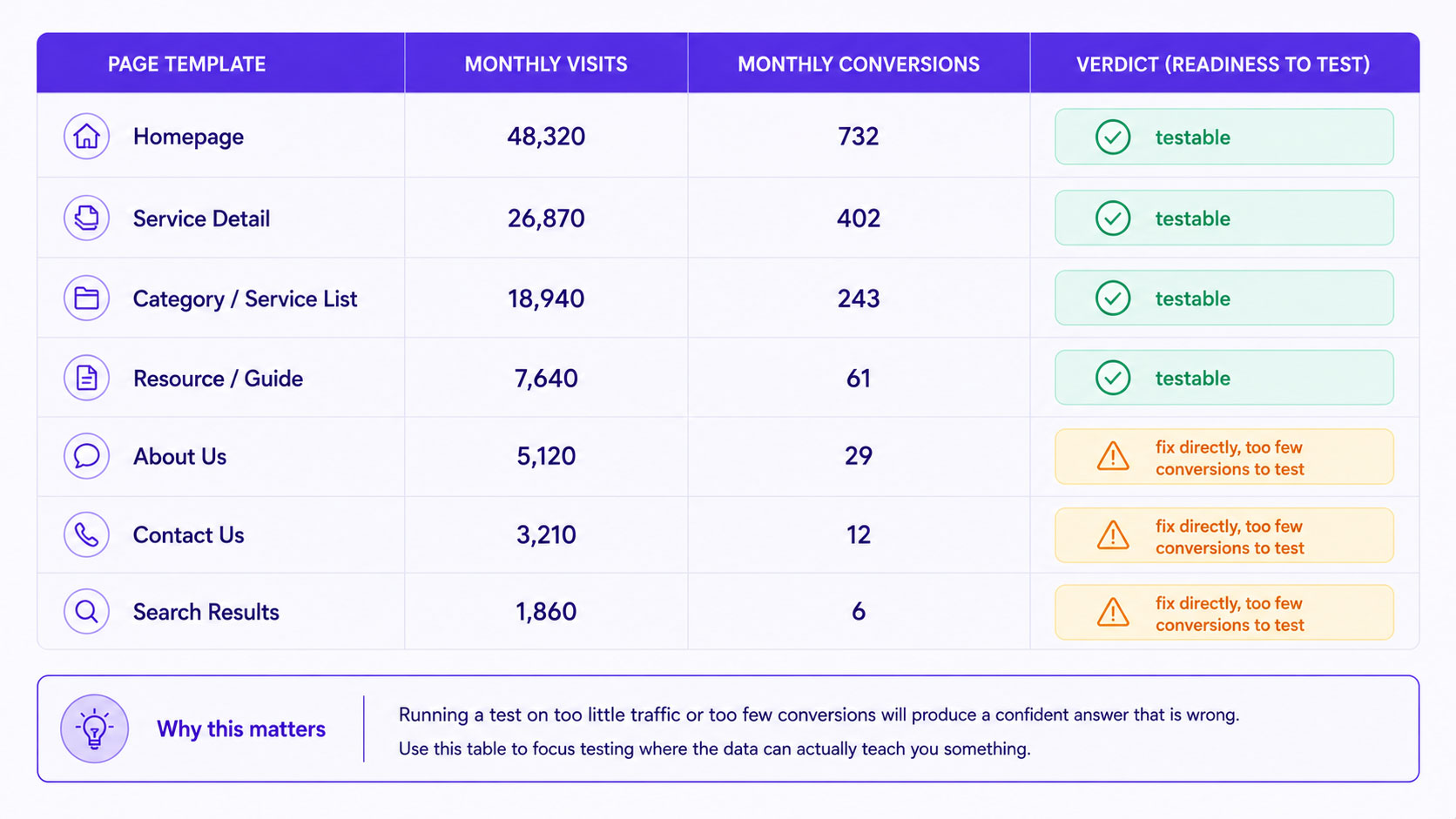
Most sites cannot test. Telling you so is the first deliverable.
A split test on thin traffic produces a confident answer that is wrong, and acting on it is worse than doing nothing. So the readiness check comes before the test plan, and for a lot of businesses it changes the entire approach.
What the readiness check covers
Where the volume is not there, we do not run a theatre of experimentation and bill for it. We fix the things that are wrong on inspection, instrument the page properly, and revisit testing when there is enough traffic for a result to mean something.
- Conversion volume per template. Not visits — completed conversions, per page, per month. This is the number that decides whether a test can resolve at all.
- Instrumentation audit. Whether form submissions, calls and chats are actually being recorded, deduplicated, and attributed to the page that produced them.
- Definition check. What counts as a conversion, agreed in writing, because half of all reporting disputes are two people counting different things.
- Inspection findings. The faults visible without any test — broken mobile forms, untracked phone numbers, a required field nobody can answer.
- Field performance. Core Web Vitals on the converting templates, from real-world data rather than a lab run.
- Test-safety review. Whether the proposed testing setup would cloak, duplicate or misredirect — checked against Google's published conditions before anything goes live.
Research, prioritize, improve — in that order, for a reason.
The order is the whole method. Teams that start at improvements are guessing; teams that stop at research are producing documents. The value is in the middle step almost nobody does properly.
Research
- Funnel drop-off measured per template, not site-wide
- Session review on the pages that actually lose people
- Call and chat transcripts read for the objection nobody answered
- Form-field abandonment, field by field
- Mobile walked on a real device, one-handed
- Field Core Web Vitals on the converting pages
Prioritize
- Each leak sized by how many conversions it plausibly costs
- Effort estimated honestly, including the engineering nobody asked
- Testable or not-testable decided on volume, not enthusiasm
- Direct fixes separated from genuine experiments
- Sequencing so one change does not confound the next
- Written hypothesis for anything that will be tested
Improve
- One change at a time, so the result is attributable
- Run to the agreed sample size rather than stopped when it looks good
- Test setup checked against Google's published conditions
- Inconclusive reported as inconclusive, never rounded into a win
- Winners kept, losers reverted, both written down
- Findings fed back into research for the next cycle
We will tell you when you should not be testing.
We run this for single-location contractors and for national franchise systems and private equity portfolios. One site or two hundred, the method is the same — and across a portfolio a single validated improvement replicates everywhere at once, which is why it pays fastest at scale.
Conversion work is the easiest place in this industry to sell activity. Tests can run indefinitely, every result can be narrated as a learning, and nobody outside the room can check the arithmetic. An agency that wanted to bill forever would design exactly the engagement most agencies sell.
The alternative is to say the uncomfortable thing early. If your converting pages do not produce enough conversions a month, a split test cannot resolve and we will not run one — we will fix what is visibly broken, instrument the page so the next conversation has data in it, and revisit when the volume is there.
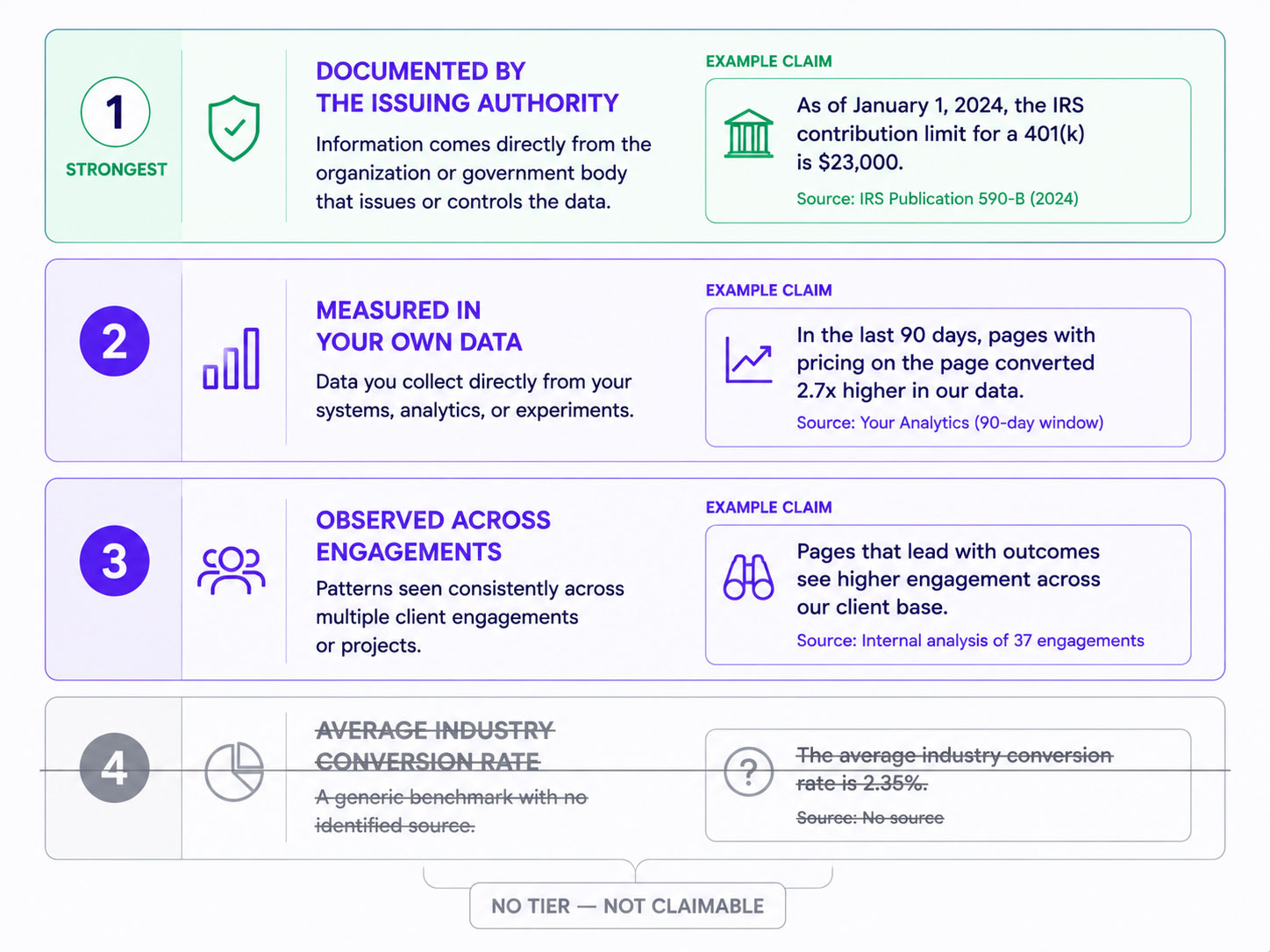
Every figure we report carries its evidence tier on its face: documented by the issuing authority, measured in your data, or observed by us. There is no fourth tier, and the industry benchmark you were quoted elsewhere does not belong to any of the three.
What separates this from a standard CRO retainer.
Not a competitor teardown — a description of where the practices differ, so the choice can be made on substance.
| Practice | Standard CRO retainer | AllegiantOMNIVIZ™ |
|---|---|---|
| Benchmarks | Industry average, source unstated | Your own baseline, because no authority publishes one |
| Low-traffic pages | Tested anyway, billed the same | Fixed directly, with the reason stated |
| When to stop a test | When the result looks good | At a sample size agreed before it started |
| Inconclusive results | Narrated as a learning | Reported as inconclusive |
| Speed work | Lab score on the homepage | Field data on the pages that convert |
| Test safety | Rarely checked | Audited against Google's published conditions |
| Every reported figure | Presented uniformly | Labeled documented, measured or observed |
Four conversion line items you can stop paying for.
Three of these are unsupportable on the evidence. The fourth is supportable and routinely mis-sold.
Industry benchmark reporting. No issuing authority publishes conversion benchmarks by industry. The figures in circulation trace back to vendor surveys of their own customers, usually undated and without methodology. We will tell you your own number and how it moved. We will not tell you how you compare to a statistic nobody can source.
Perpetual testing on thin traffic. A test that cannot reach a meaningful sample size cannot produce a meaningful answer, however long it runs. Running one anyway generates invoices and false confidence in equal measure.
Best-practice packages. A list of changes that worked on someone else's site is a hypothesis, not a plan. It may be a good place to start; it is not a result, and it should not be priced as one.
Heat maps as the deliverable. Session and click data are genuinely useful inputs — we use them in research. A report of coloured screenshots with no hypothesis, no prioritization and no test attached is a picture of a problem, invoiced as a solution.
The pattern beneath all four: activity is easy to sell and hard to check. Google's own guidance on evaluating third-party advice is a fair lens to point at us as much as anyone else.
- Google Search Central — Website testing and Google Search
- Google Search Central — Core Web Vitals
- Google Search Central — Understanding page experience
- web.dev — Largest Contentful Paint
- Google Search Central — Mobile-first indexing
- Google Search Central — Redirects and Google Search
- Google Search Central — Spam policies for Google web search
- Google Search Central — Creating helpful, people-first content
- Google Search Central — SEO starter guide
- Google Search Central — Evaluating third-party SEO advice
- Google Analytics Help — About conversions
- Google Search Central — LocalBusiness structured data
The questions operators actually ask.
Answered against primary sources where they exist, and answered honestly where they do not.
What is a good conversion rate for our industry?
Nobody can tell you, and anyone who does is quoting an unsourced number. There is no issuing authority publishing conversion benchmarks by industry — the figures in circulation trace back to vendor surveys of that vendor's own customers, typically undated and without methodology. The useful question is what your own rate is now, per template, and whether a specific change moved it. Google's guidance on evaluating third-party advice is a reasonable lens for any agency quoting one, including us. Baseline setting runs through the website audit.
Will A/B testing hurt our SEO?
Not if it is set up correctly, and Google says so directly. Its website testing guidance states that running A/B and multivariate tests is not itself a problem, and lays out the conditions: do not cloak, use temporary rather than permanent redirects for split tests, use canonicals correctly on variant URLs, and run tests only as long as necessary. The failure mode is showing crawlers one version and users another, which its spam policies name as cloaking. We audit the setup against those conditions before anything goes live, alongside technical SEO.
How much traffic do we need before testing is worth it?
More than most sites have, and the number that matters is conversions rather than visits. A page with thousands of visits and a handful of monthly conversions cannot resolve a split test in any reasonable timeframe, and stopping early because the numbers look good is how teams ship changes that do nothing. Where the volume is not there we fix what is visibly broken, instrument properly, and revisit. Google's own conversion documentation covers how conversions are counted, which is worth agreeing before anyone argues about a number. Traffic-building runs through local SEO and content.
Does site speed actually affect conversions, or just rankings?
Both, and the conversion effect is the one you can act on immediately. Core Web Vitals are reported from real-world field data, and the Largest Contentful Paint documentation defines precisely what is measured. Google's page experience guidance is careful to frame these as part of a good experience rather than a single ranking lever — which is the honest framing. A slow service page loses the call whether or not it costs a position, so we remediate where the revenue is rather than on the homepage — usually alongside website maintenance.
Our mobile conversion rate is far worse than desktop. Is that normal?
Common, and usually fixable without a test. The recurring causes we find are a phone number that is not tappable, a form that cannot be completed one-handed, a required field that needs information nobody has on them, and content quietly collapsed away at the small breakpoint. That last one has an indexing consequence too, since Google uses mobile-first indexing — the mobile version is the version that counts. We walk it on a real device rather than a resized browser window, which is where most of these are found. Related: website design.
Can you just apply best practices instead of testing?
We can, and we will say plainly what that is: a hypothesis borrowed from someone else's audience. Some of it is close to universal — a form that works on a phone, a visible phone number, a page that loads. Beyond that, the changes that worked on another site worked on that site's buyers. Applying them is a reasonable starting point and it is not a result. What we will not do is present a best-practice checklist as though it were evidence, which is the same standard Google applies to content made to be genuinely useful rather than made because it is expected. Where a change is worth making regardless, it goes straight into landing page work.
What counts as a conversion — and who decides?
You do, in writing, before anyone reports a number. Most reporting disputes turn out to be two people counting different events: one counting form submissions, the other counting qualified leads, a third counting calls that lasted more than thirty seconds. Google's conversion documentation covers the mechanics of counting; the definition itself is a business decision and it belongs to you. We write it down, instrument to it, and report against it — including calls, which are the conversion most often untracked. That pairs with CRM integration.
How long does a test need to run?
Until it reaches the sample size agreed before it started, and no longer than necessary. Both halves matter. Stopping early because a variant is ahead is the single most common way teams convince themselves of something untrue. Running indefinitely is its own problem — Google's testing guidance specifically advises running tests only as long as needed, since a permanent test starts to look like a permanent difference between what crawlers and users see. We set the end condition in the hypothesis, before the build. Related: landing pages.
What if the test comes back inconclusive?
You get told it was inconclusive. That is a real answer and it is more useful than a narrated one, because it tells you the change is not worth the engineering and the next hypothesis should go somewhere else. The alternative — presenting a flat result as a directional win — is how a year of testing produces a list of improvements and no measurable difference. Our reporting separates measured data from observed patterns for exactly this reason, the same discipline described in AI visibility monitoring. Google's guidance on evaluating advice applies here too.
How quickly will we see something?
Direct fixes land immediately — an untracked phone number, a broken mobile form, a page that takes eleven seconds. Those are usually found in the first fortnight and do not need a test to justify. Tested changes take as long as the volume dictates, which is the honest constraint. What nobody should promise is a percentage: there is no published baseline to promise against, and Google states that even meeting every technical requirement does not guarantee an outcome. What we commit to is a readiness verdict, a prioritized queue, and a number you can check. Start with an A.R.C. Report.
Find out where the visits are leaking.
A conversion audit: your own baseline per template, where people are dropping out, what is broken on inspection, and an honest verdict on whether your traffic can support testing at all. Findings are yours whether or not we work together.
- Conversion baseline per template, measured rather than benchmarked
- Funnel drop-off with the largest single loss identified
- Instrumentation check — what is being recorded, what is not
- Mobile walkthrough on a real device
- Field Core Web Vitals on the pages that convert
- Test-readiness verdict per page, with the reasoning stated
Explore the wider program: all services, SEO, paid search, email marketing, reputation management and competitor analysis.
We will show you your own baseline, where the visits are leaking, and whether your traffic can support a test — before anyone proposes one.
No cost, no commitment. We will follow up by email or phone to walk you through the findings.

